
Categories
Dive Deeper
Page Stats
Navigation
Categories
Dive Deeper
Page Stats
Complete Details
All information about this race
Overview
Stanzgarian
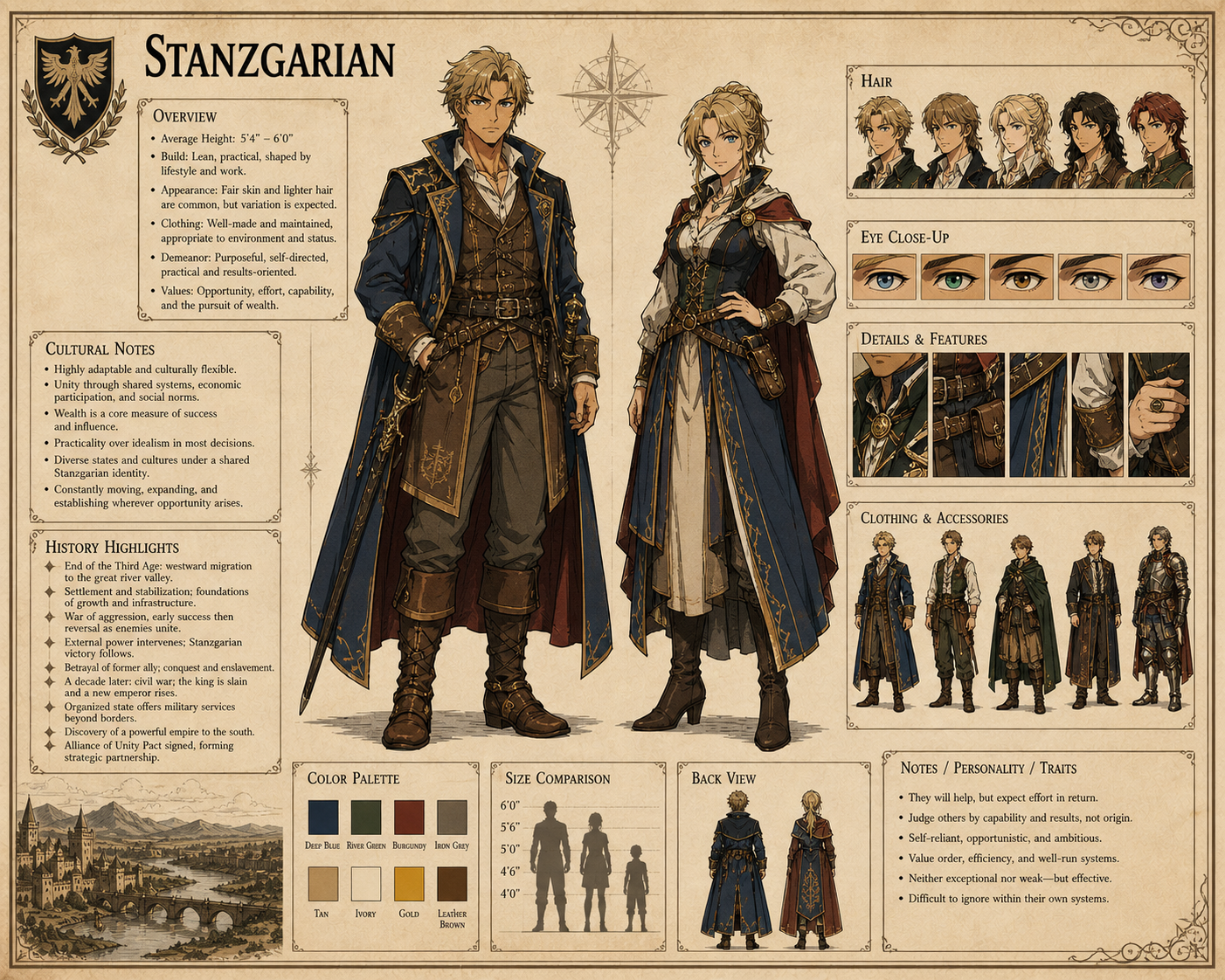
An average Stanzgarian stands at a typical height with a lean, practical build, their appearance shaped more by lifestyle than lineage. Fair skin and lighter hair are common, though variation is expected, and nothing about them immediately stands out as unusual. Their features are familiar, their presence unremarkable at a glance.
They dress appropriately for their environment, but with clear attention to quality—well-made fabrics, maintained clothing, and small signs of personal success are often visible, even among those of modest means.
In behavior, they are purposeful, self-directed, and aware of opportunity. They tend to speak and act with practical intent, valuing results over ideals. They will offer help, but expect effort in return, and measure others less by origin than by capability.
They are neither exceptional nor weak on their own—but within their systems, they are effective, adaptable, and difficult to ignore.
At their core, an average Stanzgarian is defined not by what they are—but by what they do with what is available to them.
stout folk, coin counters, the river folk, etc. etc. ( due to the wide range of cultures that count themselves as stanzgarians they have an equal number of names)
Looks
Stanzgarians display a wide range of body types, reflecting the many cultures and environments that fall under Stanzgar’s influence, though a few consistent trends emerge. The most common build is lean, efficient, and lightly muscled—not from scarcity, but from lifestyle. Many are active, work-oriented, and accustomed to movement, trade, or labor, resulting in physiques that favor endurance over raw power and mobility over bulk. Even those in less physically demanding roles often maintain a slimmer, more streamlined frame.
Because Stanzgar encompasses multiple cultural and environmental groups, body shape varies depending on climate, occupation, and local lifestyle. River populations tend toward lighter builds suited for travel and boating, urban populations show broader variation from lean laborers to softer merchant classes, and frontier or military regions produce individuals with more defined musculature, though rarely bulky. This diversity means no single body type dominates completely.
Musculature is typically practical and functional, developed through use rather than intentional size-building. Even soldiers and laborers appear corded and efficient rather than massive. Weight distribution is generally even and proportional to height, with few extremes in thickness or exaggerated features. Heavier individuals, when present, tend to be solid rather than oversized.
Stanzgarians often carry themselves with purpose and forward intent, reflecting a culture that values self-direction, work, and personal progress. Even at rest, they tend to appear ready to move or engaged with their surroundings. More than any single trait, variation defines them—unified not by identical appearance, but by a shared tendency toward lean, functional builds shaped more by life than by lineage.
Stanzgarian skin tones reflect the wide geographic and cultural range of the Stanzgar sphere, with no single tone defining the people as a whole. The most common complexion is fair to light-toned skin, including pale ivory, light beige, and soft rose undertones. These are especially prevalent in northern regions, temperate river valleys, and long-established population centers, creating the general impression that Stanzgarians are fair-skinned—though not exclusively so.
Skin tone varies naturally with climate, sun exposure, and environment. In warmer or more exposed regions, individuals often develop tanned complexions, olive tones, or deeper sun-browned skin, while colder or less sunlit areas tend to produce paler, more muted tones. This results in a spectrum where environment plays a larger role than ancestry alone. Movement, trade, and cultural mixing further contribute to blended and transitional tones, with many individuals showing subtle undertone variation or gradual shifts between lighter and darker complexions. It is not uncommon for families to display noticeable variation between members or for individuals to reflect multiple regional influences.
Despite this diversity, most Stanzgarian skin tones remain within natural human ranges. Extremely dark or unusual pigmentation is less common, though not impossible in certain regions or lineages. Skin tone often pairs with lighter hair and eye colors in some areas, but these combinations are not fixed, and variation is expected rather than exceptional.
Environmental exposure frequently leaves visible marks on the skin, such as freckling, sun-wear, or slight roughness in texture, reinforcing the sense that their appearance is shaped as much by lifestyle and environment as by origin. Stanzgarian skin is not defined by a single tone—it is natural, climate-shaped, and broadly human in range, reflecting a people spread across many lands rather than rooted in one.
Stanzgarians fall comfortably within typical human height ranges, with most individuals standing between 5’5” and 6’0”. This places them firmly within expected norms, reflecting a broader pattern across their people: broad consistency paired with meaningful variation. Most cluster between 5’5”–5’8” in the lower to mid-average range and 5’8”–6’0” in the upper-average range. Heights outside this spectrum do occur, but are less common and not defining of the population, resulting in an overall tendency toward moderate, functional height rather than extremes.
Height can vary depending on region, diet, and local living conditions. River and trade populations often remain close to the average range, urban populations show slightly more variation due to mixed backgrounds, and frontier or military regions may trend somewhat taller due to lifestyle and selection. These differences are subtle, but they contribute to noticeable diversity across the broader population.
Sex-based differences exist but are not pronounced. Males tend to fall toward the upper end of the range and average slightly taller overall, while females more commonly cluster around the mid-range with fewer extremes. In general perception, Stanzgarians are rarely seen as particularly tall or notably short. Instead, they appear physically unremarkable in scale—well within expectation—which reinforces their identity as “the most common people.”
Their height is often paired with upright, purposeful posture. They carry themselves with intent and direction, emphasizing movement and function rather than dominance or presence. Stanzgarian height is not exceptional—it is consistent, practical, and comfortably within what most would consider normal.
Stanzgarians tend to be light to moderate in weight for their height, with most individuals falling between 110 and 140 lbs. This range reflects the same overall pattern seen across their physique: lean, practical, and shaped by lifestyle rather than excess. Most commonly, individuals fall into the 110–120 lb range on the lighter end or 120–140 lbs as an average, while those between 140–160 lbs are typically more physically developed due to labor or training. Weights beyond this do exist, but are less common and usually tied to specific roles or lifestyles.
Their bodies favor lean mass over bulk. Stanzgarians rarely carry excess weight or heavy musculature, instead developing functional strength that supports efficient movement and endurance. Even soldiers and laborers tend to appear lean and capable rather than large or imposing, with muscle built through use rather than size-focused training.
Weight is strongly influenced by occupation, diet, and daily activity. Laborers and soldiers may trend slightly heavier due to muscle development, while merchants and urban populations show more variation within moderate bounds. River workers often remain lighter, favoring endurance and mobility. Despite these differences, most maintain a balanced and sustainable weight.
Body mass is typically evenly distributed and proportional to height, with few extremes or exaggerated builds. Heavier individuals tend to appear solid and grounded rather than excessive. Over time, Stanzgarians generally experience moderate weight stability, with changes occurring gradually rather than dramatically. This reflects consistent access to food and relatively stable living conditions.
Like their height, Stanzgarian weight is rarely remarkable. They are not known for being particularly heavy or notably slight, instead presenting as physically typical and broadly relatable. Their weight is not defined by extremes—it is balanced, functional, and reflective of a people shaped by work, movement, and steady living.
Stanzgarians are defined less by standout traits and more by the absence of any single defining physical feature. In many ways, they serve as the baseline against which others are compared. Unlike many peoples, they do not possess horns, tails, unusual eye structures, or distinctly non-human characteristics. There is nothing about them that immediately signals otherworldly origin, magical alteration, or biological divergence, making them physically familiar and easy to understand at a glance.
While no universal traits define them, subtle regional differences can appear depending on environment and heritage. These may include variations in facial structure, hair texture or color, and slight differences in build or posture. However, none of these are consistent across the population or strong enough to define them as a whole. Their appearance remains broadly human and varied without becoming distinctive in a singular way.
Because they lack exaggerated or alien features, Stanzgarians tend to be highly readable in expression. Their faces and body language are familiar, clear, and easy to interpret, contributing to a reputation for being approachable and socially adaptable. What stands out about them is often not biology, but lifestyle. Calloused hands from labor, weathered skin from outdoor work, well-kept appearances among the wealthy, or signs of trade and travel all reflect lives shaped by action rather than inheritance.
In place of natural distinguishing traits, they often express identity through clothing, accessories, and visible displays of wealth. Fine fabrics, well-crafted items, and subtle ornamentation act as markers of status and individuality. In many cases, what a Stanzgarian wears reveals more about them than any physical characteristic.
In a world filled with visibly distinct peoples and exaggerated traits, Stanzgarians stand out precisely because they do not. They are easy to overlook individually, but widely recognizable collectively. They are not marked by what they have, but by what they lack—physically unremarkable, broadly human, and defined more by culture and action than by form.
Stanzgarians exhibit considerable physical variance—more than most single peoples of Sol Saris—and this is not incidental. It reflects their foundation as a convergence of multiple human populations shaped by diverse regions and long-standing cultural mixing. Migration, trade, and expansion have led to blended ancestry, shared territories, and overlapping identities, resulting in wide differences in facial structure, body proportions, hair type and color, and overall appearance.
Physical traits often shift depending on environment and upbringing. River populations tend toward lighter builds and sharper features suited to travel and trade, urban populations display the greatest variation due to constant mixing, and frontier regions often produce individuals with more rugged builds and weathered features. These differences are noticeable, but not isolating, as they exist within a broader, shared population.
Despite this diversity, Stanzgarians remain entirely within normal human biological ranges. They do not exhibit extreme or unnatural features, nor do they share consistent physical markers across the population. Variation is high, but always familiar. Even within families, noticeable differences are common—variations in skin tone, build, and facial features reflect generations of mixed heritage rather than rigid lineage preservation.
Because of this, identity is shaped more by culture, region, and shared systems than by appearance. A Stanzgarian is recognized less by how they look and more by how they live, how they interact, and where they belong. What unifies them is not similarity, but a shared range of difference. They are consistent in their lack of defining features, their lean baseline tendencies, and their broadly human appearance, even as individuals vary greatly within those bounds.
Stanzgarians are not defined by a single look—they are a population of many appearances, unified by culture rather than form.
Stanzgarian clothing is defined by two core principles: adaptation to environment and visible expression of wealth. What they wear is shaped as much by climate and function as it is by status and presentation. At its foundation, clothing is practical and regionally appropriate, with individuals dressing according to weather, terrain, and daily activity. This results in wide variation—heavier layered garments in colder regions, lighter breathable clothing in warmer climates, and durable workwear for laborers and travelers. There is no single standard style, only what fits the conditions of where they are.
Across nearly all levels of society, there is a strong cultural tendency to display wealth whenever possible. This is not limited to the elite; even poorer individuals often invest in a few high-quality pieces, prioritize appearance over pure utility, or maintain their clothing carefully to preserve its value. Clothing becomes a visible measure of success and capability, regardless of station.
Material choice reflects this mindset. Stanzgarians favor fine, well-crafted fabrics—soft but durable cloth, well-treated leather, and high-quality textiles. Even simple garments are often better made than expected, emphasizing longevity and presentation. Layering is common, serving both practical and aesthetic purposes. Multiple layers allow for adaptability, contrast in fabric and color, and subtle displays of wealth, with garments arranged to appear intentional rather than purely functional.
Clothing is typically well-fitted or carefully adjusted. Even when garments are reused or passed down, effort is made to maintain a clean silhouette and avoid appearing unkempt. A Stanzgarian may not own much, but what they do have is kept in good condition. Occupational roles influence style—laborers wear durable but maintained clothing, merchants favor refined and layered attire, and military individuals adopt structured, uniformed dress—but across all roles, there is a consistent sense of pride in appearance.
Adornment is usually subtle but deliberate. Small accessories, well-made fastenings, and decorative elements act as markers of wealth, status, or personal success without becoming excessive. Despite regional differences, one trait remains constant: clothing is never purely utilitarian. Even in harsh conditions or among the lower classes, there is an effort to ensure appearance reflects more than survival.
Stanzgarian clothing is not defined by a single style—it is practical, regionally shaped, and quietly competitive, where even the simplest garments carry an undercurrent of status and self-presentation.
Traits
Stanzgarian strengths are not rooted in supernatural ability or physical extremes—they come from culture, cooperation, and adaptability. They are a people who succeed not by doing the impossible, but by working together to make the possible inevitable. Despite their wide physical and ethnic diversity, they maintain strong cultural cohesion, not through shared appearance or origin, but through common systems, economic participation, and shared expectations. This allows them to function effectively at scale, maintain stability across regions, and act with collective purpose when needed.
They are notably cooperative and pragmatic, willing to form alliances, engage in trade, and collaborate across cultural lines. This applies both internally and externally, making them reliable partners and difficult to isolate politically or economically. Their adaptability further reinforces this strength. Spread across many regions and roles, Stanzgarians can adjust to new environments, shift between occupations, and integrate new ideas or systems with relative ease, allowing them to remain stable even during periods of change.
Economically, they demonstrate a strong collective understanding of trade, value, and opportunity. Even at lower levels of society, individuals tend to possess basic economic awareness and a drive to improve their position, contributing to a generally active and prosperous system. This is paired with a self-directed mindset—individuals are encouraged to pursue opportunity, develop skills, and define their own success. Support exists, but effort is expected, resulting in a population that is motivated, independent, and forward-moving.
One of their greatest strengths is their ability to scale effort. Stanzgarians excel at organizing large groups, whether in trade networks, military campaigns, or infrastructure projects, coordinating many individuals toward shared goals. Their resilience comes not from individual toughness, but from the strength of their systems—if one part fails, others adapt, replace, or compensate, making them difficult to destabilize as a whole.
In a world of extremes, their “normalcy” is itself an advantage. They are predictable, understandable, and broadly capable, relying not on rare abilities or unstable advantages, but on consistency, reliability, and repeatable results. Stanzgarian strength is not found in what they can do alone—it is found in what they can accomplish together, consistently, and at scale.
Stanzgarian weaknesses stem from the same place as their strengths: they are fundamentally human. In a world where many peoples possess innate abilities, supernatural resilience, or extreme physical traits, Stanzgarians are limited to what they can build, learn, and organize. They lack inherent advantages such as natural regeneration, strength beyond human norms, or resistance to extreme conditions, placing them at a disadvantage against monstrous threats, magically enhanced opponents, or hostile environments. Where others rely on what they are, Stanzgarians must rely on preparation and numbers.
Much of their strength comes from systems—infrastructure, organization, and cooperation—but this also creates dependency. When those systems fail due to war, disruption, or internal conflict, their primary advantage can collapse quickly. Individually, they are far more vulnerable than they appear collectively. They are also particularly susceptible to the exceptional—powerful magic users, enhanced races, or entities that operate outside conventional rules. Strategies built on predictability and scale can struggle against forces that are unpredictable or overwhelming.
Their pragmatic mindset, while often beneficial, can become a limitation. Stanzgarians may dismiss the improbable, underestimate the unknown, or fail to account for forces that do not follow logic, leaving them unprepared for supernatural or irrational threats. Internally, their emphasis on wealth, self-direction, and personal success can create inequality, competition, and uneven distribution of resources. While opportunity exists, it is not equal, and this can generate friction within their society.
There is also a degree of moral flexibility within their culture. The idea that even nobility can be influenced or bought reflects a broader acceptance of transactional power, which can lead to corruption, short-term decision-making, and conditional trust rather than absolute loyalty. While generally cooperative, they may struggle to maintain unity under stress—when interests diverge, resources become scarce, or leadership is contested, their independence can shift into fragmentation.
At their core, Stanzgarians are bound by human limits. They tire, they break, and they cannot endure what other races might survive. Their weaknesses are not flaws to be corrected—they are the natural limits of being human in a world that is not bound by those same limits.
Stanzgarians are not defined by any singular or unique condition; instead, they are subject to the full range of natural human limitations, illnesses, and physical decline. They can experience disease, injury, chronic conditions, and age-related deterioration without any inherent resistances or protections. Their bodies respond to harm in predictable, natural, and sometimes unforgiving ways, with recovery following standard biological processes—injuries take time to heal, severe damage can leave lasting effects, and without proper care even minor issues may worsen or become debilitating.
Because of this, they rely heavily on external care. Medicine, treatment, and supportive environments play a major role in their health, with recovery and stability often determined by access to resources, quality of living conditions, and available knowledge. They are also fully affected by their surroundings, suffering from extreme heat or cold, poor environments, and prolonged exposure to harsh conditions. Any adaptation comes through preparation, equipment, and behavior rather than biology.
Their physical limits are entirely human. They tire with exertion, require rest, and cannot sustain continuous strain without consequence. Overextension can lead to exhaustion, injury, and long-term reduction in capability. Mental and emotional conditions are equally present—stress, fatigue, and psychological strain are common, shaped by lifestyle, work demands, and personal experience.
Health varies widely between individuals, as there is no shared biological condition to unify them. Occupation, environment, and personal habits determine whether someone experiences chronic wear, repeated injury, or relatively stable health. Stanzgarians are not defined by a shared affliction, but by the absence of protection from any of them—their condition is entirely natural, highly variable, and shaped by how they live rather than what they are.
Culture
Stanzgarian traditions are shaped by practicality, social structure, and a shared understanding of value and autonomy. While regional variation is significant, several core traditions appear consistently across their society. The most widespread funerary practice is cremation: the dead are burned, reduced to ash, and then either scattered or stored. This is not merely preference, but a deliberate and historically reinforced norm, viewed as final and secure, ensuring the dead cannot be disturbed. Burial is often seen as unsettling or incomplete, and while remnants of older practices persist—such as preserved ashes, family urns, or constructed resting places—these have been adapted to align with the expectation that the body must not remain intact. Stanzgarian treatment of the dead is therefore about certainty, finality, and preventing what should not return.
Another deeply ingrained tradition is the belief that wealth equates to power. Visible displays of success, investment in quality goods, and the constant pursuit of upward mobility reflect a culture where wealth is both a resource and a signal of capability, status, and personal achievement. Alongside this is a strong respect for martial ability and organized force. Military service, weapons training, and disciplined combat are valued, and even outside formal structures there is an expectation that individuals should be capable of defending themselves or contributing to collective defense.
Socially, Stanzgarians adhere to a principle of non-interference—individuals are expected to pursue their own path and manage their own affairs, with intervention typically occurring only when actions begin to affect others. This fosters a culture that values independence, personal responsibility, and restrained involvement. Conflict is often handled through negotiation, bargaining, and exchange rather than immediate escalation, with an emphasis on reaching workable agreements across business, politics, and personal disputes.
Public displays of success are common, expressed through clothing, property, or hosted gatherings. These are usually intentional rather than extravagant, serving to establish reputation and signal standing within a community. At the same time, there is a strong tradition of apprenticeship and self-advancement. Individuals are expected to find their own path, but mentorship is valued as a means of developing skill and opportunity, with support typically tied to effort and return.
Agreements are treated with seriousness, even when informal. Stanzgarians often operate with a contractual mindset, where expectations—spoken or unspoken—carry weight, and commitments are understood to have consequences. Additional common practices include gatherings that double as opportunities for trade and networking, a strong respect for competence over background, and a form of selective generosity where aid is given with purpose, often directed toward those who demonstrate effort or potential.
Stanzgarian traditions are not centered on ritual or heritage alone—they are practical, socially enforced, and built around value, independence, and the visible measure of success.
Stanzgarian beliefs are defined by pragmatism, transactional thinking, and structured reverence. They do not follow a single rigid doctrine, instead operating within a system where belief is flexible, power is measurable, and devotion is managed rather than absolute. The primary religious structure is the Church of the One, which, despite its name, does not center on a single deity but recognizes a vast pantheon as a unified divine system. This approach avoids favoring one god over another, prevents divine offense, and maintains balance in worship. Followers do not devote themselves exclusively to one god, but acknowledge all, appease where necessary, and participate in structured, collective reverence.
Stanzgarian gods are understood to be active, present, and morally complex—neither purely benevolent nor malicious, but powerful beings acting according to their own nature. They are believed to influence events and respond to attention, though rarely in direct or predictable ways. As a result, worship is less about personal faith and more about proper acknowledgment. Rituals and offerings are performed to maintain balance, avoid negative attention, and ensure stability, with devotion kept measured and intentional rather than absolute.
A widely accepted belief is that status is not fixed but can be acquired. Noble titles can be purchased through established systems, reinforcing the idea that power is transactional and hierarchy negotiable. While opinions differ, this practice is accepted and ingrained, shaping a worldview where wealth is often seen as proof of capability. Those who accumulate it are assumed to have succeeded through skill, strategy, or effective action, emphasizing results over origin.
Stanzgarians approach belief with practical intent. They rarely engage in doctrinal disputes or ideological purity, instead observing rituals, participating where beneficial, and aligning with systems that function. Belief is something to work within, not be consumed by. There is also a widespread acceptance that the gods are unpredictable—proper worship does not guarantee outcomes, and uncertainty is expected. This fosters a mindset that prepares for shifting results rather than relying on certainty.
Balance is a central concept, both in divine relationships and personal life. Excessive devotion to any single path is often viewed as risky or destabilizing. Ultimately, Stanzgarian belief is not about unquestioning faith—it is about managing relationships with power, navigating a complex divine system, and ensuring that no force, mortal or divine, is ignored or underestimated.
Stanzgarian governance is not unified under a single system, but instead exists as a collection of independent states tied together by shared identity and overlapping political traditions. There are roughly thirty distinct countries that identify as Stanzgarian, each maintaining its own leadership, laws, and internal structure. These states are not governed by a central authority; they function as separate nations, yet remain connected through culture, economic interaction, and historical identity. While they may cooperate, compete, or even come into conflict, they still recognize one another as part of a broader Stanzgarian world.
The most common form of governance among these states is feudal monarchy, typically structured around a ruling monarch, layered nobility, and land-based authority. Power is distributed through titles, territory, and obligation. However, this model is not universal. Some states operate under more centralized monarchies with stronger direct control, others lean toward merchant-influenced governments where wealth plays a significant role in authority, and still others combine noble hierarchies with administrative systems. This results in a political landscape where no single structure defines them all.
A distinctive feature across many of these states is the practice of purchased nobility. Noble titles can often be legally acquired, a long-standing and regulated system that allows individuals to enter the noble class, gain influence, and participate in governance. As a result, the nobility is both inherited and economically accessible, reinforcing the idea that power is at least partly transactional. While opinions on this system vary, it remains widely accepted and culturally ingrained.
Lineage still carries weight in certain regions. Some states can trace their origins back to the earliest founding populations and often hold greater historical prestige or perceived legitimacy. However, this distinction does not grant them authority over other Stanzgarian nations, as no overarching hierarchy exists between states.
Authority within these systems is often localized. Even under monarchies, power may be distributed among regional leaders, nobles, or local authorities, creating flexibility but also inconsistency from one area to another. This decentralization allows adaptation but can lead to uneven governance.
Political identity in Stanzgar is defined less by allegiance to a single government and more by participation in shared systems, economic structures, and cultural norms. A state may differ significantly in its internal governance yet still be recognized as Stanzgarian if it operates within these broader patterns. Relationships between states vary—alliances, rivalries, and conflicts all occur—but there is generally a tendency toward interaction rather than isolation.
Stanzgarian governance is not unified, standardized, or singular; it is a network of independent states, most shaped by feudal tradition, connected by shared identity, and defined by variation rather than uniformity.
Stanzgarian technology is defined by access, scale, and integration. It operates at a broadly pre-industrial level while steadily advancing toward early industrial development, all while incorporating widespread magical systems. The result is a technological landscape that feels familiar at its core but increasingly complex in execution.
At its foundation, most Stanzgarian societies rely on established, reliable technologies such as advanced metallurgy, well-developed construction methods, large-scale agriculture, and refined craftsmanship. These systems are efficient, widely available, and broadly understood, allowing society to function at scale without requiring constant innovation. Building on this, more developed regions are beginning to transition toward early industrialization, introducing improved production methods, mechanical systems, and the beginnings of large-scale manufacturing. This shift is uneven across regions but steadily progressing toward greater efficiency, output, and infrastructure.
A defining feature of Stanzgarian technology is the integration of magic into everyday systems. Magical elements are not rare or isolated; they are incorporated into tools, used alongside mechanical processes, and treated as part of the overall technological framework. This includes enhanced tools, stabilized systems, and hybrid devices that blur the line between craft and arcane function—sometimes approaching effects that resemble “super-science” in capability.
Accessibility is a key priority. Unlike more specialized societies, Stanzgarians emphasize broad access to tools and systems, producing them in quantity, distributing them widely, and ensuring they can be used by the average individual. Technology is treated as a shared resource rather than an elite advantage. Development tends to favor practical application over theory, with innovation driven by need, profit, and efficiency. If something works, it is adopted, refined, and scaled rather than endlessly theorized.
There is, however, regional disparity. Access to advanced technology varies depending on wealth, infrastructure, and local priorities. Some areas rely heavily on traditional methods, while others push toward mechanized and magically integrated systems. Regardless of level, Stanzgarian technology is typically designed for durability, repairability, and long-term reliability. Tools are expected to function consistently and be maintainable over time.
One of their greatest strengths lies in blending systems. Mechanical, magical, and manual approaches are often combined into layered solutions that are flexible and adaptable. Stanzgarian technology is not defined by a single breakthrough—it is widely available, steadily advancing, and built on the seamless integration of practical engineering and applied magic.
Stanzgarian occupations are defined by opportunity, self-direction, and access to systems. There is no singular expected role; instead, individuals are encouraged to find their own way, pursue viable work, and build their position over time. Stanzgarians can be found in nearly every occupation available within their societies, with few cultural restrictions on what someone can become. This creates a workforce that is diverse, flexible, and widely distributed across roles.
A core belief shaping occupation is that progress must be earned. While others may offer guidance, provide opportunities, or assist in limited ways, individuals are expected to take initiative, develop skills, and move themselves forward. Success is viewed as something built rather than given. A significant portion of the population is involved in trade and commerce, including merchants, brokers, caravan operators, and market specialists. These roles are highly valued for generating wealth, creating connections, and driving economic activity.
Many also work in labor and skilled trades such as construction, metalwork, transport, and general production. Even in these roles, there is a strong emphasis on improving one’s position through skill development. Military service is another respected and common path, ranging from standing forces to contracted service, with opportunities to gain wealth, status, and experience through disciplined or combat-oriented work.
Stanzgarians also occupy administrative and financial roles, supporting governance, trade networks, and large-scale organization through record-keeping and management. As their technological systems advance, there is growing demand for specialized and technical work involving complex tools and integrated methods. These roles are harder to access but offer greater rewards.
A notable portion of the population operates independently as freelancers, small traders, contract workers, or self-employed specialists. These individuals rely on reputation, adaptability, and personal networks, often moving between opportunities rather than remaining fixed in one role. While support exists within society, it is typically conditional—opportunities may be introduced or shared, but rarely completed for someone, reinforcing the expectation that effort is required to benefit from assistance.
Stanzgarian occupations are not simply assigned or inherited—they are chosen, pursued, and built over time within a system that rewards initiative and expects individuals to create their own place within it.
Stanzgarian economics are defined by prosperity, accessibility, and the constant movement of wealth. Money is widely available across all levels of society, and participation in the economy is expected rather than optional. Even those at the lowest levels can acquire income through labor, trade, or service, allowing most individuals to earn, spend, and engage with economic systems, even if not all achieve significant wealth.
The economy is highly active and fluid. Wealth moves quickly through constant trade, contracts, and transactions, creating a system that is responsive and rarely stagnant. Money functions as more than currency—it is a direct measure of status and power, influencing access to opportunity, social standing, and even entry into higher classes through mechanisms like purchasable titles.
Commerce forms the backbone of the system. Markets, caravans, and exchange networks are widespread, ensuring goods and wealth circulate efficiently across regions. This creates strong opportunities for advancement, as individuals can improve their position through effort, skill, and decision-making. However, success is not guaranteed, and outcomes vary widely.
Despite overall prosperity, wealth distribution is uneven. Some individuals accumulate significant resources, while others remain at modest or unstable levels. The system supports both upward mobility and disparity. Wealth is also rarely static—rather than being hoarded, it is actively used, invested in goods, appearance, or opportunities, reinforcing the idea that money should remain in motion.
Economic systems are closely tied to governance. Financial capability often translates into influence, with wealth shaping authority, legal standing, and access to power. At the same time, the economy remains resilient due to broad participation; because so many individuals are actively engaged, disruptions in one area are often offset by activity in another.
Stanzgarian economics are not defined by scarcity or isolation—they are defined by movement, access, and the continuous conversion of effort into opportunity.
Stanzgarian food is shaped by one defining factor: the river. Their cuisine centers around rice, aquatic life, and readily available ingredients from the surrounding valley, resulting in meals that are practical, filling, and highly adaptable across regions. Rice forms the foundation of most meals—widely grown, easily stored, and versatile. It appears steamed, boiled, pressed into cakes, or combined into larger dishes, making it a constant presence in everyday life.
Fish and other aquatic resources provide a steady source of protein. Common ingredients include river fish, shellfish, and similar fare, often prepared through stewing, grilling, drying, or smoking. Fish stews are especially common, combining rice, broth, and whatever ingredients are available into hearty, efficient meals. This leads into a broader cooking style built around mixed, one-pot dishes that incorporate rice, fish or meat, vegetables, and seasoning. These meals are valued for their efficiency, scalability, and ease of preparation in large quantities.
Preserved foods are also important, especially in a culture shaped by trade and movement. Dried fish, smoked meats, and fermented ingredients provide long shelf life, portability, and reliable access to food. Flavoring tends to be strong but practical, with savory, salt-forward profiles and occasional use of spice. Seasoning is generally used to enhance staple ingredients rather than transform them into something entirely different.
Food serves both practical and social roles. Everyday meals are simple and efficient, but in wealthier settings, cuisine becomes richer, more varied, and more refined, incorporating rare ingredients, better cuts of meat, and more complex preparation. Meals are often shared, with large pots and communal servings common in families, work environments, and gatherings, reinforcing both efficiency and shared experience.
While rice and river life dominate, Stanzgarians readily incorporate local foods, traded goods, and regional specialties, allowing their diet to shift based on location and availability. Stanzgarian food is not defined by luxury or ritual—it is river-born, rice-based, and built for consistency, adaptability, and scale.
History
Stanzgarian history is defined by migration, conflict, expansion, and internal upheaval. It is not a single continuous narrative, but a series of turning points that shaped a collection of states into a shared identity. The earliest defining moment came at the end of the Third Age, when large populations migrated westward and settled along a massive river valley. This decision prioritized stability and distance from wider conflicts, marking the beginning of what would become the Stanzgarian sphere.
Following this migration, a period of settlement and stabilization took hold. Populations consolidated territory, built settlements, and focused on survival and growth. Expansion slowed as attention shifted toward establishing infrastructure, securing resources, and creating a stable foundation for society. This era laid the groundwork for the prosperity that would follow.
At a later stage, Stanzgarian forces initiated a major war of aggression. Early successes eventually met organized resistance, and the conflict began to turn against them as opposing forces unified. The tide shifted again when an external power intervened for its own benefit, allowing Stanzgarian forces to regain momentum, defeat their enemies, and secure victory.
In the aftermath, however, this alliance gave way to one of the most defining and controversial moments in their history. Stanzgarian leadership turned on their former ally, conquering their lands and enslaving their people. This act created deep internal division and lasting consequences.
Roughly a decade later, these tensions erupted into civil war. Widespread unrest fractured the existing power structure until a rebel leader led a direct strike against the capital, slew the ruling king, and seized control. In the aftermath, this leader declared himself emperor, marking the rise of a new imperial structure and reshaping political authority across multiple states.
Following the civil war, Stanzgarian forces remained highly organized and active. Rather than becoming idle, they began offering military services beyond their own borders, enforcing order in other regions and operating as contracted forces. This established a reputation for discipline, reliability, and controlled projection of power.
Later exploration led to the discovery of a powerful empire to the south, expanding Stanzgarian awareness and influencing future strategic planning. One of the most significant diplomatic developments followed with the signing of the Alliance of Unity Pact, formalizing cooperation between major powers and marking a shift toward strategic partnership and coordinated influence.
Stanzgarian history is not defined by a single empire or uninterrupted rule—it is a sequence of migrations, calculated decisions, and internal corrections that shaped a people capable of adapting, expanding, and restructuring themselves when necessary.
Notes
Stanzgarians are often described as “the most common people,” not as a dismissal, but because they represent the baseline. They lack defining physical traits, supernatural identity, or extreme specialization, making them widely relatable, easily understood, and frequently used as a point of comparison. This “commonness” allows them to integrate into many environments, expand across regions, and function effectively within a wide range of systems.
Despite being divided into many independent states, they maintain a strong sense of shared identity. This identity is not enforced through a single government or strict lineage, but through culture, economic participation, and recognizable social norms. A Stanzgarian is identified less by origin and more by how they operate within the world—how they engage with systems, pursue opportunity, and interact with others.
They are highly adaptable culturally, capable of absorbing regional differences, adjusting to new environments, and adopting practices that prove useful. This flexibility allows their identity to persist even as it evolves. Across all regions, one concept remains consistent: wealth matters. It serves as a measure of success, a source of influence, and a means of accessing opportunity, reinforcing a shared understanding even where other traditions differ.
Stanzgarian systems favor practicality over idealism. Decisions are typically made based on outcome, efficiency, and benefit rather than tradition or principle alone. Their internal diversity—spanning culture, governance, and lifestyle—is both a strength and a source of tension. It enables them to adapt and survive in many forms, but can make unified action more difficult when interests conflict.
They are also not a static people. Stanzgarians tend to move, expand, and establish themselves wherever opportunity arises, contributing to their continued growth and the spread of their systems across multiple regions. They are not defined by a single origin, form, or structure, but by shared participation and approach—a widely dispersed, culturally connected people shaped by practicality, adaptability, and the ability to function within a changing world.
Overview
Details about this race's overview
Stanzgarian
An average Stanzgarian stands at a typical height with a lean, practical build, their appearance shaped more by lifestyle than lineage. Fair skin and lighter hair are common, though variation is expected, and nothing about them immediately stands out as unusual. Their features are familiar, their presence unremarkable at a glance.
They dress appropriately for their environment, but with clear attention to quality—well-made fabrics, maintained clothing, and small signs of personal success are often visible, even among those of modest means.
In behavior, they are purposeful, self-directed, and aware of opportunity. They tend to speak and act with practical intent, valuing results over ideals. They will offer help, but expect effort in return, and measure others less by origin than by capability.
They are neither exceptional nor weak on their own—but within their systems, they are effective, adaptable, and difficult to ignore.
At their core, an average Stanzgarian is defined not by what they are—but by what they do with what is available to them.
stout folk, coin counters, the river folk, etc. etc. ( due to the wide range of cultures that count themselves as stanzgarians they have an equal number of names)
Looks
Details about this race's looks
Stanzgarians display a wide range of body types, reflecting the many cultures and environments that fall under Stanzgar’s influence, though a few consistent trends emerge. The most common build is lean, efficient, and lightly muscled—not from scarcity, but from lifestyle. Many are active, work-oriented, and accustomed to movement, trade, or labor, resulting in physiques that favor endurance over raw power and mobility over bulk. Even those in less physically demanding roles often maintain a slimmer, more streamlined frame.
Because Stanzgar encompasses multiple cultural and environmental groups, body shape varies depending on climate, occupation, and local lifestyle. River populations tend toward lighter builds suited for travel and boating, urban populations show broader variation from lean laborers to softer merchant classes, and frontier or military regions produce individuals with more defined musculature, though rarely bulky. This diversity means no single body type dominates completely.
Musculature is typically practical and functional, developed through use rather than intentional size-building. Even soldiers and laborers appear corded and efficient rather than massive. Weight distribution is generally even and proportional to height, with few extremes in thickness or exaggerated features. Heavier individuals, when present, tend to be solid rather than oversized.
Stanzgarians often carry themselves with purpose and forward intent, reflecting a culture that values self-direction, work, and personal progress. Even at rest, they tend to appear ready to move or engaged with their surroundings. More than any single trait, variation defines them—unified not by identical appearance, but by a shared tendency toward lean, functional builds shaped more by life than by lineage.
Stanzgarian skin tones reflect the wide geographic and cultural range of the Stanzgar sphere, with no single tone defining the people as a whole. The most common complexion is fair to light-toned skin, including pale ivory, light beige, and soft rose undertones. These are especially prevalent in northern regions, temperate river valleys, and long-established population centers, creating the general impression that Stanzgarians are fair-skinned—though not exclusively so.
Skin tone varies naturally with climate, sun exposure, and environment. In warmer or more exposed regions, individuals often develop tanned complexions, olive tones, or deeper sun-browned skin, while colder or less sunlit areas tend to produce paler, more muted tones. This results in a spectrum where environment plays a larger role than ancestry alone. Movement, trade, and cultural mixing further contribute to blended and transitional tones, with many individuals showing subtle undertone variation or gradual shifts between lighter and darker complexions. It is not uncommon for families to display noticeable variation between members or for individuals to reflect multiple regional influences.
Despite this diversity, most Stanzgarian skin tones remain within natural human ranges. Extremely dark or unusual pigmentation is less common, though not impossible in certain regions or lineages. Skin tone often pairs with lighter hair and eye colors in some areas, but these combinations are not fixed, and variation is expected rather than exceptional.
Environmental exposure frequently leaves visible marks on the skin, such as freckling, sun-wear, or slight roughness in texture, reinforcing the sense that their appearance is shaped as much by lifestyle and environment as by origin. Stanzgarian skin is not defined by a single tone—it is natural, climate-shaped, and broadly human in range, reflecting a people spread across many lands rather than rooted in one.
Stanzgarians fall comfortably within typical human height ranges, with most individuals standing between 5’5” and 6’0”. This places them firmly within expected norms, reflecting a broader pattern across their people: broad consistency paired with meaningful variation. Most cluster between 5’5”–5’8” in the lower to mid-average range and 5’8”–6’0” in the upper-average range. Heights outside this spectrum do occur, but are less common and not defining of the population, resulting in an overall tendency toward moderate, functional height rather than extremes.
Height can vary depending on region, diet, and local living conditions. River and trade populations often remain close to the average range, urban populations show slightly more variation due to mixed backgrounds, and frontier or military regions may trend somewhat taller due to lifestyle and selection. These differences are subtle, but they contribute to noticeable diversity across the broader population.
Sex-based differences exist but are not pronounced. Males tend to fall toward the upper end of the range and average slightly taller overall, while females more commonly cluster around the mid-range with fewer extremes. In general perception, Stanzgarians are rarely seen as particularly tall or notably short. Instead, they appear physically unremarkable in scale—well within expectation—which reinforces their identity as “the most common people.”
Their height is often paired with upright, purposeful posture. They carry themselves with intent and direction, emphasizing movement and function rather than dominance or presence. Stanzgarian height is not exceptional—it is consistent, practical, and comfortably within what most would consider normal.
Stanzgarians tend to be light to moderate in weight for their height, with most individuals falling between 110 and 140 lbs. This range reflects the same overall pattern seen across their physique: lean, practical, and shaped by lifestyle rather than excess. Most commonly, individuals fall into the 110–120 lb range on the lighter end or 120–140 lbs as an average, while those between 140–160 lbs are typically more physically developed due to labor or training. Weights beyond this do exist, but are less common and usually tied to specific roles or lifestyles.
Their bodies favor lean mass over bulk. Stanzgarians rarely carry excess weight or heavy musculature, instead developing functional strength that supports efficient movement and endurance. Even soldiers and laborers tend to appear lean and capable rather than large or imposing, with muscle built through use rather than size-focused training.
Weight is strongly influenced by occupation, diet, and daily activity. Laborers and soldiers may trend slightly heavier due to muscle development, while merchants and urban populations show more variation within moderate bounds. River workers often remain lighter, favoring endurance and mobility. Despite these differences, most maintain a balanced and sustainable weight.
Body mass is typically evenly distributed and proportional to height, with few extremes or exaggerated builds. Heavier individuals tend to appear solid and grounded rather than excessive. Over time, Stanzgarians generally experience moderate weight stability, with changes occurring gradually rather than dramatically. This reflects consistent access to food and relatively stable living conditions.
Like their height, Stanzgarian weight is rarely remarkable. They are not known for being particularly heavy or notably slight, instead presenting as physically typical and broadly relatable. Their weight is not defined by extremes—it is balanced, functional, and reflective of a people shaped by work, movement, and steady living.
Stanzgarians are defined less by standout traits and more by the absence of any single defining physical feature. In many ways, they serve as the baseline against which others are compared. Unlike many peoples, they do not possess horns, tails, unusual eye structures, or distinctly non-human characteristics. There is nothing about them that immediately signals otherworldly origin, magical alteration, or biological divergence, making them physically familiar and easy to understand at a glance.
While no universal traits define them, subtle regional differences can appear depending on environment and heritage. These may include variations in facial structure, hair texture or color, and slight differences in build or posture. However, none of these are consistent across the population or strong enough to define them as a whole. Their appearance remains broadly human and varied without becoming distinctive in a singular way.
Because they lack exaggerated or alien features, Stanzgarians tend to be highly readable in expression. Their faces and body language are familiar, clear, and easy to interpret, contributing to a reputation for being approachable and socially adaptable. What stands out about them is often not biology, but lifestyle. Calloused hands from labor, weathered skin from outdoor work, well-kept appearances among the wealthy, or signs of trade and travel all reflect lives shaped by action rather than inheritance.
In place of natural distinguishing traits, they often express identity through clothing, accessories, and visible displays of wealth. Fine fabrics, well-crafted items, and subtle ornamentation act as markers of status and individuality. In many cases, what a Stanzgarian wears reveals more about them than any physical characteristic.
In a world filled with visibly distinct peoples and exaggerated traits, Stanzgarians stand out precisely because they do not. They are easy to overlook individually, but widely recognizable collectively. They are not marked by what they have, but by what they lack—physically unremarkable, broadly human, and defined more by culture and action than by form.
Stanzgarians exhibit considerable physical variance—more than most single peoples of Sol Saris—and this is not incidental. It reflects their foundation as a convergence of multiple human populations shaped by diverse regions and long-standing cultural mixing. Migration, trade, and expansion have led to blended ancestry, shared territories, and overlapping identities, resulting in wide differences in facial structure, body proportions, hair type and color, and overall appearance.
Physical traits often shift depending on environment and upbringing. River populations tend toward lighter builds and sharper features suited to travel and trade, urban populations display the greatest variation due to constant mixing, and frontier regions often produce individuals with more rugged builds and weathered features. These differences are noticeable, but not isolating, as they exist within a broader, shared population.
Despite this diversity, Stanzgarians remain entirely within normal human biological ranges. They do not exhibit extreme or unnatural features, nor do they share consistent physical markers across the population. Variation is high, but always familiar. Even within families, noticeable differences are common—variations in skin tone, build, and facial features reflect generations of mixed heritage rather than rigid lineage preservation.
Because of this, identity is shaped more by culture, region, and shared systems than by appearance. A Stanzgarian is recognized less by how they look and more by how they live, how they interact, and where they belong. What unifies them is not similarity, but a shared range of difference. They are consistent in their lack of defining features, their lean baseline tendencies, and their broadly human appearance, even as individuals vary greatly within those bounds.
Stanzgarians are not defined by a single look—they are a population of many appearances, unified by culture rather than form.
Stanzgarian clothing is defined by two core principles: adaptation to environment and visible expression of wealth. What they wear is shaped as much by climate and function as it is by status and presentation. At its foundation, clothing is practical and regionally appropriate, with individuals dressing according to weather, terrain, and daily activity. This results in wide variation—heavier layered garments in colder regions, lighter breathable clothing in warmer climates, and durable workwear for laborers and travelers. There is no single standard style, only what fits the conditions of where they are.
Across nearly all levels of society, there is a strong cultural tendency to display wealth whenever possible. This is not limited to the elite; even poorer individuals often invest in a few high-quality pieces, prioritize appearance over pure utility, or maintain their clothing carefully to preserve its value. Clothing becomes a visible measure of success and capability, regardless of station.
Material choice reflects this mindset. Stanzgarians favor fine, well-crafted fabrics—soft but durable cloth, well-treated leather, and high-quality textiles. Even simple garments are often better made than expected, emphasizing longevity and presentation. Layering is common, serving both practical and aesthetic purposes. Multiple layers allow for adaptability, contrast in fabric and color, and subtle displays of wealth, with garments arranged to appear intentional rather than purely functional.
Clothing is typically well-fitted or carefully adjusted. Even when garments are reused or passed down, effort is made to maintain a clean silhouette and avoid appearing unkempt. A Stanzgarian may not own much, but what they do have is kept in good condition. Occupational roles influence style—laborers wear durable but maintained clothing, merchants favor refined and layered attire, and military individuals adopt structured, uniformed dress—but across all roles, there is a consistent sense of pride in appearance.
Adornment is usually subtle but deliberate. Small accessories, well-made fastenings, and decorative elements act as markers of wealth, status, or personal success without becoming excessive. Despite regional differences, one trait remains constant: clothing is never purely utilitarian. Even in harsh conditions or among the lower classes, there is an effort to ensure appearance reflects more than survival.
Stanzgarian clothing is not defined by a single style—it is practical, regionally shaped, and quietly competitive, where even the simplest garments carry an undercurrent of status and self-presentation.
Traits
Details about this race's traits
Stanzgarian strengths are not rooted in supernatural ability or physical extremes—they come from culture, cooperation, and adaptability. They are a people who succeed not by doing the impossible, but by working together to make the possible inevitable. Despite their wide physical and ethnic diversity, they maintain strong cultural cohesion, not through shared appearance or origin, but through common systems, economic participation, and shared expectations. This allows them to function effectively at scale, maintain stability across regions, and act with collective purpose when needed.
They are notably cooperative and pragmatic, willing to form alliances, engage in trade, and collaborate across cultural lines. This applies both internally and externally, making them reliable partners and difficult to isolate politically or economically. Their adaptability further reinforces this strength. Spread across many regions and roles, Stanzgarians can adjust to new environments, shift between occupations, and integrate new ideas or systems with relative ease, allowing them to remain stable even during periods of change.
Economically, they demonstrate a strong collective understanding of trade, value, and opportunity. Even at lower levels of society, individuals tend to possess basic economic awareness and a drive to improve their position, contributing to a generally active and prosperous system. This is paired with a self-directed mindset—individuals are encouraged to pursue opportunity, develop skills, and define their own success. Support exists, but effort is expected, resulting in a population that is motivated, independent, and forward-moving.
One of their greatest strengths is their ability to scale effort. Stanzgarians excel at organizing large groups, whether in trade networks, military campaigns, or infrastructure projects, coordinating many individuals toward shared goals. Their resilience comes not from individual toughness, but from the strength of their systems—if one part fails, others adapt, replace, or compensate, making them difficult to destabilize as a whole.
In a world of extremes, their “normalcy” is itself an advantage. They are predictable, understandable, and broadly capable, relying not on rare abilities or unstable advantages, but on consistency, reliability, and repeatable results. Stanzgarian strength is not found in what they can do alone—it is found in what they can accomplish together, consistently, and at scale.
Stanzgarian weaknesses stem from the same place as their strengths: they are fundamentally human. In a world where many peoples possess innate abilities, supernatural resilience, or extreme physical traits, Stanzgarians are limited to what they can build, learn, and organize. They lack inherent advantages such as natural regeneration, strength beyond human norms, or resistance to extreme conditions, placing them at a disadvantage against monstrous threats, magically enhanced opponents, or hostile environments. Where others rely on what they are, Stanzgarians must rely on preparation and numbers.
Much of their strength comes from systems—infrastructure, organization, and cooperation—but this also creates dependency. When those systems fail due to war, disruption, or internal conflict, their primary advantage can collapse quickly. Individually, they are far more vulnerable than they appear collectively. They are also particularly susceptible to the exceptional—powerful magic users, enhanced races, or entities that operate outside conventional rules. Strategies built on predictability and scale can struggle against forces that are unpredictable or overwhelming.
Their pragmatic mindset, while often beneficial, can become a limitation. Stanzgarians may dismiss the improbable, underestimate the unknown, or fail to account for forces that do not follow logic, leaving them unprepared for supernatural or irrational threats. Internally, their emphasis on wealth, self-direction, and personal success can create inequality, competition, and uneven distribution of resources. While opportunity exists, it is not equal, and this can generate friction within their society.
There is also a degree of moral flexibility within their culture. The idea that even nobility can be influenced or bought reflects a broader acceptance of transactional power, which can lead to corruption, short-term decision-making, and conditional trust rather than absolute loyalty. While generally cooperative, they may struggle to maintain unity under stress—when interests diverge, resources become scarce, or leadership is contested, their independence can shift into fragmentation.
At their core, Stanzgarians are bound by human limits. They tire, they break, and they cannot endure what other races might survive. Their weaknesses are not flaws to be corrected—they are the natural limits of being human in a world that is not bound by those same limits.
Stanzgarians are not defined by any singular or unique condition; instead, they are subject to the full range of natural human limitations, illnesses, and physical decline. They can experience disease, injury, chronic conditions, and age-related deterioration without any inherent resistances or protections. Their bodies respond to harm in predictable, natural, and sometimes unforgiving ways, with recovery following standard biological processes—injuries take time to heal, severe damage can leave lasting effects, and without proper care even minor issues may worsen or become debilitating.
Because of this, they rely heavily on external care. Medicine, treatment, and supportive environments play a major role in their health, with recovery and stability often determined by access to resources, quality of living conditions, and available knowledge. They are also fully affected by their surroundings, suffering from extreme heat or cold, poor environments, and prolonged exposure to harsh conditions. Any adaptation comes through preparation, equipment, and behavior rather than biology.
Their physical limits are entirely human. They tire with exertion, require rest, and cannot sustain continuous strain without consequence. Overextension can lead to exhaustion, injury, and long-term reduction in capability. Mental and emotional conditions are equally present—stress, fatigue, and psychological strain are common, shaped by lifestyle, work demands, and personal experience.
Health varies widely between individuals, as there is no shared biological condition to unify them. Occupation, environment, and personal habits determine whether someone experiences chronic wear, repeated injury, or relatively stable health. Stanzgarians are not defined by a shared affliction, but by the absence of protection from any of them—their condition is entirely natural, highly variable, and shaped by how they live rather than what they are.
Culture
Details about this race's culture
Stanzgarian traditions are shaped by practicality, social structure, and a shared understanding of value and autonomy. While regional variation is significant, several core traditions appear consistently across their society. The most widespread funerary practice is cremation: the dead are burned, reduced to ash, and then either scattered or stored. This is not merely preference, but a deliberate and historically reinforced norm, viewed as final and secure, ensuring the dead cannot be disturbed. Burial is often seen as unsettling or incomplete, and while remnants of older practices persist—such as preserved ashes, family urns, or constructed resting places—these have been adapted to align with the expectation that the body must not remain intact. Stanzgarian treatment of the dead is therefore about certainty, finality, and preventing what should not return.
Another deeply ingrained tradition is the belief that wealth equates to power. Visible displays of success, investment in quality goods, and the constant pursuit of upward mobility reflect a culture where wealth is both a resource and a signal of capability, status, and personal achievement. Alongside this is a strong respect for martial ability and organized force. Military service, weapons training, and disciplined combat are valued, and even outside formal structures there is an expectation that individuals should be capable of defending themselves or contributing to collective defense.
Socially, Stanzgarians adhere to a principle of non-interference—individuals are expected to pursue their own path and manage their own affairs, with intervention typically occurring only when actions begin to affect others. This fosters a culture that values independence, personal responsibility, and restrained involvement. Conflict is often handled through negotiation, bargaining, and exchange rather than immediate escalation, with an emphasis on reaching workable agreements across business, politics, and personal disputes.
Public displays of success are common, expressed through clothing, property, or hosted gatherings. These are usually intentional rather than extravagant, serving to establish reputation and signal standing within a community. At the same time, there is a strong tradition of apprenticeship and self-advancement. Individuals are expected to find their own path, but mentorship is valued as a means of developing skill and opportunity, with support typically tied to effort and return.
Agreements are treated with seriousness, even when informal. Stanzgarians often operate with a contractual mindset, where expectations—spoken or unspoken—carry weight, and commitments are understood to have consequences. Additional common practices include gatherings that double as opportunities for trade and networking, a strong respect for competence over background, and a form of selective generosity where aid is given with purpose, often directed toward those who demonstrate effort or potential.
Stanzgarian traditions are not centered on ritual or heritage alone—they are practical, socially enforced, and built around value, independence, and the visible measure of success.
Stanzgarian beliefs are defined by pragmatism, transactional thinking, and structured reverence. They do not follow a single rigid doctrine, instead operating within a system where belief is flexible, power is measurable, and devotion is managed rather than absolute. The primary religious structure is the Church of the One, which, despite its name, does not center on a single deity but recognizes a vast pantheon as a unified divine system. This approach avoids favoring one god over another, prevents divine offense, and maintains balance in worship. Followers do not devote themselves exclusively to one god, but acknowledge all, appease where necessary, and participate in structured, collective reverence.
Stanzgarian gods are understood to be active, present, and morally complex—neither purely benevolent nor malicious, but powerful beings acting according to their own nature. They are believed to influence events and respond to attention, though rarely in direct or predictable ways. As a result, worship is less about personal faith and more about proper acknowledgment. Rituals and offerings are performed to maintain balance, avoid negative attention, and ensure stability, with devotion kept measured and intentional rather than absolute.
A widely accepted belief is that status is not fixed but can be acquired. Noble titles can be purchased through established systems, reinforcing the idea that power is transactional and hierarchy negotiable. While opinions differ, this practice is accepted and ingrained, shaping a worldview where wealth is often seen as proof of capability. Those who accumulate it are assumed to have succeeded through skill, strategy, or effective action, emphasizing results over origin.
Stanzgarians approach belief with practical intent. They rarely engage in doctrinal disputes or ideological purity, instead observing rituals, participating where beneficial, and aligning with systems that function. Belief is something to work within, not be consumed by. There is also a widespread acceptance that the gods are unpredictable—proper worship does not guarantee outcomes, and uncertainty is expected. This fosters a mindset that prepares for shifting results rather than relying on certainty.
Balance is a central concept, both in divine relationships and personal life. Excessive devotion to any single path is often viewed as risky or destabilizing. Ultimately, Stanzgarian belief is not about unquestioning faith—it is about managing relationships with power, navigating a complex divine system, and ensuring that no force, mortal or divine, is ignored or underestimated.
Stanzgarian governance is not unified under a single system, but instead exists as a collection of independent states tied together by shared identity and overlapping political traditions. There are roughly thirty distinct countries that identify as Stanzgarian, each maintaining its own leadership, laws, and internal structure. These states are not governed by a central authority; they function as separate nations, yet remain connected through culture, economic interaction, and historical identity. While they may cooperate, compete, or even come into conflict, they still recognize one another as part of a broader Stanzgarian world.
The most common form of governance among these states is feudal monarchy, typically structured around a ruling monarch, layered nobility, and land-based authority. Power is distributed through titles, territory, and obligation. However, this model is not universal. Some states operate under more centralized monarchies with stronger direct control, others lean toward merchant-influenced governments where wealth plays a significant role in authority, and still others combine noble hierarchies with administrative systems. This results in a political landscape where no single structure defines them all.
A distinctive feature across many of these states is the practice of purchased nobility. Noble titles can often be legally acquired, a long-standing and regulated system that allows individuals to enter the noble class, gain influence, and participate in governance. As a result, the nobility is both inherited and economically accessible, reinforcing the idea that power is at least partly transactional. While opinions on this system vary, it remains widely accepted and culturally ingrained.
Lineage still carries weight in certain regions. Some states can trace their origins back to the earliest founding populations and often hold greater historical prestige or perceived legitimacy. However, this distinction does not grant them authority over other Stanzgarian nations, as no overarching hierarchy exists between states.
Authority within these systems is often localized. Even under monarchies, power may be distributed among regional leaders, nobles, or local authorities, creating flexibility but also inconsistency from one area to another. This decentralization allows adaptation but can lead to uneven governance.
Political identity in Stanzgar is defined less by allegiance to a single government and more by participation in shared systems, economic structures, and cultural norms. A state may differ significantly in its internal governance yet still be recognized as Stanzgarian if it operates within these broader patterns. Relationships between states vary—alliances, rivalries, and conflicts all occur—but there is generally a tendency toward interaction rather than isolation.
Stanzgarian governance is not unified, standardized, or singular; it is a network of independent states, most shaped by feudal tradition, connected by shared identity, and defined by variation rather than uniformity.
Stanzgarian technology is defined by access, scale, and integration. It operates at a broadly pre-industrial level while steadily advancing toward early industrial development, all while incorporating widespread magical systems. The result is a technological landscape that feels familiar at its core but increasingly complex in execution.
At its foundation, most Stanzgarian societies rely on established, reliable technologies such as advanced metallurgy, well-developed construction methods, large-scale agriculture, and refined craftsmanship. These systems are efficient, widely available, and broadly understood, allowing society to function at scale without requiring constant innovation. Building on this, more developed regions are beginning to transition toward early industrialization, introducing improved production methods, mechanical systems, and the beginnings of large-scale manufacturing. This shift is uneven across regions but steadily progressing toward greater efficiency, output, and infrastructure.
A defining feature of Stanzgarian technology is the integration of magic into everyday systems. Magical elements are not rare or isolated; they are incorporated into tools, used alongside mechanical processes, and treated as part of the overall technological framework. This includes enhanced tools, stabilized systems, and hybrid devices that blur the line between craft and arcane function—sometimes approaching effects that resemble “super-science” in capability.
Accessibility is a key priority. Unlike more specialized societies, Stanzgarians emphasize broad access to tools and systems, producing them in quantity, distributing them widely, and ensuring they can be used by the average individual. Technology is treated as a shared resource rather than an elite advantage. Development tends to favor practical application over theory, with innovation driven by need, profit, and efficiency. If something works, it is adopted, refined, and scaled rather than endlessly theorized.
There is, however, regional disparity. Access to advanced technology varies depending on wealth, infrastructure, and local priorities. Some areas rely heavily on traditional methods, while others push toward mechanized and magically integrated systems. Regardless of level, Stanzgarian technology is typically designed for durability, repairability, and long-term reliability. Tools are expected to function consistently and be maintainable over time.
One of their greatest strengths lies in blending systems. Mechanical, magical, and manual approaches are often combined into layered solutions that are flexible and adaptable. Stanzgarian technology is not defined by a single breakthrough—it is widely available, steadily advancing, and built on the seamless integration of practical engineering and applied magic.
Stanzgarian occupations are defined by opportunity, self-direction, and access to systems. There is no singular expected role; instead, individuals are encouraged to find their own way, pursue viable work, and build their position over time. Stanzgarians can be found in nearly every occupation available within their societies, with few cultural restrictions on what someone can become. This creates a workforce that is diverse, flexible, and widely distributed across roles.
A core belief shaping occupation is that progress must be earned. While others may offer guidance, provide opportunities, or assist in limited ways, individuals are expected to take initiative, develop skills, and move themselves forward. Success is viewed as something built rather than given. A significant portion of the population is involved in trade and commerce, including merchants, brokers, caravan operators, and market specialists. These roles are highly valued for generating wealth, creating connections, and driving economic activity.
Many also work in labor and skilled trades such as construction, metalwork, transport, and general production. Even in these roles, there is a strong emphasis on improving one’s position through skill development. Military service is another respected and common path, ranging from standing forces to contracted service, with opportunities to gain wealth, status, and experience through disciplined or combat-oriented work.
Stanzgarians also occupy administrative and financial roles, supporting governance, trade networks, and large-scale organization through record-keeping and management. As their technological systems advance, there is growing demand for specialized and technical work involving complex tools and integrated methods. These roles are harder to access but offer greater rewards.
A notable portion of the population operates independently as freelancers, small traders, contract workers, or self-employed specialists. These individuals rely on reputation, adaptability, and personal networks, often moving between opportunities rather than remaining fixed in one role. While support exists within society, it is typically conditional—opportunities may be introduced or shared, but rarely completed for someone, reinforcing the expectation that effort is required to benefit from assistance.
Stanzgarian occupations are not simply assigned or inherited—they are chosen, pursued, and built over time within a system that rewards initiative and expects individuals to create their own place within it.
Stanzgarian economics are defined by prosperity, accessibility, and the constant movement of wealth. Money is widely available across all levels of society, and participation in the economy is expected rather than optional. Even those at the lowest levels can acquire income through labor, trade, or service, allowing most individuals to earn, spend, and engage with economic systems, even if not all achieve significant wealth.
The economy is highly active and fluid. Wealth moves quickly through constant trade, contracts, and transactions, creating a system that is responsive and rarely stagnant. Money functions as more than currency—it is a direct measure of status and power, influencing access to opportunity, social standing, and even entry into higher classes through mechanisms like purchasable titles.
Commerce forms the backbone of the system. Markets, caravans, and exchange networks are widespread, ensuring goods and wealth circulate efficiently across regions. This creates strong opportunities for advancement, as individuals can improve their position through effort, skill, and decision-making. However, success is not guaranteed, and outcomes vary widely.
Despite overall prosperity, wealth distribution is uneven. Some individuals accumulate significant resources, while others remain at modest or unstable levels. The system supports both upward mobility and disparity. Wealth is also rarely static—rather than being hoarded, it is actively used, invested in goods, appearance, or opportunities, reinforcing the idea that money should remain in motion.
Economic systems are closely tied to governance. Financial capability often translates into influence, with wealth shaping authority, legal standing, and access to power. At the same time, the economy remains resilient due to broad participation; because so many individuals are actively engaged, disruptions in one area are often offset by activity in another.
Stanzgarian economics are not defined by scarcity or isolation—they are defined by movement, access, and the continuous conversion of effort into opportunity.
Stanzgarian food is shaped by one defining factor: the river. Their cuisine centers around rice, aquatic life, and readily available ingredients from the surrounding valley, resulting in meals that are practical, filling, and highly adaptable across regions. Rice forms the foundation of most meals—widely grown, easily stored, and versatile. It appears steamed, boiled, pressed into cakes, or combined into larger dishes, making it a constant presence in everyday life.
Fish and other aquatic resources provide a steady source of protein. Common ingredients include river fish, shellfish, and similar fare, often prepared through stewing, grilling, drying, or smoking. Fish stews are especially common, combining rice, broth, and whatever ingredients are available into hearty, efficient meals. This leads into a broader cooking style built around mixed, one-pot dishes that incorporate rice, fish or meat, vegetables, and seasoning. These meals are valued for their efficiency, scalability, and ease of preparation in large quantities.
Preserved foods are also important, especially in a culture shaped by trade and movement. Dried fish, smoked meats, and fermented ingredients provide long shelf life, portability, and reliable access to food. Flavoring tends to be strong but practical, with savory, salt-forward profiles and occasional use of spice. Seasoning is generally used to enhance staple ingredients rather than transform them into something entirely different.
Food serves both practical and social roles. Everyday meals are simple and efficient, but in wealthier settings, cuisine becomes richer, more varied, and more refined, incorporating rare ingredients, better cuts of meat, and more complex preparation. Meals are often shared, with large pots and communal servings common in families, work environments, and gatherings, reinforcing both efficiency and shared experience.
While rice and river life dominate, Stanzgarians readily incorporate local foods, traded goods, and regional specialties, allowing their diet to shift based on location and availability. Stanzgarian food is not defined by luxury or ritual—it is river-born, rice-based, and built for consistency, adaptability, and scale.
History
Details about this race's history
Stanzgarian history is defined by migration, conflict, expansion, and internal upheaval. It is not a single continuous narrative, but a series of turning points that shaped a collection of states into a shared identity. The earliest defining moment came at the end of the Third Age, when large populations migrated westward and settled along a massive river valley. This decision prioritized stability and distance from wider conflicts, marking the beginning of what would become the Stanzgarian sphere.
Following this migration, a period of settlement and stabilization took hold. Populations consolidated territory, built settlements, and focused on survival and growth. Expansion slowed as attention shifted toward establishing infrastructure, securing resources, and creating a stable foundation for society. This era laid the groundwork for the prosperity that would follow.
At a later stage, Stanzgarian forces initiated a major war of aggression. Early successes eventually met organized resistance, and the conflict began to turn against them as opposing forces unified. The tide shifted again when an external power intervened for its own benefit, allowing Stanzgarian forces to regain momentum, defeat their enemies, and secure victory.
In the aftermath, however, this alliance gave way to one of the most defining and controversial moments in their history. Stanzgarian leadership turned on their former ally, conquering their lands and enslaving their people. This act created deep internal division and lasting consequences.
Roughly a decade later, these tensions erupted into civil war. Widespread unrest fractured the existing power structure until a rebel leader led a direct strike against the capital, slew the ruling king, and seized control. In the aftermath, this leader declared himself emperor, marking the rise of a new imperial structure and reshaping political authority across multiple states.
Following the civil war, Stanzgarian forces remained highly organized and active. Rather than becoming idle, they began offering military services beyond their own borders, enforcing order in other regions and operating as contracted forces. This established a reputation for discipline, reliability, and controlled projection of power.
Later exploration led to the discovery of a powerful empire to the south, expanding Stanzgarian awareness and influencing future strategic planning. One of the most significant diplomatic developments followed with the signing of the Alliance of Unity Pact, formalizing cooperation between major powers and marking a shift toward strategic partnership and coordinated influence.
Stanzgarian history is not defined by a single empire or uninterrupted rule—it is a sequence of migrations, calculated decisions, and internal corrections that shaped a people capable of adapting, expanding, and restructuring themselves when necessary.
Notes
Details about this race's notes
Stanzgarians are often described as “the most common people,” not as a dismissal, but because they represent the baseline. They lack defining physical traits, supernatural identity, or extreme specialization, making them widely relatable, easily understood, and frequently used as a point of comparison. This “commonness” allows them to integrate into many environments, expand across regions, and function effectively within a wide range of systems.
Despite being divided into many independent states, they maintain a strong sense of shared identity. This identity is not enforced through a single government or strict lineage, but through culture, economic participation, and recognizable social norms. A Stanzgarian is identified less by origin and more by how they operate within the world—how they engage with systems, pursue opportunity, and interact with others.
They are highly adaptable culturally, capable of absorbing regional differences, adjusting to new environments, and adopting practices that prove useful. This flexibility allows their identity to persist even as it evolves. Across all regions, one concept remains consistent: wealth matters. It serves as a measure of success, a source of influence, and a means of accessing opportunity, reinforcing a shared understanding even where other traditions differ.
Stanzgarian systems favor practicality over idealism. Decisions are typically made based on outcome, efficiency, and benefit rather than tradition or principle alone. Their internal diversity—spanning culture, governance, and lifestyle—is both a strength and a source of tension. It enables them to adapt and survive in many forms, but can make unified action more difficult when interests conflict.
They are also not a static people. Stanzgarians tend to move, expand, and establish themselves wherever opportunity arises, contributing to their continued growth and the spread of their systems across multiple regions. They are not defined by a single origin, form, or structure, but by shared participation and approach—a widely dispersed, culturally connected people shaped by practicality, adaptability, and the ability to function within a changing world.
Gallery
Images and visual content for this race
Associations
Other pages that reference or connect to this race
Referenced By
40Lisbith Duron Lord of Gurdacrest Commander of the Third Army
Linked Races
Beatrix Drachenbär
Linked Races
Dodson
Linked Races
Mariana Donnerhirsch
Linked Races
Lunara Greykeep
Linked Races
Desmond Drachenbär
Linked Races
Michel Drachenbär
Linked Races
Nicolas Drachenbär
Linked Races
Richard Drachenbär
Linked Races
Saren Morep
Linked Races
Sol Saris
Races
Sol Saris
Races
Darius Drachenbär
Linked Races
Christopher Drachenbär
Linked Races
Annarita Stanzgar
Linked Races
Black Circle
Groups
Balen Stanzgar
Linked Races
Calia Stanzgar
Linked Races
Jezabelle Mythrocal Stanzgar
Linked Races
Creena Stanzgar
Linked Races
Horace Stanzgar
Linked Races
Jason Stanzgar
Linked Races
Milie Sugarbeach
Linked Races
Nathaniel Stanzgar
Linked Races
Philipe Stanzgar
Linked Races
Marius Quint
Linked Races
Zamanar
Linked Races
Zamanar
Linked Races
Priscilla Stanzgar
Linked Races
Sierione
Linked Races
Serena Stanzgar
Linked Races
Tobais Stanzgar
Linked Races
Valera Stanzgar
Linked Races
Zera Stanzgar
Linked Races
Charles III King of stanzgar
Linked Races
Ra' Gaolos
Related races
Sarala
Related races
Daric
Linked Races
Kanara
Linked Races
Na Gealaich
Related races
Collections
Published collections that feature this race
Not in any collections yet
This race hasn't been published in any collections yet. Collections are curated groups of related content that help organize and showcase your world.
Tip: Collections are a great way to group related content together and share themed stories or worldbuilding elements with others.
Timelines
Timelines that reference or include this race
No timeline connections yet
This race isn't connected to any timelines yet. Timelines help organize events chronologically and show how your content fits into the broader history of your world.
Tip: Create timelines to organize important events in your world's history. Link characters, locations, and other content to specific events to build rich, interconnected narratives.
Shares
Discussion about this race
No shares yet
Be the first to start a discussion about this race by sharing it to the community stream.
Privacy & Sharing
Manage who can see and access this race
Current Status
refresh
This race is currently
Privacy Settings
Choose who can see and access this race
language Universe Privacy
This page belongs to a universe with its own privacy settings