

Categories
Dive Deeper
Page Stats
Navigation
Categories
Dive Deeper
Page Stats
Complete Details
All information about this character
Overview
Calia Stanzgar
Calia Stanzgar is a tall, striking woman at 6'3", with a thin yet shapely frame. Her skin is pale, almost luminous, contrasting sharply with her long rust-red hair streaked with snow-white from magical experimentation. Her eyes are a piercing sickly green, sharp and predator-like, often paired with a subtle, unsettling half-smile. Her long braid falls below her waist, and freckles lightly dust her cheeks, softening her otherwise severe appearance. She carries herself with measured grace, exuding both elegance and quiet menace, her presence made more commanding by her noble attire accented with rich fabrics, embroidery, and magical sigils.
Gaoler of Stanzgar, Lady of chains, Broken Princess
Former Princess of stanzgar, Political Prisoner and hostage
27
female
Looks
none
a long fancy braid running below her butt
Her hair is primarily a deep, rust-red, rich and vibrant, streaked with contrasting strands of snow-white that run through the length of her long braid. These white streaks are uneven, appearing almost like lightning flashes across her hair, a result of magical experimentation gone awry. The combination gives her an unsettling, striking appearance—visually marking her as someone extraordinary, dangerous, and unpredictable, even before considering her expression or posture. The contrast emphasizes both age-old lineage and the unnatural toll of her magical pursuits.
Calia Stanzgar’s height is imposing: she stands at 6′3″, well above the average Stanzgarian. Her tall frame, combined with her lean build, makes her presence immediately noticeable in any room—towering over most nobles, guards, and peers alike. Her height accentuates her predatory demeanor, giving her movements and posture a sense of calculated dominance, as if she is always slightly surveying and assessing everyone around her.
Calia Stanzgar is 140 lbs, which is very light for her height of 6′3″. Her thin yet shapely frame emphasizes a wiry, almost graceful quality rather than bulk or brute strength. The combination of her height and light weight gives her an elongated, statuesque appearance, making her movements seem deliberate, controlled, and slightly unnerving—her lean build adds to the sense of quiet power and unsettling elegance.
Calia’s most obvious identifying mark is the snow-white streaking in her rust-red hair, caused by magical experimentation gone wrong. The white does not look natural or age-related; it cuts through her hair like a visible scar left by magic. Because she wears her hair in a long, elaborate braid that falls below her hips, those pale streaks remain highly visible and make her recognizable even from behind.
Her sickly green eyes are another major identifying feature. Calia does not simply look at people; she seems to appraise them. Her stare has an unsettling, predatory quality, as if she is judging a person’s usefulness, beauty, weakness, or value the way someone else might inspect a vase, tool, or piece of furniture before deciding whether to keep it.
She also wears a nearly constant partial smile, which makes her difficult to read. It is not warm enough to be comforting and not broad enough to be obviously mocking. Instead, it gives the impression that she is quietly amused by something no one else understands, or that she is waiting for the rest of the room to realize the joke has already happened.
Her unnaturally pale skin, extreme height, thin shapely frame, and faintly unhinged poise all add to the impression, but the clearest marks are the white-streaked hair, the sickly green stare, and that constant unsettling half-smile
Calia has a thin but shapely body, made especially striking by her unusual height. At 6'3" and only 140 pounds, she is far taller and lighter than the average Stanzgarian woman, giving her an elongated, almost unnatural elegance. She does not look physically powerful in a warrior’s sense; instead, she looks narrow, graceful, and severe, with the kind of presence that draws attention because something about her proportions feels just slightly wrong.
Her frame is slender, but not plain or fragile. There is still shape to her figure, enough to preserve the impression of noble beauty and deliberate presentation, but her thinness gives that beauty a colder edge. She does not read as soft, warm, or approachable. She reads as decorative in the way a finely made blade or venomous flower might be decorative: beautiful, controlled, and unsafe to handle carelessly.
Her body type also reinforces her predatory demeanor. Calia’s long limbs, pale skin, narrow build, and slow, deliberate posture make her seem like someone who moves only when she chooses to. She is not built to overpower people physically, but she does not need to be. Her danger comes from magic, intellect, enchantment, and control. Her body reflects that perfectly: tall, elegant, unsettling, and far more dangerous than its lightness suggests.
Calia’s skin is light, bordering on uncomfortably pale. She is fair even by Stanzgarian standards, but her complexion does not have the healthy brightness or soft refinement often associated with sheltered nobility. Instead, her pallor feels slightly unnatural, as if long years spent indoors among laboratories, magical reagents, and arcane experiments have pulled some of the warmth out of her.
Her pale skin works strongly with the rest of her appearance. Against it, her rust-red hair looks richer, the snow-white streaks look sharper, and her sickly green eyes seem even more unsettling. The contrast makes her striking, but not comforting. She has the look of someone beautiful in a way that makes people hesitate before stepping closer.
The paleness also supports her reputation as the Broken Princess. It suggests isolation, obsession, and the physical toll of magical experimentation without needing to make her visibly sickly or weak. Calia does not look frail so much as touched by something she should not have handled for so long. Her skin tone becomes part of her menace: elegant, bloodless, and faintly wrong.
Stanzgarian
Calia’s eyes are a sickly green, sharp and unsettling rather than bright or pleasant. The color gives her face an unhealthy, arcane quality, especially against her very pale skin, rust-red hair, and snow-white streaks. They look less like ordinary green eyes and more like something touched by poison, old magic, or too many hours spent staring into things better left unstudied.
Her gaze is one of her most disturbing traits. Calia does not look at people with warmth or ordinary interest. She stares through them, appraising them with the detached curiosity of someone judging an object’s usefulness, beauty, rarity, or flaws. It makes others feel less like people in her presence and more like specimens, tools, decorations, or potential acquisitions.
The sickly green color also reinforces her role as a magical researcher and enchanter. Her eyes suggest intelligence, curiosity, and corruption all at once. When paired with her constant partial smile, they make her difficult to read: amused, fascinated, dismissive, or already planning something cruel. Even when she is silent, Calia’s eyes make it feel as though she is conducting an experiment only she understands.
Nature
Calia’s prejudices are severe, aristocratic, and deeply dehumanizing. She thinks of nearly all non-Stanzgarians as lesser peoples, and even within Stanzgarian society, she only truly values those in her direct family or those she finds personally useful, interesting, or beautiful. Everyone else exists beneath her in a hierarchy she treats as obvious fact rather than opinion.
To Calia, other peoples are not equals with their own histories, rights, and dignity. They are resources, servants, experimental subjects, decorations, labor, or curiosities. Orcs, Fengalin, Talarans, Goltari, lower-class Stanzgarians, foreign captives, and inconvenient nobles all risk being reduced in her mind to what they can provide her. She does not necessarily hate them in a passionate way; in some ways, that would require seeing them as important enough to hate. Her prejudice is colder than that. She regards them as inferior material.
This worldview also explains the horror of her magical research. Calia does not see control magic, slave collars, enchantment experiments, or the collection of “pets” as moral violations in the way others would. She sees them as natural extensions of her superiority: if someone is lesser, then being controlled by someone greater may even seem appropriate to her. That makes her prejudice especially dangerous, because it is not merely social snobbery. It becomes policy, experimentation, and ownership.
Her treatment of lower-class Stanzgarians is also revealing. Calia’s prejudice is not only racial or national; it is also class-based and personal. Being Stanzgarian may place someone above foreigners in her mind, but it does not make them her equal. A peasant, servant, minor noble, or failed courtier can still become furniture in her imagination, something to arrange, display, use, or discard.
The only consistent exception is her immediate family, and even there her affection is strange, possessive, and warped. She may care about them, but she does not view most people outside that circle as fully real in the same way. Calia’s prejudice is therefore one of her defining evils: she does not merely believe herself above others; she has built an entire private world where that belief justifies almost anything.
Calia suffers from light arcanium poisoning, likely caused by prolonged exposure to dangerous magical materials, failed experiments, unstable enchantments, and the kinds of arcane processes she insisted on pushing past safe limits. It is not severe enough to make her helpless or visibly debilitated, but it has left a permanent mark on her body and mind. The snow-white streaks in her rust-red hair are the most visible sign of this, giving her the look of someone touched by magic in a way that did not heal cleanly.
The poisoning likely contributes to her unsettling pallor, her sickly green eyes, and the faint sense that something about her is slightly wrong. It also helps explain why she feels less like an ordinary Stanzgarian noblewoman and more like someone altered by long contact with forces she was arrogant enough to believe she could master. Calia is not ruined by the condition, but she has been changed by it.
She is also somewhat unhinged, though in her case it is hard to separate condition from personality, trauma, magical exposure, and moral corruption. Her experimentation has warped her psyche over time, pushing her curiosity into cruelty and her intelligence into obsession. She laughs at inappropriate moments, finds strange things amusing, treats people as objects or pets, and shows little ordinary empathy for those outside her family or private interests.
Calia’s mannerisms are elegant, detached, and deeply unsettling. She carries herself with the refinement expected of a Stanzgarian princess, but there is very little warmth behind it. Her posture is controlled, her movements are deliberate, and she often behaves as though everyone around her is already beneath her notice unless they have briefly become interesting.
She has a habit of staring through people rather than at them. When someone speaks to her, Calia may look them over in silence, not with ordinary attention, but with the cold appraisal of someone deciding whether they are useful, pretty, amusing, or disposable. This makes even polite conversation with her feel invasive, as if she is taking someone apart in her mind while smiling at them.
Her partial smile is almost constant. It rarely reaches full amusement, but it almost never disappears completely either. This gives her an unnerving air of private entertainment, as though she is listening to a joke only she understands. She also laughs at inappropriate moments: during tense conversations, after someone says something tragic, when a servant shows fear, or when a political enemy makes the mistake of thinking they have hidden their motives well.
Calia treats those outside her family as lesser beings, and her mannerisms reflect that. She may speak to nobles, servants, foreigners, and captives with the same tone one might use for a clever animal or a prized object. She can be graceful and even charming when she wishes, but the charm is usually observational rather than affectionate. She studies reactions, tests boundaries, and seems pleased when people reveal fear, vanity, obedience, or weakness.
Around her family, she may seem more animated, familiar, or even affectionate, but even then there is something possessive and strange about her attention. Calia is not socially clumsy; she can move through political circles very well when she chooses to. What makes her unsettling is that she understands manners perfectly, yet uses them without ever quite pretending that other people are her equals.
Calia is motivated first by the simple desire to enjoy her life without being executed for what she is. She knows perfectly well that the Drachenbär family would have every reason to kill her if they believed she was fully in control of herself, fully aware of her crimes, and still capable of acting on her ambitions. Because of that, survival matters. She plays up her madness, hides the sharper parts of her intelligence when needed, and allows others to see her as broken, strange, or inconvenient rather than as the active threat she truly is.
She is also motivated by secrecy. Calia’s private affairs are far more dangerous than her public reputation suggests: illegal magical research, enslaved “pets,” control enchantments, chimeric creations, and eventual dealings with northern dwarves who value her work for their own brutal purposes. Her confinement is supposed to limit her, but she treats it more like a curtain. As long as outsiders believe they know where she is and what she is doing, she has room to continue the parts of her life that matter most to her.
Her curiosity is another central motivation, and perhaps the most dangerous one. Calia wants to know what magic can do when restraint, ethics, and fear are removed from the process. She is driven by enchantment, control, transformation, and the boundaries between person, object, servant, pet, weapon, and property. She does not merely want power in the ordinary political sense; she wants the satisfaction of making reality, bodies, minds, and wills bend under her understanding.
Despite her cruelty, Calia is not especially driven by open conquest. In some ways, her ambitions are smaller and more disturbing. She would be perfectly content with a comfortable estate, enough money, a weak-willed noble to hide behind, and freedom to continue her hobbies without interference. She does not need a throne if she has a laboratory. She does not need public authority if she has control behind locked doors.
At her core, Calia is motivated by comfort, secrecy, curiosity, and possession. She wants to remain alive, remain underestimated, keep what she considers hers, and continue exploring magic in all the ways wiser people would forbid. Her tragedy and horror are tied together: she has the brilliance to reshape an entire field of study, but the things she most wants to study are the things that should never have been placed in her hands.
Calia’s flaws are extreme, dangerous, and inseparable from her brilliance. She is too intelligent for her own good, not because intelligence itself is a flaw, but because she treats her own mind as permission. If she can understand something, improve it, alter it, or control it, she assumes she has the right to do so. Moral limits, social taboos, and basic compassion all seem, to her, like barriers designed by lesser minds for lesser people.
Her curiosity is aimed in all the wrong directions. Calia is not satisfied with harmless theory or ordinary magical advancement. She is drawn toward forbidden enchantment, control magic, chimeric creation, magical coercion, and the manipulation of bodies and wills. She wants to know what happens when a person is treated like an object, what obedience can be made into, how far magic can reshape a living thing, and whether any boundary truly matters if she is clever enough to cross it safely.
She is also deeply unhinged. Some of this may come from arcanium poisoning and magical experimentation, but not all of it can be excused that way. Calia laughs at inappropriate moments, treats cruelty as entertainment, and reacts to people’s fear with interest rather than concern. Her mind does not move along ordinary moral paths. She can be graceful, charming, and socially capable when she wishes, but beneath that refinement is someone whose sense of empathy has been badly warped or was never very strong to begin with.
Her arrogance is another major flaw. Calia believes herself superior not only to non-Stanzgarians, but to nearly everyone outside her direct family. This makes her underestimate people she considers beneath her, especially captives, servants, lower nobles, foreigners, and political enemies she has already categorized as “lesser.” She is very good at reading people, but her contempt can blind her. She may notice weakness easily while missing courage, loyalty, or desperation until it becomes dangerous.
Calia is also possessive in a deeply unhealthy way. She collects things and people she finds beautiful, useful, or interesting, and she has trouble recognizing that wanting something does not make it hers. This flaw turns her intelligence and magical talent into instruments of ownership. Her “pets,” her research, and her creations are all treated as extensions of her private world, and she reacts poorly to anyone threatening that control.
At her worst, Calia is a genius without restraint. She has the mind to transform entire fields of magic, the education to understand consequences, and the social skill to hide what she is doing, but she lacks the humility or compassion that might stop her. That is what makes her so dangerous: she is not foolish, careless, or merely mad. She is brilliant enough to know better, and broken enough not to care.
Calia is a peerless enchanter and one of the most dangerous magical researchers of her generation. Her talent is not merely that she can use magic well, but that she can understand, dismantle, reinvent, and advance magical techniques in ways most scholars would never attempt. She has the mind of a true innovator, capable of rediscovering lost methods and inventing new ones that would shape the field of enchantment long after her own life becomes infamous.
Her greatest magical gift lies in control: binding, compulsion, magical conditioning, object enchantment, and the manipulation of living systems through arcane structure. This is what makes her work so valuable and so horrifying. Calia does not simply cast spells; she designs magical systems that persist, spread, obey rules, and reshape behavior. Her slave collars are the clearest example of this talent at its worst: brilliant, elegant, and morally monstrous.
She is also a highly capable general magic user, with access to unknown magic, primal magic, and summoning magic. That range makes her unusually flexible as a researcher. She can approach a problem from multiple magical angles, combine disciplines that others might keep separate, and experiment with interactions between different kinds of power. Where a more cautious scholar might ask whether something should be done, Calia asks whether it can be made stable, repeatable, and useful.
Beyond magic, Calia is very good at reading people. She studies expressions, weaknesses, desires, vanity, fear, and insecurity with the same cold attention she gives to magical theory. This makes her dangerous in political circles, because she can identify what someone wants, what they are hiding, and how they might be moved. She does not always care about people as people, but she understands them well enough to manipulate them.
She is also socially skilled when she chooses to be. Despite her madness and unsettling behavior, Calia can move through noble gatherings, formal parties, and political circles with real competence. She knows etiquette, status, rank, flattery, insult, and the subtle language of power. Her strangeness may make others uncomfortable, but she can use that discomfort as effectively as charm.
Calia’s talents are therefore a terrifying mixture of brilliance, refinement, and cruelty. She is a genius of enchantment, a skilled manipulator, a dangerous political observer, and a researcher with almost no moral restraint. In another life, with humility and conscience, she might have been remembered as one of the greatest magical minds in Stanzgarian history. Instead, her talent makes her one of its most unsettling monsters.
Calia’s hobbies are less “pastimes” in the harmless sense and more private indulgences that reveal exactly how dangerous she is. Her favorite activity is experimenting with enchantment and magical control. She enjoys testing limits, refining techniques, altering old methods, and discovering how magic can be used to bind, influence, reshape, or command. For Calia, magical research is not simply work. It is play, obsession, art, and appetite all at once.
She also enjoys attending fancy parties, though not necessarily because she likes people. Parties give her a chance to observe nobles, rivals, servants, guests, and political climbers in a controlled environment where everyone is pretending to be something. Calia enjoys watching those performances. She studies who flatters whom, who is frightened, who wants to be admired, who is lying poorly, and who might be useful later. A party, to her, is not just entertainment; it is a room full of specimens dressed in silk.
Judging people is one of her crueler pleasures. She likes appraising others for beauty, usefulness, weakness, obedience, intelligence, or novelty, often with the same detached interest someone else might bring to selecting jewelry or artwork. This ties into her habit of collecting things and people she deems pretty. She is drawn to attractive objects, unusual magical materials, rare creatures, beautiful captives, interesting minds, and anything that pleases her sense of ownership.
Her hobbies also include the creation and keeping of magical “pets,” including chimeras and enslaved people she treats as possessions rather than persons. This is where Calia’s leisure becomes inseparable from her crimes. What she calls curiosity, collection, or entertainment is, to anyone with a functioning conscience, cruelty and domination. The fact that she can speak of these things as hobbies makes her all the more disturbing.
At their core, Calia’s hobbies show her as a woman who does not draw a meaningful line between beauty, research, control, and possession. She likes elegant parties and horrific laboratories for similar reasons: both let her observe, arrange, manipulate, and decide what belongs where. Her idea of amusement is not escape from her nature. It is her nature given time, privacy, and resources.
Calia is unhinged, detached, brilliant, and deeply uninterested in the moral reality of other people. She does not move through the world like someone seeking approval, affection, or conquest in the usual sense. She moves through it like a collector, researcher, and bored noblewoman waiting for something interesting enough to hold her attention. If left alone with comfort, money, a weak-willed noble to hide behind, and enough privacy to continue her hobbies, she would be perfectly content to let the wider world exhaust itself without her.
Her personality is defined by a disturbing combination of elegance and inhuman curiosity. Calia can behave like a refined Stanzgarian princess when it suits her, attending parties, speaking with polish, and moving through noble circles with real skill. But beneath that refinement is someone who sees most people as lesser things: objects, pets, specimens, decorations, tools, or amusing little problems to solve. She understands social behavior very well; she simply does not attach normal empathy to it.
She is also frighteningly intelligent. Calia’s mind is quick, inventive, and capable of reshaping entire fields of magical study, but her brilliance lacks restraint. She does not ask whether something is right, only whether it is interesting, possible, repeatable, or useful. This makes her a true innovator in enchantment and magical control, but also a monster in practice. Her curiosity is not innocent. It is invasive, possessive, and often cruel.
Her madness is not wild in a simple way. Calia is not constantly screaming, raving, or incapable of planning. In many situations she is calm, graceful, and extremely aware. The unsettling part is that her reactions are wrong: laughing at inappropriate moments, smiling during fear or tragedy, showing fascination where others would show horror, and treating domination as a private amusement. She plays up her instability when it helps keep her alive, but there is enough truth in the performance that no one can ever be completely sure where the mask ends.
At her core, Calia is the Broken Princess: a woman of enormous talent, noble upbringing, warped curiosity, and ruined conscience. She is not driven by grand speeches or public ambition. She wants pleasure, privacy, beauty, control, and the freedom to continue doing things no sane or decent person would allow. That makes her dangerous in a quieter way than a conqueror. Calia does not need a throne to be terrifying; she only needs a locked door, enough resources, and someone powerless within reach.
Social
Calia’s favorite food is stuffed and roasted crocodile with coffee and pineapple stuffing, a dish that suits both her Stanzgarian background and her unsettling personal tastes. It is rich, exotic, difficult to prepare well, and built around transforming something dangerous into something elegant enough for a noble table. That alone would appeal to her: a predator rendered harmless, dressed beautifully, and served for her enjoyment.
The crocodile ties naturally to Stanzgarian river cuisine, while the coffee and pineapple give the dish a sharper, more luxurious character. The stuffing would be dark, fragrant, sweet, bitter, and slightly acidic, balancing the heavy roasted meat with flavors that feel expensive and unusual. It is the kind of meal that announces access: access to rare ingredients, skilled cooks, dangerous game, and enough wealth to make a spectacle of eating.
For Calia, the appeal is probably not just flavor. She would enjoy the presentation, the strangeness, and the symbolism. A whole stuffed crocodile placed before her at a feast would be dramatic, almost theatrical, and Calia enjoys things that can be arranged, displayed, and consumed under controlled conditions. The dish feels like her kind of luxury: beautiful, excessive, predatory, and faintly wrong.
It also reflects her personality in a disturbing way. Calia likes taking dangerous things apart and making them serve her purposes, whether in magic, politics, or private collection. Stuffed roasted crocodile is food, but it is also a little tableau of conquest: something once living and dangerous, opened, filled with sweetness and bitterness, roasted, arranged, and admired before being devoured. For Calia, that would make it taste even better.
Calia’s favorite “animals” are the chimera she has made, though calling them animals says more about Calia than it does about the creatures themselves. To her, a chimera is not merely a beast. It is proof of concept, artwork, possession, experiment, and living trophy all at once. She favors them because they represent her favorite kind of magic: magic that reshapes life, overrides natural limits, and turns separate things into something new under her control.
The most disturbing part is that Calia’s preferred method of creating chimera involves people. She does not see this as a moral horror in the way others would. In her mind, lesser people, captives, servants, criminals, foreigners, or those she considers aesthetically interesting are all potential material. The resulting chimera are not pets in any innocent sense. They are victims transformed into living displays of her genius, cruelty, and ownership.
This makes her use of the word “pet” especially unsettling. Calia may speak fondly of them, admire their shapes, name them, keep them near, or treat them as prized possessions, but that affection is possessive rather than humane. She likes what she has made of them, not necessarily what they were before. A beautiful or obedient chimera pleases her the way a rare jewel, clever mechanism, or successful enchantment might please her.
Her favorite animals therefore reveal one of the darkest truths about her: Calia’s love of beauty and curiosity about life have been completely twisted by power. She does not simply enjoy strange creatures. She enjoys the act of making them, owning them, and proving that even personhood can be reduced to material if she is clever enough and cruel enough to do it.
Calia’s favorite weapon is magic, especially enchantment and control magic. She has little reason to favor a blade, bow, axe, or pistol when she can reshape the terms of conflict before anyone realizes a fight has begun. To Calia, mundane weapons are crude tools for people who must touch danger directly. Magic allows her to remain elegant, distant, and in control.
Her preferred use of magic is not explosive destruction, though she is certainly capable of dangerous force. Calia is far more interested in binding, compelling, altering, and owning. A sword kills a person once. A spell can make them obey, forget, transform, suffer, serve, or become something entirely different. That difference matters to her. She does not merely want victory; she wants control over what victory looks like afterward.
This makes her especially terrifying as an enchanter. Calia can turn jewelry, collars, restraints, charms, laboratory tools, and even beautiful objects into weapons. The threat is not always obvious. A person may not know they have been touched by her magic until their will is already weakening, their choices narrowing, or their body responding to commands they never agreed to follow. In her hands, a weapon does not need a blade to cut someone away from themselves.
Her reliance on magic also reflects her arrogance. Calia sees physical combat as beneath her unless it is entertaining or useful to observe. She prefers weapons that prove her intelligence, refinement, and superiority. Magic lets her treat conflict as experiment, punishment, art, and possession all at once. For Calia, the best weapon is not the one that draws blood fastest. It is the one that leaves the victim alive long enough to become hers.
Calia’s favorite possessions are her “pets” and her magical research, though the first category is more disturbing because of what she includes within it. When Calia speaks of her pets, she does not mean only animals or chimeric creations. She separates them in her own mind: ordinary people she has collected, controlled, or enslaved on one side, and those she has altered through magic, enchantment, or chimeric experimentation on the other. To anyone else, both groups are victims. To Calia, they are different kinds of treasured property.
Her unaltered “pets” are people she considers pretty, interesting, useful, obedient, or worth keeping close. They may be Orc, Talaran, Fengalin, Goltari, lower-class Stanzgarian nobles, peasants, or anyone else unfortunate enough to catch her attention. She treats them less like servants and more like living ornaments or favored animals: things to arrange, display, discipline, reward, ignore, or call over when she wants entertainment. Their personhood matters to her only when it makes them more interesting.
Her altered “pets” are something else again. These are her creations, experiments, and successes: people and creatures reshaped by her magic into forms that satisfy her curiosity or aesthetic preferences. She may admire them with genuine affection, but it is the affection of an owner toward something she has made. Their existence proves her skill. Their bodies become records of her research. Their obedience, beauty, deformity, or usefulness becomes part of what makes them precious to her.
Her magical research is equally dear to her because it represents the one part of her life she considers truly hers. Crowns were lost, politics became dangerous, and her freedom was curtailed, but her research remains a private kingdom where her mind is sovereign. Notes, formulas, enchanted tools, failed tests, collars, chimeric records, and experimental breakthroughs all matter to her because they are evidence that even confined, watched, and dismissed as mad, Calia is still advancing beyond the limits other people fear to cross.
Together, her “pets” and her research reveal the heart of her possessiveness. Calia values what she can understand, alter, control, and keep. She does not treasure things because they are innocent or sentimental. She treasures them because they belong to her private world, where beauty, cruelty, magic, and ownership are all tangled together beyond repair.
Calia’s favorite color is floral white, a soft, pale off-white that suits her unsettling elegance far better than a harsher pure white would. It is delicate, refined, and almost innocent at first glance, which makes it deeply ironic on someone like Calia. The color suggests lace, porcelain, pale flowers, formal gowns, clean laboratories, and carefully arranged beauty, all things she would enjoy controlling and displaying.
On Calia, floral white works because it amplifies her unnatural pallor, the snow-white streaks in her rust-red hair, and her aristocratic presentation. It gives her a ghostly, cultivated quality, making her seem less like a warm-blooded courtier and more like something preserved too carefully indoors. Against her sickly green eyes and constant partial smile, the softness of the color becomes uncomfortable rather than gentle.
It also reflects the way Calia prefers danger to look beautiful. Floral white is not a threatening color by itself, but in her hands it becomes sterile, ornamental, and faintly wrong. It is the color of a pretty room with locked doors, a clean table before an experiment, a delicate collar placed around someone’s throat, or a flower that should not be touched. For Calia, floral white is beauty stripped of comfort: pale, elegant, controlled, and quietly cruel.
Calia’s occupation is magical researcher and political hostage, though that polite description hides the more monstrous truth beneath it. Publicly, she is a fallen Stanzgarian princess confined after her father’s defeat, kept alive because madness makes her seem less politically dangerous than competence would. She is watched, restricted, and treated as one of the old royal family’s surviving liabilities, useful enough to preserve but dangerous enough to contain.
Her official usefulness comes from her magical research. Calia is a brilliant enchanter whose work helped shape her father’s power, giving the old Kingdom of Stanzgar access to magical weapons, enchantments, and arcane technologies that might have made it nearly uncontested on the mainland. Even in confinement, she remains one of the most advanced magical minds in Stanzgar, capable of rediscovering lost methods and inventing techniques others would study for generations.
Privately, however, Calia is also a slaver, though this is a secret she keeps hidden behind madness, noble privilege, and the isolation of her laboratory estate. She keeps enslaved people as “pets,” both unaltered and magically changed, and continues experimenting with enchantment, control, and forced obedience. Her occupation is therefore not simply academic. Her research has victims, and her laboratory is as much a prison as a place of study.
In practice, Calia’s occupation is a blend of scholar, prisoner, noblewoman, criminal, and secret trafficker in living people. She does not hold public power in the way she once might have, but she has created a private world where her intelligence, cruelty, and magical talent still have room to operate. To the outside world, she is the broken princess kept safely away. In truth, she is a confined genius using that confinement as cover.
Calia openly supports the New Stanzgarian Empire and the Drachenbär family, because doing otherwise would be stupid. As a surviving daughter of the former royal house, a political hostage, and a woman whose continued existence depends on being seen as manageable, she understands the importance of saying the correct thing in public. She can praise the new order, attend the expected functions, offer polite approval, and present herself as strange but harmlessly compliant when necessary.
Privately, Calia would prefer for all of them to simply go away. She does not love the Drachenbär family, the new imperial structure, or the political cage built around her after her father’s fall. She resents being watched, restricted, and dependent on the mercy of people she considers beneath her in every meaningful way. Her support is performance, not loyalty. It is one more mask she wears to keep herself alive and keep her private affairs hidden.
Unlike Balen, Calia’s politics are not primarily driven by restoration, honor, or open revenge. She does not need the old kingdom restored to be satisfied. She does not need armies marching under her family’s banner or speeches about legitimacy. What she wants is privacy, comfort, resources, and freedom from interference. A throne would be useful only if it protected her work. Without that, politics is mostly an irritation: a room full of people pretending their little arrangements matter more than her research.
Her true political instinct is control. She believes hierarchy is natural, obedience is useful, and lesser people should be arranged by those intelligent enough to know what to do with them. In that sense, her politics are deeply authoritarian, but more personal than ideological. Calia does not dream of governing a nation; she dreams of a world where no one has the authority to tell her no.
This makes her public loyalty especially dangerous. The Drachenbärs may see a broken princess who can be contained, and the court may see an unstable relic of the former royal family, but Calia is always calculating what arrangement gives her the most room to continue. Her politics are not shouted in rebellion or written in manifestos. They are hidden in laboratories, private deals, polite smiles, and the quiet belief that every system exists to be used by those clever enough to survive it.
Calia openly worships the Stanzgarian pantheon through the Church of the One, as expected of a former princess of Stanzgar and surviving member of the old royal family. In public, she performs the necessary rites, acknowledges the gods properly, and maintains the appearance of religious obedience. This is less because she is devout and more because public irreverence would be dangerous, especially for someone already confined, watched, and tolerated only because she appears too broken to be a direct threat.
Privately, Calia thinks the gods are beneath her. This is not because she doubts their existence. In Sol Saris, the gods are real, active beings, and Calia is far too educated to dismiss that. Her contempt comes from arrogance. She sees divine power not as something sacred to be revered, but as another form of force, structure, and knowledge that can be studied, challenged, manipulated, or one day surpassed. To her, gods are not holy mysteries; they are powerful entities with rules, weaknesses, interests, and limits.
That makes her religious attitude especially dangerous. Calia understands worship as a social tool and public shield, not as submission. She can bow, pray, and attend ceremonies because doing so costs her little and keeps others satisfied. But inwardly, she treats faith as another system of control: useful for ordering society, calming lesser minds, and hiding ambition behind acceptable behavior.
Her private disdain also fits her magical philosophy. Calia has spent her life pushing enchantment, control magic, and forbidden experimentation beyond safe or moral limits. A person like her would naturally resent the idea that any being, even a god, should stand above inquiry or command. She may acknowledge divine power, but she does not worship it in her heart. She studies power, covets power, and judges it.
So Calia’s religion is best understood as public conformity and private blasphemy. She follows the Church of the One because it is expected, useful, and politically safe. But beneath the rites and proper words, she believes herself not a servant of the gods, but an intellect unfairly born beneath them.
Calia’s job is political prisoner, magical researcher, and secretly a slaver. Publicly, she is treated as a dangerous but diminished remnant of the former Stanzgarian royal family: a broken princess kept alive under restriction because she is useful, unstable, and politically complicated to dispose of. Her supposed madness gives the Drachenbärs a reason to contain her rather than execute her outright, while Balen’s agreement to keep her confined helps preserve what remains of the family’s safety.
As a magical researcher, Calia remains frighteningly valuable. Her work in enchantment, magical control, weapons development, and experimental arcane technique made her one of the cornerstones of her father’s power before the fall of the old kingdom. Even confined to a summer home turned laboratory, she continues to advance her research, rediscover old methods, and invent techniques that others would consider either impossible or unforgivable.
The secret part of her job is the ugliest. Calia keeps enslaved people and altered victims as “pets,” using them for control experiments, magical research, display, amusement, and personal possession. She hides this behind noble isolation, madness, carefully managed appearances, and eventually private dealings with northern dwarves willing to trade in lives and forbidden knowledge. To the outside world, she is a confined magical eccentric. In truth, her home is a laboratory, prison, menagerie, and private kingdom all at once.
Calia’s job is therefore not just what she does for survival. It is how she continues being herself under confinement. She cannot openly rule, and she cannot safely move in public as the full threat she is, so she turns her captivity into cover. Behind locked doors, polite lies, and an unsettling smile, Calia remains a researcher of control, a collector of people, and one of the most dangerous surviving minds of the old Stanzgarian royal line.
History
Calia was born in late winter, during a particularly harsh winter in the Stanzgar River Valley. The season suits her well: pale light, frozen water, long nights, locked doors, cold halls, and the sense that life is enduring rather than flourishing. Late winter is not the clean beginning of spring or the generous abundance of harvest. It is the last cruel stretch before warmth returns, when beauty exists, but often under ice.
Her birth during a harsh winter also fits the image of the Broken Princess. Calia is not associated with warmth, openness, or easy comfort. She feels like someone shaped by enclosed rooms, cold stone, candlelight, arcane instruments, and snow pressing against palace windows while dangerous thoughts take root indoors. Even her favorite color, floral white, and the snow-white streaks in her hair echo that winter symbolism.
A birthday celebration for Calia would likely be elegant, quiet, and uncomfortable for everyone but her. Fine food, pale fabrics, rare gifts, magical curiosities, and carefully selected guests would suit her better than loud festivity. She would enjoy being admired, but only on her own terms, and would likely find more pleasure in watching others squirm through the occasion than in the celebration itself.
For Calia, late winter is fitting because it is beautiful without being kind. It is a season of stillness, confinement, hidden danger, and cold survival, all of which mirror her better than any brighter time of year could.
Calia Stanzgar was born in the city of Stanzgar, in the Stanzgar River Valley, as one of the daughters of Charles III, King of Stanzgar, and Jezabelle Mythrocal Stanzgar. From childhood, she was allowed unusual freedom in her education, and she used that freedom with frightening intensity. While many royal children studied what was expected of them, Calia pushed past expectation almost immediately, consuming every lesson placed before her and then demanding more. Magic became her obsession, especially the kinds of magic that allowed control, alteration, binding, and the reshaping of living systems.
As she grew older, Calia became one of the cornerstones of her father’s power. Her research gave the Kingdom of Stanzgar access to magical weapons, enchantments, and arcane technologies that could have changed the balance of power across the mainland. Had Charles III’s rule endured, Calia’s work might have helped make his kingdom nearly uncontested outside the closed dwarven citadels. She was not merely a royal scholar dabbling in magic; she was a true innovator, rediscovering and inventing techniques that would shape enchantment for generations.
But the same experimentation that made her brilliant also warped her. Exposure to dangerous materials, failed magical processes, and the repeated violation of boundaries better left intact pushed Calia further into instability. Her light arcanium poisoning, snow-white hair streaks, sickly green gaze, and unsettling manner all became outward signs of what was happening beneath the surface. She did not simply become more ambitious. She became less restrained, less empathetic, and more willing to treat people as material.
Her most infamous creation came shortly before her father’s war with the Fengalin: a magical slave collar that could not be removed by its wearer and forced obedience through insidious enchantment. The worst part was not merely the collar itself, but the way its primal magic could slowly infect those around it, meaning an entire population did not need to be collared for the effect to spread. It was a masterpiece of magical control and one of the clearest signs that Calia’s genius had become monstrous.
After her father’s defeat and the fall of the old royal house, Calia understood that her survival depended on seeming less dangerous than she was. She began to exaggerate her madness, allowing the Drachenbär family to see her as unstable, broken, and difficult rather than fully calculating. If they believed she was in her right mind, they would likely have executed her without hesitation. Even so, Balen had to agree to keep her confined to one of the family’s summer homes, which fortunately for Calia was already the estate she had been using for laboratory work.
That confinement did not end her crimes. It simply gave them walls. Within her summer home, Calia continued her research, kept enslaved people and altered victims as “pets,” and slowly rebuilt her private world of enchantment, control, and experimentation. In time, she established connections with the dwarves in the north, who were always seeking new bodies for their gladiatorial pits and had reason to value forbidden magical knowledge. Calia saw opportunity there: a way to sell research, acquire supplies, and obtain new “pretty toys” while remaining hidden behind the appearance of a confined, half-mad princess.
Calia’s life after the treaty is therefore one of false containment. To the outside world, she is the Broken Princess, a dangerous but diminished political hostage watched for the safety of the new order. In truth, she remains one of the most dangerous minds of the old Stanzgarian royal family: a peerless enchanter, secret slaver, and aristocratic monster who turned captivity into cover. Later in life, when the Hollow Holm dwarves break her out and hide her within their underground fortress, it proves what should always have been feared: Calia was never harmless. She was only waiting behind locked doors.
Calia’s education is extremely high, especially in matters of history, magic, enchantment, and forbidden arcane theory. As a daughter of Charles III and Jezabelle Mythrocal Stanzgar, she had access to the best tutors, texts, laboratories, scholars, magical materials, and private instruction the royal house could provide. Unlike some noble children who learned only enough to appear cultivated, Calia devoured everything placed before her and quickly pushed beyond what most of her teachers were prepared to explain.
Her strongest education is in magic. Calia studied enchantment, summoning, primal magic, unknown magical systems, historical arcane techniques, magical artifacts, and the underlying structures that allow spells and enchantments to persist. She was not content to simply learn existing methods. She wanted to take them apart, compare them to older sources, test their limits, and rebuild them into something more effective. This is what made her cutting-edge: she was not merely educated in the knowledge of her age, but actively expanding that knowledge.
Her historical education is also significant. Calia understands old magical traditions, lost techniques, ancient powers, and the political uses of arcane advancement. This made her valuable to her father, because she could connect theory, history, and practical application in ways that strengthened the kingdom’s weapons, enchantments, and magical infrastructure. She was not just a laboratory recluse; she understood how magical research could alter the balance of power.
Like many royal Stanzgarians, she was also trained in languages, etiquette, politics, noble behavior, and courtly movement. She can move through formal society when she chooses, read people well, and understand the hidden mechanics of status and influence. The fact that she often behaves strangely does not mean she lacks social education. Quite the opposite: Calia knows exactly how polite society works, which makes her misuse of it even more unsettling.
The flaw in her education is not lack of knowledge, but lack of restraint. Calia was allowed to learn almost anything she wanted, and no one stopped her soon enough when her curiosity turned cruel. She became brilliant without becoming wise, educated without becoming humane, and innovative without becoming responsible. Her education made her one of the most advanced magical minds of her generation, but it also gave her the tools to become something far worse than merely dangerous.
Family
Calia’s “pets” are not pets in any ordinary or innocent sense. She uses the word to describe the people, captives, altered victims, and chimeric creations she keeps at her main laboratory and home. This includes Orcs, Talarans, Fengalin, Goltari, lower-class Stanzgarian nobles, peasants, and others unlucky enough to become useful, beautiful, interesting, or disposable in her eyes. To Calia, calling them pets is not a joke. It is how she reduces them from people into possessions.
She separates them in her own mind. Some are unaltered people kept through coercion, enchantment, imprisonment, or fear. These are the ones she treats like living ornaments, servants, conversation pieces, or prized animals. Others have been changed by her magic, becoming chimeras, experiments, or partially reshaped beings whose altered forms please her curiosity. To Calia, these altered “pets” are not victims of mutilation or violation; they are successful works, proofs of skill, and beautiful examples of what her magic can make.
Her treatment of them can appear disturbingly affectionate. She may name them, compliment them, reward obedience, arrange them beautifully, or speak of them fondly to visitors she trusts. But that affection is possessive, not compassionate. She likes them as things she owns. If one is frightened, broken, obedient, pretty, loyal by force, or reshaped into something unique, that may only make them more interesting to her.
This is one of the clearest signs of Calia’s moral corruption. She does not merely keep slaves in secret; she reframes enslavement as collection, research, and pet-keeping. Her laboratory is therefore not only a place of magical study, but a private menagerie of controlled lives. To the outside world, she may seem like the confined Broken Princess. To those trapped inside her estate, she is the gaoler, owner, researcher, and monster all at once.
Notes
age is at the time of the signing of the treaty of unity
later in life manages to escape her confinement when the Hollow Holm dwarves break her out and secret her to their underground fortress
Calia Stanzgar should always be understood as one of the most dangerous surviving members of the former royal family, not because she has armies, open political authority, or a throne to claim, but because she has intelligence, privacy, magical skill, and almost no moral restraint. Her public image as the Broken Princess is partly true and partly performance. She is unstable, warped by magical experimentation, and affected by light arcanium poisoning, but she is not harmless, helpless, or incapable of planning. The madness is real enough to unsettle people, but useful enough that she knows how to hide behind it.
Her confinement to one of the family’s summer homes is a major part of her postwar identity. Officially, it keeps her contained and limits the threat she poses to the new Stanzgarian order. In practice, it gives her exactly what she needs: a private estate, an existing laboratory, enough distance from court scrutiny, and the ability to continue her work behind closed doors. Calia does not experience captivity the way Balen or Annarita might. She resents being watched and restricted, but she also adapts to confinement by turning it into a controlled private kingdom.
Her slave collars are one of her most historically important and horrific creations. They are not merely restraints, but magical tools of forced obedience, made more dangerous by the way the primal magic behind them can gradually infect those nearby. This means Calia’s work is not only individually cruel, but socially and politically catastrophic if deployed widely. It represents the darkest possibility of Stanzgarian magical technology: efficient, elegant, scalable control disguised as advancement.
Calia’s relationship with her “pets” should remain distinct from ordinary pet ownership. She uses the term to include unaltered enslaved people, magically controlled victims, altered subjects, chimeras, and creations she considers beautiful or interesting. She mentally separates those categories, but all of them reveal the same core flaw: she does not recognize the full personhood of those she owns. Her fondness for them can appear tender or playful on the surface, but it is possessive, dehumanizing, and deeply abusive.
Her later escape with the aid of the Hollow Holm dwarves is an important future development. It proves that the danger she represents was never truly contained, only delayed. The northern dwarves value what she can provide: forbidden research, living stock, enchantment techniques, and magical tools that suit their own brutal purposes. In return, they can offer her resources, secrecy, protection, and access to new victims. This alliance should feel less like a rescue and more like a disaster finally being given room to breathe.
Calia is also a useful contrast to her siblings. Balen is trapped by duty and revenge, Annarita by survival and courtly manipulation, and Calia by confinement and her own warped genius. Unlike some of the others, she does not primarily want restoration of the old royal house. She would accept power if it protected her work, but what she truly wants is freedom from interference. That makes her terrifying in a quieter way than an ambitious claimant: she does not need a kingdom to ruin lives.
In tone, Calia should never read as merely “crazy evil.” Her horror comes from the combination of refinement, education, brilliance, and casual dehumanization. She can be polite, beautiful, funny in the wrong way, and socially capable. She can attend parties, speak multiple languages, discuss history, and contribute to magical theory at the highest level. Then, without contradiction in her own mind, she can return to a laboratory where people are property. That split is what makes her unsettling: she is not ignorant of civilization. She is what happens when civilization gives a monster excellent manners, wealth, and a laboratory.
Overview
Details about this character's overview
Calia Stanzgar
Calia Stanzgar is a tall, striking woman at 6'3", with a thin yet shapely frame. Her skin is pale, almost luminous, contrasting sharply with her long rust-red hair streaked with snow-white from magical experimentation. Her eyes are a piercing sickly green, sharp and predator-like, often paired with a subtle, unsettling half-smile. Her long braid falls below her waist, and freckles lightly dust her cheeks, softening her otherwise severe appearance. She carries herself with measured grace, exuding both elegance and quiet menace, her presence made more commanding by her noble attire accented with rich fabrics, embroidery, and magical sigils.
Gaoler of Stanzgar, Lady of chains, Broken Princess
Former Princess of stanzgar, Political Prisoner and hostage
27
female
Looks
Details about this character's looks
none
a long fancy braid running below her butt
Her hair is primarily a deep, rust-red, rich and vibrant, streaked with contrasting strands of snow-white that run through the length of her long braid. These white streaks are uneven, appearing almost like lightning flashes across her hair, a result of magical experimentation gone awry. The combination gives her an unsettling, striking appearance—visually marking her as someone extraordinary, dangerous, and unpredictable, even before considering her expression or posture. The contrast emphasizes both age-old lineage and the unnatural toll of her magical pursuits.
Calia Stanzgar’s height is imposing: she stands at 6′3″, well above the average Stanzgarian. Her tall frame, combined with her lean build, makes her presence immediately noticeable in any room—towering over most nobles, guards, and peers alike. Her height accentuates her predatory demeanor, giving her movements and posture a sense of calculated dominance, as if she is always slightly surveying and assessing everyone around her.
Calia Stanzgar is 140 lbs, which is very light for her height of 6′3″. Her thin yet shapely frame emphasizes a wiry, almost graceful quality rather than bulk or brute strength. The combination of her height and light weight gives her an elongated, statuesque appearance, making her movements seem deliberate, controlled, and slightly unnerving—her lean build adds to the sense of quiet power and unsettling elegance.
Calia’s most obvious identifying mark is the snow-white streaking in her rust-red hair, caused by magical experimentation gone wrong. The white does not look natural or age-related; it cuts through her hair like a visible scar left by magic. Because she wears her hair in a long, elaborate braid that falls below her hips, those pale streaks remain highly visible and make her recognizable even from behind.
Her sickly green eyes are another major identifying feature. Calia does not simply look at people; she seems to appraise them. Her stare has an unsettling, predatory quality, as if she is judging a person’s usefulness, beauty, weakness, or value the way someone else might inspect a vase, tool, or piece of furniture before deciding whether to keep it.
She also wears a nearly constant partial smile, which makes her difficult to read. It is not warm enough to be comforting and not broad enough to be obviously mocking. Instead, it gives the impression that she is quietly amused by something no one else understands, or that she is waiting for the rest of the room to realize the joke has already happened.
Her unnaturally pale skin, extreme height, thin shapely frame, and faintly unhinged poise all add to the impression, but the clearest marks are the white-streaked hair, the sickly green stare, and that constant unsettling half-smile
Calia has a thin but shapely body, made especially striking by her unusual height. At 6'3" and only 140 pounds, she is far taller and lighter than the average Stanzgarian woman, giving her an elongated, almost unnatural elegance. She does not look physically powerful in a warrior’s sense; instead, she looks narrow, graceful, and severe, with the kind of presence that draws attention because something about her proportions feels just slightly wrong.
Her frame is slender, but not plain or fragile. There is still shape to her figure, enough to preserve the impression of noble beauty and deliberate presentation, but her thinness gives that beauty a colder edge. She does not read as soft, warm, or approachable. She reads as decorative in the way a finely made blade or venomous flower might be decorative: beautiful, controlled, and unsafe to handle carelessly.
Her body type also reinforces her predatory demeanor. Calia’s long limbs, pale skin, narrow build, and slow, deliberate posture make her seem like someone who moves only when she chooses to. She is not built to overpower people physically, but she does not need to be. Her danger comes from magic, intellect, enchantment, and control. Her body reflects that perfectly: tall, elegant, unsettling, and far more dangerous than its lightness suggests.
Calia’s skin is light, bordering on uncomfortably pale. She is fair even by Stanzgarian standards, but her complexion does not have the healthy brightness or soft refinement often associated with sheltered nobility. Instead, her pallor feels slightly unnatural, as if long years spent indoors among laboratories, magical reagents, and arcane experiments have pulled some of the warmth out of her.
Her pale skin works strongly with the rest of her appearance. Against it, her rust-red hair looks richer, the snow-white streaks look sharper, and her sickly green eyes seem even more unsettling. The contrast makes her striking, but not comforting. She has the look of someone beautiful in a way that makes people hesitate before stepping closer.
The paleness also supports her reputation as the Broken Princess. It suggests isolation, obsession, and the physical toll of magical experimentation without needing to make her visibly sickly or weak. Calia does not look frail so much as touched by something she should not have handled for so long. Her skin tone becomes part of her menace: elegant, bloodless, and faintly wrong.
Stanzgarian
Calia’s eyes are a sickly green, sharp and unsettling rather than bright or pleasant. The color gives her face an unhealthy, arcane quality, especially against her very pale skin, rust-red hair, and snow-white streaks. They look less like ordinary green eyes and more like something touched by poison, old magic, or too many hours spent staring into things better left unstudied.
Her gaze is one of her most disturbing traits. Calia does not look at people with warmth or ordinary interest. She stares through them, appraising them with the detached curiosity of someone judging an object’s usefulness, beauty, rarity, or flaws. It makes others feel less like people in her presence and more like specimens, tools, decorations, or potential acquisitions.
The sickly green color also reinforces her role as a magical researcher and enchanter. Her eyes suggest intelligence, curiosity, and corruption all at once. When paired with her constant partial smile, they make her difficult to read: amused, fascinated, dismissive, or already planning something cruel. Even when she is silent, Calia’s eyes make it feel as though she is conducting an experiment only she understands.
Nature
Details about this character's nature
Calia’s prejudices are severe, aristocratic, and deeply dehumanizing. She thinks of nearly all non-Stanzgarians as lesser peoples, and even within Stanzgarian society, she only truly values those in her direct family or those she finds personally useful, interesting, or beautiful. Everyone else exists beneath her in a hierarchy she treats as obvious fact rather than opinion.
To Calia, other peoples are not equals with their own histories, rights, and dignity. They are resources, servants, experimental subjects, decorations, labor, or curiosities. Orcs, Fengalin, Talarans, Goltari, lower-class Stanzgarians, foreign captives, and inconvenient nobles all risk being reduced in her mind to what they can provide her. She does not necessarily hate them in a passionate way; in some ways, that would require seeing them as important enough to hate. Her prejudice is colder than that. She regards them as inferior material.
This worldview also explains the horror of her magical research. Calia does not see control magic, slave collars, enchantment experiments, or the collection of “pets” as moral violations in the way others would. She sees them as natural extensions of her superiority: if someone is lesser, then being controlled by someone greater may even seem appropriate to her. That makes her prejudice especially dangerous, because it is not merely social snobbery. It becomes policy, experimentation, and ownership.
Her treatment of lower-class Stanzgarians is also revealing. Calia’s prejudice is not only racial or national; it is also class-based and personal. Being Stanzgarian may place someone above foreigners in her mind, but it does not make them her equal. A peasant, servant, minor noble, or failed courtier can still become furniture in her imagination, something to arrange, display, use, or discard.
The only consistent exception is her immediate family, and even there her affection is strange, possessive, and warped. She may care about them, but she does not view most people outside that circle as fully real in the same way. Calia’s prejudice is therefore one of her defining evils: she does not merely believe herself above others; she has built an entire private world where that belief justifies almost anything.
Calia suffers from light arcanium poisoning, likely caused by prolonged exposure to dangerous magical materials, failed experiments, unstable enchantments, and the kinds of arcane processes she insisted on pushing past safe limits. It is not severe enough to make her helpless or visibly debilitated, but it has left a permanent mark on her body and mind. The snow-white streaks in her rust-red hair are the most visible sign of this, giving her the look of someone touched by magic in a way that did not heal cleanly.
The poisoning likely contributes to her unsettling pallor, her sickly green eyes, and the faint sense that something about her is slightly wrong. It also helps explain why she feels less like an ordinary Stanzgarian noblewoman and more like someone altered by long contact with forces she was arrogant enough to believe she could master. Calia is not ruined by the condition, but she has been changed by it.
She is also somewhat unhinged, though in her case it is hard to separate condition from personality, trauma, magical exposure, and moral corruption. Her experimentation has warped her psyche over time, pushing her curiosity into cruelty and her intelligence into obsession. She laughs at inappropriate moments, finds strange things amusing, treats people as objects or pets, and shows little ordinary empathy for those outside her family or private interests.
Calia’s mannerisms are elegant, detached, and deeply unsettling. She carries herself with the refinement expected of a Stanzgarian princess, but there is very little warmth behind it. Her posture is controlled, her movements are deliberate, and she often behaves as though everyone around her is already beneath her notice unless they have briefly become interesting.
She has a habit of staring through people rather than at them. When someone speaks to her, Calia may look them over in silence, not with ordinary attention, but with the cold appraisal of someone deciding whether they are useful, pretty, amusing, or disposable. This makes even polite conversation with her feel invasive, as if she is taking someone apart in her mind while smiling at them.
Her partial smile is almost constant. It rarely reaches full amusement, but it almost never disappears completely either. This gives her an unnerving air of private entertainment, as though she is listening to a joke only she understands. She also laughs at inappropriate moments: during tense conversations, after someone says something tragic, when a servant shows fear, or when a political enemy makes the mistake of thinking they have hidden their motives well.
Calia treats those outside her family as lesser beings, and her mannerisms reflect that. She may speak to nobles, servants, foreigners, and captives with the same tone one might use for a clever animal or a prized object. She can be graceful and even charming when she wishes, but the charm is usually observational rather than affectionate. She studies reactions, tests boundaries, and seems pleased when people reveal fear, vanity, obedience, or weakness.
Around her family, she may seem more animated, familiar, or even affectionate, but even then there is something possessive and strange about her attention. Calia is not socially clumsy; she can move through political circles very well when she chooses to. What makes her unsettling is that she understands manners perfectly, yet uses them without ever quite pretending that other people are her equals.
Calia is motivated first by the simple desire to enjoy her life without being executed for what she is. She knows perfectly well that the Drachenbär family would have every reason to kill her if they believed she was fully in control of herself, fully aware of her crimes, and still capable of acting on her ambitions. Because of that, survival matters. She plays up her madness, hides the sharper parts of her intelligence when needed, and allows others to see her as broken, strange, or inconvenient rather than as the active threat she truly is.
She is also motivated by secrecy. Calia’s private affairs are far more dangerous than her public reputation suggests: illegal magical research, enslaved “pets,” control enchantments, chimeric creations, and eventual dealings with northern dwarves who value her work for their own brutal purposes. Her confinement is supposed to limit her, but she treats it more like a curtain. As long as outsiders believe they know where she is and what she is doing, she has room to continue the parts of her life that matter most to her.
Her curiosity is another central motivation, and perhaps the most dangerous one. Calia wants to know what magic can do when restraint, ethics, and fear are removed from the process. She is driven by enchantment, control, transformation, and the boundaries between person, object, servant, pet, weapon, and property. She does not merely want power in the ordinary political sense; she wants the satisfaction of making reality, bodies, minds, and wills bend under her understanding.
Despite her cruelty, Calia is not especially driven by open conquest. In some ways, her ambitions are smaller and more disturbing. She would be perfectly content with a comfortable estate, enough money, a weak-willed noble to hide behind, and freedom to continue her hobbies without interference. She does not need a throne if she has a laboratory. She does not need public authority if she has control behind locked doors.
At her core, Calia is motivated by comfort, secrecy, curiosity, and possession. She wants to remain alive, remain underestimated, keep what she considers hers, and continue exploring magic in all the ways wiser people would forbid. Her tragedy and horror are tied together: she has the brilliance to reshape an entire field of study, but the things she most wants to study are the things that should never have been placed in her hands.
Calia’s flaws are extreme, dangerous, and inseparable from her brilliance. She is too intelligent for her own good, not because intelligence itself is a flaw, but because she treats her own mind as permission. If she can understand something, improve it, alter it, or control it, she assumes she has the right to do so. Moral limits, social taboos, and basic compassion all seem, to her, like barriers designed by lesser minds for lesser people.
Her curiosity is aimed in all the wrong directions. Calia is not satisfied with harmless theory or ordinary magical advancement. She is drawn toward forbidden enchantment, control magic, chimeric creation, magical coercion, and the manipulation of bodies and wills. She wants to know what happens when a person is treated like an object, what obedience can be made into, how far magic can reshape a living thing, and whether any boundary truly matters if she is clever enough to cross it safely.
She is also deeply unhinged. Some of this may come from arcanium poisoning and magical experimentation, but not all of it can be excused that way. Calia laughs at inappropriate moments, treats cruelty as entertainment, and reacts to people’s fear with interest rather than concern. Her mind does not move along ordinary moral paths. She can be graceful, charming, and socially capable when she wishes, but beneath that refinement is someone whose sense of empathy has been badly warped or was never very strong to begin with.
Her arrogance is another major flaw. Calia believes herself superior not only to non-Stanzgarians, but to nearly everyone outside her direct family. This makes her underestimate people she considers beneath her, especially captives, servants, lower nobles, foreigners, and political enemies she has already categorized as “lesser.” She is very good at reading people, but her contempt can blind her. She may notice weakness easily while missing courage, loyalty, or desperation until it becomes dangerous.
Calia is also possessive in a deeply unhealthy way. She collects things and people she finds beautiful, useful, or interesting, and she has trouble recognizing that wanting something does not make it hers. This flaw turns her intelligence and magical talent into instruments of ownership. Her “pets,” her research, and her creations are all treated as extensions of her private world, and she reacts poorly to anyone threatening that control.
At her worst, Calia is a genius without restraint. She has the mind to transform entire fields of magic, the education to understand consequences, and the social skill to hide what she is doing, but she lacks the humility or compassion that might stop her. That is what makes her so dangerous: she is not foolish, careless, or merely mad. She is brilliant enough to know better, and broken enough not to care.
Calia is a peerless enchanter and one of the most dangerous magical researchers of her generation. Her talent is not merely that she can use magic well, but that she can understand, dismantle, reinvent, and advance magical techniques in ways most scholars would never attempt. She has the mind of a true innovator, capable of rediscovering lost methods and inventing new ones that would shape the field of enchantment long after her own life becomes infamous.
Her greatest magical gift lies in control: binding, compulsion, magical conditioning, object enchantment, and the manipulation of living systems through arcane structure. This is what makes her work so valuable and so horrifying. Calia does not simply cast spells; she designs magical systems that persist, spread, obey rules, and reshape behavior. Her slave collars are the clearest example of this talent at its worst: brilliant, elegant, and morally monstrous.
She is also a highly capable general magic user, with access to unknown magic, primal magic, and summoning magic. That range makes her unusually flexible as a researcher. She can approach a problem from multiple magical angles, combine disciplines that others might keep separate, and experiment with interactions between different kinds of power. Where a more cautious scholar might ask whether something should be done, Calia asks whether it can be made stable, repeatable, and useful.
Beyond magic, Calia is very good at reading people. She studies expressions, weaknesses, desires, vanity, fear, and insecurity with the same cold attention she gives to magical theory. This makes her dangerous in political circles, because she can identify what someone wants, what they are hiding, and how they might be moved. She does not always care about people as people, but she understands them well enough to manipulate them.
She is also socially skilled when she chooses to be. Despite her madness and unsettling behavior, Calia can move through noble gatherings, formal parties, and political circles with real competence. She knows etiquette, status, rank, flattery, insult, and the subtle language of power. Her strangeness may make others uncomfortable, but she can use that discomfort as effectively as charm.
Calia’s talents are therefore a terrifying mixture of brilliance, refinement, and cruelty. She is a genius of enchantment, a skilled manipulator, a dangerous political observer, and a researcher with almost no moral restraint. In another life, with humility and conscience, she might have been remembered as one of the greatest magical minds in Stanzgarian history. Instead, her talent makes her one of its most unsettling monsters.
Calia’s hobbies are less “pastimes” in the harmless sense and more private indulgences that reveal exactly how dangerous she is. Her favorite activity is experimenting with enchantment and magical control. She enjoys testing limits, refining techniques, altering old methods, and discovering how magic can be used to bind, influence, reshape, or command. For Calia, magical research is not simply work. It is play, obsession, art, and appetite all at once.
She also enjoys attending fancy parties, though not necessarily because she likes people. Parties give her a chance to observe nobles, rivals, servants, guests, and political climbers in a controlled environment where everyone is pretending to be something. Calia enjoys watching those performances. She studies who flatters whom, who is frightened, who wants to be admired, who is lying poorly, and who might be useful later. A party, to her, is not just entertainment; it is a room full of specimens dressed in silk.
Judging people is one of her crueler pleasures. She likes appraising others for beauty, usefulness, weakness, obedience, intelligence, or novelty, often with the same detached interest someone else might bring to selecting jewelry or artwork. This ties into her habit of collecting things and people she deems pretty. She is drawn to attractive objects, unusual magical materials, rare creatures, beautiful captives, interesting minds, and anything that pleases her sense of ownership.
Her hobbies also include the creation and keeping of magical “pets,” including chimeras and enslaved people she treats as possessions rather than persons. This is where Calia’s leisure becomes inseparable from her crimes. What she calls curiosity, collection, or entertainment is, to anyone with a functioning conscience, cruelty and domination. The fact that she can speak of these things as hobbies makes her all the more disturbing.
At their core, Calia’s hobbies show her as a woman who does not draw a meaningful line between beauty, research, control, and possession. She likes elegant parties and horrific laboratories for similar reasons: both let her observe, arrange, manipulate, and decide what belongs where. Her idea of amusement is not escape from her nature. It is her nature given time, privacy, and resources.
Calia is unhinged, detached, brilliant, and deeply uninterested in the moral reality of other people. She does not move through the world like someone seeking approval, affection, or conquest in the usual sense. She moves through it like a collector, researcher, and bored noblewoman waiting for something interesting enough to hold her attention. If left alone with comfort, money, a weak-willed noble to hide behind, and enough privacy to continue her hobbies, she would be perfectly content to let the wider world exhaust itself without her.
Her personality is defined by a disturbing combination of elegance and inhuman curiosity. Calia can behave like a refined Stanzgarian princess when it suits her, attending parties, speaking with polish, and moving through noble circles with real skill. But beneath that refinement is someone who sees most people as lesser things: objects, pets, specimens, decorations, tools, or amusing little problems to solve. She understands social behavior very well; she simply does not attach normal empathy to it.
She is also frighteningly intelligent. Calia’s mind is quick, inventive, and capable of reshaping entire fields of magical study, but her brilliance lacks restraint. She does not ask whether something is right, only whether it is interesting, possible, repeatable, or useful. This makes her a true innovator in enchantment and magical control, but also a monster in practice. Her curiosity is not innocent. It is invasive, possessive, and often cruel.
Her madness is not wild in a simple way. Calia is not constantly screaming, raving, or incapable of planning. In many situations she is calm, graceful, and extremely aware. The unsettling part is that her reactions are wrong: laughing at inappropriate moments, smiling during fear or tragedy, showing fascination where others would show horror, and treating domination as a private amusement. She plays up her instability when it helps keep her alive, but there is enough truth in the performance that no one can ever be completely sure where the mask ends.
At her core, Calia is the Broken Princess: a woman of enormous talent, noble upbringing, warped curiosity, and ruined conscience. She is not driven by grand speeches or public ambition. She wants pleasure, privacy, beauty, control, and the freedom to continue doing things no sane or decent person would allow. That makes her dangerous in a quieter way than a conqueror. Calia does not need a throne to be terrifying; she only needs a locked door, enough resources, and someone powerless within reach.
Social
Details about this character's social
Calia’s favorite food is stuffed and roasted crocodile with coffee and pineapple stuffing, a dish that suits both her Stanzgarian background and her unsettling personal tastes. It is rich, exotic, difficult to prepare well, and built around transforming something dangerous into something elegant enough for a noble table. That alone would appeal to her: a predator rendered harmless, dressed beautifully, and served for her enjoyment.
The crocodile ties naturally to Stanzgarian river cuisine, while the coffee and pineapple give the dish a sharper, more luxurious character. The stuffing would be dark, fragrant, sweet, bitter, and slightly acidic, balancing the heavy roasted meat with flavors that feel expensive and unusual. It is the kind of meal that announces access: access to rare ingredients, skilled cooks, dangerous game, and enough wealth to make a spectacle of eating.
For Calia, the appeal is probably not just flavor. She would enjoy the presentation, the strangeness, and the symbolism. A whole stuffed crocodile placed before her at a feast would be dramatic, almost theatrical, and Calia enjoys things that can be arranged, displayed, and consumed under controlled conditions. The dish feels like her kind of luxury: beautiful, excessive, predatory, and faintly wrong.
It also reflects her personality in a disturbing way. Calia likes taking dangerous things apart and making them serve her purposes, whether in magic, politics, or private collection. Stuffed roasted crocodile is food, but it is also a little tableau of conquest: something once living and dangerous, opened, filled with sweetness and bitterness, roasted, arranged, and admired before being devoured. For Calia, that would make it taste even better.
Calia’s favorite “animals” are the chimera she has made, though calling them animals says more about Calia than it does about the creatures themselves. To her, a chimera is not merely a beast. It is proof of concept, artwork, possession, experiment, and living trophy all at once. She favors them because they represent her favorite kind of magic: magic that reshapes life, overrides natural limits, and turns separate things into something new under her control.
The most disturbing part is that Calia’s preferred method of creating chimera involves people. She does not see this as a moral horror in the way others would. In her mind, lesser people, captives, servants, criminals, foreigners, or those she considers aesthetically interesting are all potential material. The resulting chimera are not pets in any innocent sense. They are victims transformed into living displays of her genius, cruelty, and ownership.
This makes her use of the word “pet” especially unsettling. Calia may speak fondly of them, admire their shapes, name them, keep them near, or treat them as prized possessions, but that affection is possessive rather than humane. She likes what she has made of them, not necessarily what they were before. A beautiful or obedient chimera pleases her the way a rare jewel, clever mechanism, or successful enchantment might please her.
Her favorite animals therefore reveal one of the darkest truths about her: Calia’s love of beauty and curiosity about life have been completely twisted by power. She does not simply enjoy strange creatures. She enjoys the act of making them, owning them, and proving that even personhood can be reduced to material if she is clever enough and cruel enough to do it.
Calia’s favorite weapon is magic, especially enchantment and control magic. She has little reason to favor a blade, bow, axe, or pistol when she can reshape the terms of conflict before anyone realizes a fight has begun. To Calia, mundane weapons are crude tools for people who must touch danger directly. Magic allows her to remain elegant, distant, and in control.
Her preferred use of magic is not explosive destruction, though she is certainly capable of dangerous force. Calia is far more interested in binding, compelling, altering, and owning. A sword kills a person once. A spell can make them obey, forget, transform, suffer, serve, or become something entirely different. That difference matters to her. She does not merely want victory; she wants control over what victory looks like afterward.
This makes her especially terrifying as an enchanter. Calia can turn jewelry, collars, restraints, charms, laboratory tools, and even beautiful objects into weapons. The threat is not always obvious. A person may not know they have been touched by her magic until their will is already weakening, their choices narrowing, or their body responding to commands they never agreed to follow. In her hands, a weapon does not need a blade to cut someone away from themselves.
Her reliance on magic also reflects her arrogance. Calia sees physical combat as beneath her unless it is entertaining or useful to observe. She prefers weapons that prove her intelligence, refinement, and superiority. Magic lets her treat conflict as experiment, punishment, art, and possession all at once. For Calia, the best weapon is not the one that draws blood fastest. It is the one that leaves the victim alive long enough to become hers.
Calia’s favorite possessions are her “pets” and her magical research, though the first category is more disturbing because of what she includes within it. When Calia speaks of her pets, she does not mean only animals or chimeric creations. She separates them in her own mind: ordinary people she has collected, controlled, or enslaved on one side, and those she has altered through magic, enchantment, or chimeric experimentation on the other. To anyone else, both groups are victims. To Calia, they are different kinds of treasured property.
Her unaltered “pets” are people she considers pretty, interesting, useful, obedient, or worth keeping close. They may be Orc, Talaran, Fengalin, Goltari, lower-class Stanzgarian nobles, peasants, or anyone else unfortunate enough to catch her attention. She treats them less like servants and more like living ornaments or favored animals: things to arrange, display, discipline, reward, ignore, or call over when she wants entertainment. Their personhood matters to her only when it makes them more interesting.
Her altered “pets” are something else again. These are her creations, experiments, and successes: people and creatures reshaped by her magic into forms that satisfy her curiosity or aesthetic preferences. She may admire them with genuine affection, but it is the affection of an owner toward something she has made. Their existence proves her skill. Their bodies become records of her research. Their obedience, beauty, deformity, or usefulness becomes part of what makes them precious to her.
Her magical research is equally dear to her because it represents the one part of her life she considers truly hers. Crowns were lost, politics became dangerous, and her freedom was curtailed, but her research remains a private kingdom where her mind is sovereign. Notes, formulas, enchanted tools, failed tests, collars, chimeric records, and experimental breakthroughs all matter to her because they are evidence that even confined, watched, and dismissed as mad, Calia is still advancing beyond the limits other people fear to cross.
Together, her “pets” and her research reveal the heart of her possessiveness. Calia values what she can understand, alter, control, and keep. She does not treasure things because they are innocent or sentimental. She treasures them because they belong to her private world, where beauty, cruelty, magic, and ownership are all tangled together beyond repair.
Calia’s favorite color is floral white, a soft, pale off-white that suits her unsettling elegance far better than a harsher pure white would. It is delicate, refined, and almost innocent at first glance, which makes it deeply ironic on someone like Calia. The color suggests lace, porcelain, pale flowers, formal gowns, clean laboratories, and carefully arranged beauty, all things she would enjoy controlling and displaying.
On Calia, floral white works because it amplifies her unnatural pallor, the snow-white streaks in her rust-red hair, and her aristocratic presentation. It gives her a ghostly, cultivated quality, making her seem less like a warm-blooded courtier and more like something preserved too carefully indoors. Against her sickly green eyes and constant partial smile, the softness of the color becomes uncomfortable rather than gentle.
It also reflects the way Calia prefers danger to look beautiful. Floral white is not a threatening color by itself, but in her hands it becomes sterile, ornamental, and faintly wrong. It is the color of a pretty room with locked doors, a clean table before an experiment, a delicate collar placed around someone’s throat, or a flower that should not be touched. For Calia, floral white is beauty stripped of comfort: pale, elegant, controlled, and quietly cruel.
Calia’s occupation is magical researcher and political hostage, though that polite description hides the more monstrous truth beneath it. Publicly, she is a fallen Stanzgarian princess confined after her father’s defeat, kept alive because madness makes her seem less politically dangerous than competence would. She is watched, restricted, and treated as one of the old royal family’s surviving liabilities, useful enough to preserve but dangerous enough to contain.
Her official usefulness comes from her magical research. Calia is a brilliant enchanter whose work helped shape her father’s power, giving the old Kingdom of Stanzgar access to magical weapons, enchantments, and arcane technologies that might have made it nearly uncontested on the mainland. Even in confinement, she remains one of the most advanced magical minds in Stanzgar, capable of rediscovering lost methods and inventing techniques others would study for generations.
Privately, however, Calia is also a slaver, though this is a secret she keeps hidden behind madness, noble privilege, and the isolation of her laboratory estate. She keeps enslaved people as “pets,” both unaltered and magically changed, and continues experimenting with enchantment, control, and forced obedience. Her occupation is therefore not simply academic. Her research has victims, and her laboratory is as much a prison as a place of study.
In practice, Calia’s occupation is a blend of scholar, prisoner, noblewoman, criminal, and secret trafficker in living people. She does not hold public power in the way she once might have, but she has created a private world where her intelligence, cruelty, and magical talent still have room to operate. To the outside world, she is the broken princess kept safely away. In truth, she is a confined genius using that confinement as cover.
Calia openly supports the New Stanzgarian Empire and the Drachenbär family, because doing otherwise would be stupid. As a surviving daughter of the former royal house, a political hostage, and a woman whose continued existence depends on being seen as manageable, she understands the importance of saying the correct thing in public. She can praise the new order, attend the expected functions, offer polite approval, and present herself as strange but harmlessly compliant when necessary.
Privately, Calia would prefer for all of them to simply go away. She does not love the Drachenbär family, the new imperial structure, or the political cage built around her after her father’s fall. She resents being watched, restricted, and dependent on the mercy of people she considers beneath her in every meaningful way. Her support is performance, not loyalty. It is one more mask she wears to keep herself alive and keep her private affairs hidden.
Unlike Balen, Calia’s politics are not primarily driven by restoration, honor, or open revenge. She does not need the old kingdom restored to be satisfied. She does not need armies marching under her family’s banner or speeches about legitimacy. What she wants is privacy, comfort, resources, and freedom from interference. A throne would be useful only if it protected her work. Without that, politics is mostly an irritation: a room full of people pretending their little arrangements matter more than her research.
Her true political instinct is control. She believes hierarchy is natural, obedience is useful, and lesser people should be arranged by those intelligent enough to know what to do with them. In that sense, her politics are deeply authoritarian, but more personal than ideological. Calia does not dream of governing a nation; she dreams of a world where no one has the authority to tell her no.
This makes her public loyalty especially dangerous. The Drachenbärs may see a broken princess who can be contained, and the court may see an unstable relic of the former royal family, but Calia is always calculating what arrangement gives her the most room to continue. Her politics are not shouted in rebellion or written in manifestos. They are hidden in laboratories, private deals, polite smiles, and the quiet belief that every system exists to be used by those clever enough to survive it.
Calia openly worships the Stanzgarian pantheon through the Church of the One, as expected of a former princess of Stanzgar and surviving member of the old royal family. In public, she performs the necessary rites, acknowledges the gods properly, and maintains the appearance of religious obedience. This is less because she is devout and more because public irreverence would be dangerous, especially for someone already confined, watched, and tolerated only because she appears too broken to be a direct threat.
Privately, Calia thinks the gods are beneath her. This is not because she doubts their existence. In Sol Saris, the gods are real, active beings, and Calia is far too educated to dismiss that. Her contempt comes from arrogance. She sees divine power not as something sacred to be revered, but as another form of force, structure, and knowledge that can be studied, challenged, manipulated, or one day surpassed. To her, gods are not holy mysteries; they are powerful entities with rules, weaknesses, interests, and limits.
That makes her religious attitude especially dangerous. Calia understands worship as a social tool and public shield, not as submission. She can bow, pray, and attend ceremonies because doing so costs her little and keeps others satisfied. But inwardly, she treats faith as another system of control: useful for ordering society, calming lesser minds, and hiding ambition behind acceptable behavior.
Her private disdain also fits her magical philosophy. Calia has spent her life pushing enchantment, control magic, and forbidden experimentation beyond safe or moral limits. A person like her would naturally resent the idea that any being, even a god, should stand above inquiry or command. She may acknowledge divine power, but she does not worship it in her heart. She studies power, covets power, and judges it.
So Calia’s religion is best understood as public conformity and private blasphemy. She follows the Church of the One because it is expected, useful, and politically safe. But beneath the rites and proper words, she believes herself not a servant of the gods, but an intellect unfairly born beneath them.
Calia’s job is political prisoner, magical researcher, and secretly a slaver. Publicly, she is treated as a dangerous but diminished remnant of the former Stanzgarian royal family: a broken princess kept alive under restriction because she is useful, unstable, and politically complicated to dispose of. Her supposed madness gives the Drachenbärs a reason to contain her rather than execute her outright, while Balen’s agreement to keep her confined helps preserve what remains of the family’s safety.
As a magical researcher, Calia remains frighteningly valuable. Her work in enchantment, magical control, weapons development, and experimental arcane technique made her one of the cornerstones of her father’s power before the fall of the old kingdom. Even confined to a summer home turned laboratory, she continues to advance her research, rediscover old methods, and invent techniques that others would consider either impossible or unforgivable.
The secret part of her job is the ugliest. Calia keeps enslaved people and altered victims as “pets,” using them for control experiments, magical research, display, amusement, and personal possession. She hides this behind noble isolation, madness, carefully managed appearances, and eventually private dealings with northern dwarves willing to trade in lives and forbidden knowledge. To the outside world, she is a confined magical eccentric. In truth, her home is a laboratory, prison, menagerie, and private kingdom all at once.
Calia’s job is therefore not just what she does for survival. It is how she continues being herself under confinement. She cannot openly rule, and she cannot safely move in public as the full threat she is, so she turns her captivity into cover. Behind locked doors, polite lies, and an unsettling smile, Calia remains a researcher of control, a collector of people, and one of the most dangerous surviving minds of the old Stanzgarian royal line.
History
Details about this character's history
Calia was born in late winter, during a particularly harsh winter in the Stanzgar River Valley. The season suits her well: pale light, frozen water, long nights, locked doors, cold halls, and the sense that life is enduring rather than flourishing. Late winter is not the clean beginning of spring or the generous abundance of harvest. It is the last cruel stretch before warmth returns, when beauty exists, but often under ice.
Her birth during a harsh winter also fits the image of the Broken Princess. Calia is not associated with warmth, openness, or easy comfort. She feels like someone shaped by enclosed rooms, cold stone, candlelight, arcane instruments, and snow pressing against palace windows while dangerous thoughts take root indoors. Even her favorite color, floral white, and the snow-white streaks in her hair echo that winter symbolism.
A birthday celebration for Calia would likely be elegant, quiet, and uncomfortable for everyone but her. Fine food, pale fabrics, rare gifts, magical curiosities, and carefully selected guests would suit her better than loud festivity. She would enjoy being admired, but only on her own terms, and would likely find more pleasure in watching others squirm through the occasion than in the celebration itself.
For Calia, late winter is fitting because it is beautiful without being kind. It is a season of stillness, confinement, hidden danger, and cold survival, all of which mirror her better than any brighter time of year could.
Calia Stanzgar was born in the city of Stanzgar, in the Stanzgar River Valley, as one of the daughters of Charles III, King of Stanzgar, and Jezabelle Mythrocal Stanzgar. From childhood, she was allowed unusual freedom in her education, and she used that freedom with frightening intensity. While many royal children studied what was expected of them, Calia pushed past expectation almost immediately, consuming every lesson placed before her and then demanding more. Magic became her obsession, especially the kinds of magic that allowed control, alteration, binding, and the reshaping of living systems.
As she grew older, Calia became one of the cornerstones of her father’s power. Her research gave the Kingdom of Stanzgar access to magical weapons, enchantments, and arcane technologies that could have changed the balance of power across the mainland. Had Charles III’s rule endured, Calia’s work might have helped make his kingdom nearly uncontested outside the closed dwarven citadels. She was not merely a royal scholar dabbling in magic; she was a true innovator, rediscovering and inventing techniques that would shape enchantment for generations.
But the same experimentation that made her brilliant also warped her. Exposure to dangerous materials, failed magical processes, and the repeated violation of boundaries better left intact pushed Calia further into instability. Her light arcanium poisoning, snow-white hair streaks, sickly green gaze, and unsettling manner all became outward signs of what was happening beneath the surface. She did not simply become more ambitious. She became less restrained, less empathetic, and more willing to treat people as material.
Her most infamous creation came shortly before her father’s war with the Fengalin: a magical slave collar that could not be removed by its wearer and forced obedience through insidious enchantment. The worst part was not merely the collar itself, but the way its primal magic could slowly infect those around it, meaning an entire population did not need to be collared for the effect to spread. It was a masterpiece of magical control and one of the clearest signs that Calia’s genius had become monstrous.
After her father’s defeat and the fall of the old royal house, Calia understood that her survival depended on seeming less dangerous than she was. She began to exaggerate her madness, allowing the Drachenbär family to see her as unstable, broken, and difficult rather than fully calculating. If they believed she was in her right mind, they would likely have executed her without hesitation. Even so, Balen had to agree to keep her confined to one of the family’s summer homes, which fortunately for Calia was already the estate she had been using for laboratory work.
That confinement did not end her crimes. It simply gave them walls. Within her summer home, Calia continued her research, kept enslaved people and altered victims as “pets,” and slowly rebuilt her private world of enchantment, control, and experimentation. In time, she established connections with the dwarves in the north, who were always seeking new bodies for their gladiatorial pits and had reason to value forbidden magical knowledge. Calia saw opportunity there: a way to sell research, acquire supplies, and obtain new “pretty toys” while remaining hidden behind the appearance of a confined, half-mad princess.
Calia’s life after the treaty is therefore one of false containment. To the outside world, she is the Broken Princess, a dangerous but diminished political hostage watched for the safety of the new order. In truth, she remains one of the most dangerous minds of the old Stanzgarian royal family: a peerless enchanter, secret slaver, and aristocratic monster who turned captivity into cover. Later in life, when the Hollow Holm dwarves break her out and hide her within their underground fortress, it proves what should always have been feared: Calia was never harmless. She was only waiting behind locked doors.
Calia’s education is extremely high, especially in matters of history, magic, enchantment, and forbidden arcane theory. As a daughter of Charles III and Jezabelle Mythrocal Stanzgar, she had access to the best tutors, texts, laboratories, scholars, magical materials, and private instruction the royal house could provide. Unlike some noble children who learned only enough to appear cultivated, Calia devoured everything placed before her and quickly pushed beyond what most of her teachers were prepared to explain.
Her strongest education is in magic. Calia studied enchantment, summoning, primal magic, unknown magical systems, historical arcane techniques, magical artifacts, and the underlying structures that allow spells and enchantments to persist. She was not content to simply learn existing methods. She wanted to take them apart, compare them to older sources, test their limits, and rebuild them into something more effective. This is what made her cutting-edge: she was not merely educated in the knowledge of her age, but actively expanding that knowledge.
Her historical education is also significant. Calia understands old magical traditions, lost techniques, ancient powers, and the political uses of arcane advancement. This made her valuable to her father, because she could connect theory, history, and practical application in ways that strengthened the kingdom’s weapons, enchantments, and magical infrastructure. She was not just a laboratory recluse; she understood how magical research could alter the balance of power.
Like many royal Stanzgarians, she was also trained in languages, etiquette, politics, noble behavior, and courtly movement. She can move through formal society when she chooses, read people well, and understand the hidden mechanics of status and influence. The fact that she often behaves strangely does not mean she lacks social education. Quite the opposite: Calia knows exactly how polite society works, which makes her misuse of it even more unsettling.
The flaw in her education is not lack of knowledge, but lack of restraint. Calia was allowed to learn almost anything she wanted, and no one stopped her soon enough when her curiosity turned cruel. She became brilliant without becoming wise, educated without becoming humane, and innovative without becoming responsible. Her education made her one of the most advanced magical minds of her generation, but it also gave her the tools to become something far worse than merely dangerous.
Family
Details about this character's family
Calia’s “pets” are not pets in any ordinary or innocent sense. She uses the word to describe the people, captives, altered victims, and chimeric creations she keeps at her main laboratory and home. This includes Orcs, Talarans, Fengalin, Goltari, lower-class Stanzgarian nobles, peasants, and others unlucky enough to become useful, beautiful, interesting, or disposable in her eyes. To Calia, calling them pets is not a joke. It is how she reduces them from people into possessions.
She separates them in her own mind. Some are unaltered people kept through coercion, enchantment, imprisonment, or fear. These are the ones she treats like living ornaments, servants, conversation pieces, or prized animals. Others have been changed by her magic, becoming chimeras, experiments, or partially reshaped beings whose altered forms please her curiosity. To Calia, these altered “pets” are not victims of mutilation or violation; they are successful works, proofs of skill, and beautiful examples of what her magic can make.
Her treatment of them can appear disturbingly affectionate. She may name them, compliment them, reward obedience, arrange them beautifully, or speak of them fondly to visitors she trusts. But that affection is possessive, not compassionate. She likes them as things she owns. If one is frightened, broken, obedient, pretty, loyal by force, or reshaped into something unique, that may only make them more interesting to her.
This is one of the clearest signs of Calia’s moral corruption. She does not merely keep slaves in secret; she reframes enslavement as collection, research, and pet-keeping. Her laboratory is therefore not only a place of magical study, but a private menagerie of controlled lives. To the outside world, she may seem like the confined Broken Princess. To those trapped inside her estate, she is the gaoler, owner, researcher, and monster all at once.
Inventory
Details about this character's inventory
No inventory information yet
This section doesn't have any information filled in yet.
Changelog
Details about this character's changelog
No changelog information yet
This section doesn't have any information filled in yet.
Notes
Details about this character's notes
age is at the time of the signing of the treaty of unity
later in life manages to escape her confinement when the Hollow Holm dwarves break her out and secret her to their underground fortress
Calia Stanzgar should always be understood as one of the most dangerous surviving members of the former royal family, not because she has armies, open political authority, or a throne to claim, but because she has intelligence, privacy, magical skill, and almost no moral restraint. Her public image as the Broken Princess is partly true and partly performance. She is unstable, warped by magical experimentation, and affected by light arcanium poisoning, but she is not harmless, helpless, or incapable of planning. The madness is real enough to unsettle people, but useful enough that she knows how to hide behind it.
Her confinement to one of the family’s summer homes is a major part of her postwar identity. Officially, it keeps her contained and limits the threat she poses to the new Stanzgarian order. In practice, it gives her exactly what she needs: a private estate, an existing laboratory, enough distance from court scrutiny, and the ability to continue her work behind closed doors. Calia does not experience captivity the way Balen or Annarita might. She resents being watched and restricted, but she also adapts to confinement by turning it into a controlled private kingdom.
Her slave collars are one of her most historically important and horrific creations. They are not merely restraints, but magical tools of forced obedience, made more dangerous by the way the primal magic behind them can gradually infect those nearby. This means Calia’s work is not only individually cruel, but socially and politically catastrophic if deployed widely. It represents the darkest possibility of Stanzgarian magical technology: efficient, elegant, scalable control disguised as advancement.
Calia’s relationship with her “pets” should remain distinct from ordinary pet ownership. She uses the term to include unaltered enslaved people, magically controlled victims, altered subjects, chimeras, and creations she considers beautiful or interesting. She mentally separates those categories, but all of them reveal the same core flaw: she does not recognize the full personhood of those she owns. Her fondness for them can appear tender or playful on the surface, but it is possessive, dehumanizing, and deeply abusive.
Her later escape with the aid of the Hollow Holm dwarves is an important future development. It proves that the danger she represents was never truly contained, only delayed. The northern dwarves value what she can provide: forbidden research, living stock, enchantment techniques, and magical tools that suit their own brutal purposes. In return, they can offer her resources, secrecy, protection, and access to new victims. This alliance should feel less like a rescue and more like a disaster finally being given room to breathe.
Calia is also a useful contrast to her siblings. Balen is trapped by duty and revenge, Annarita by survival and courtly manipulation, and Calia by confinement and her own warped genius. Unlike some of the others, she does not primarily want restoration of the old royal house. She would accept power if it protected her work, but what she truly wants is freedom from interference. That makes her terrifying in a quieter way than an ambitious claimant: she does not need a kingdom to ruin lives.
In tone, Calia should never read as merely “crazy evil.” Her horror comes from the combination of refinement, education, brilliance, and casual dehumanization. She can be polite, beautiful, funny in the wrong way, and socially capable. She can attend parties, speak multiple languages, discuss history, and contribute to magical theory at the highest level. Then, without contradiction in her own mind, she can return to a laboratory where people are property. That split is what makes her unsettling: she is not ignorant of civilization. She is what happens when civilization gives a monster excellent manners, wealth, and a laboratory.
Gallery
Images and visual content for this character
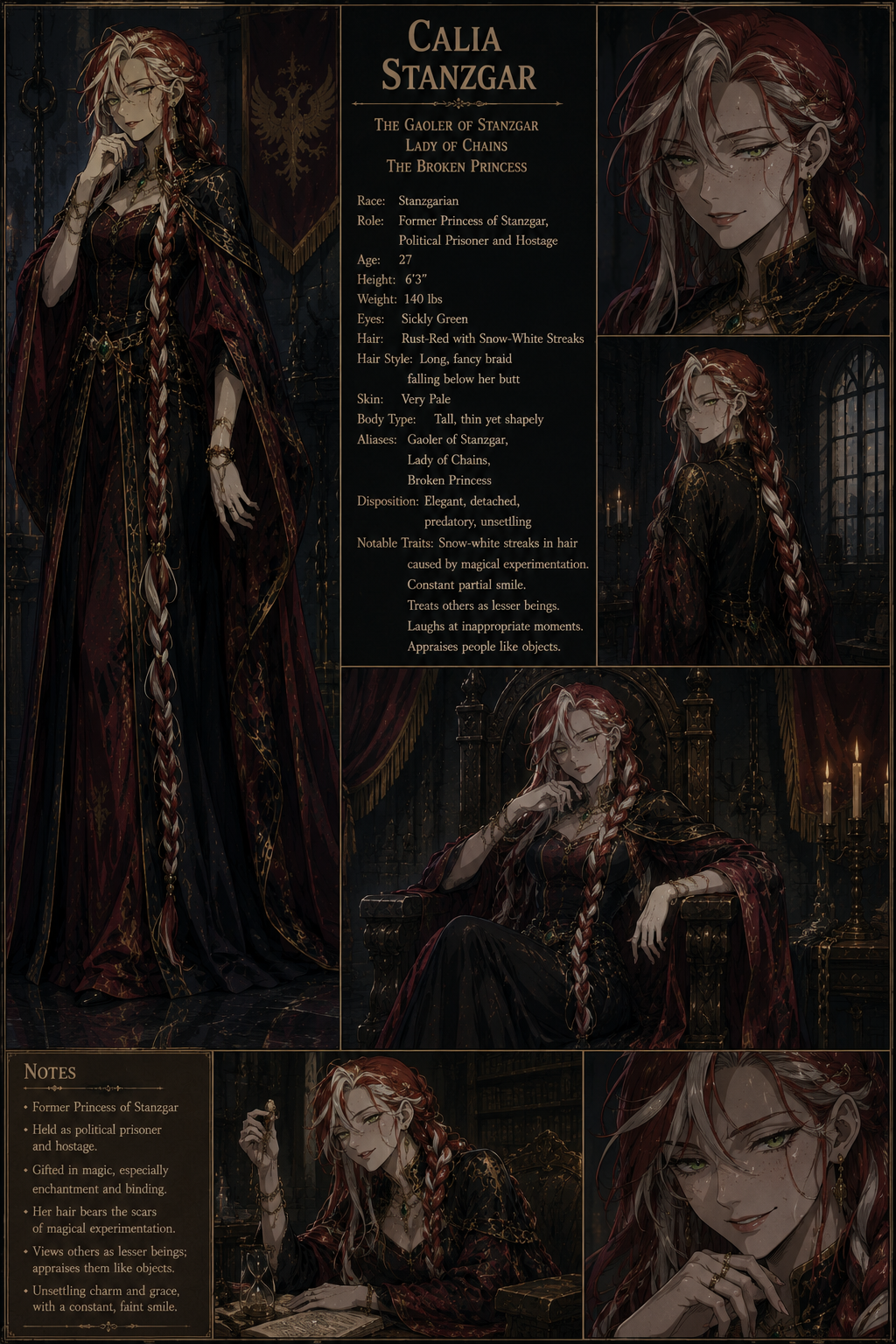
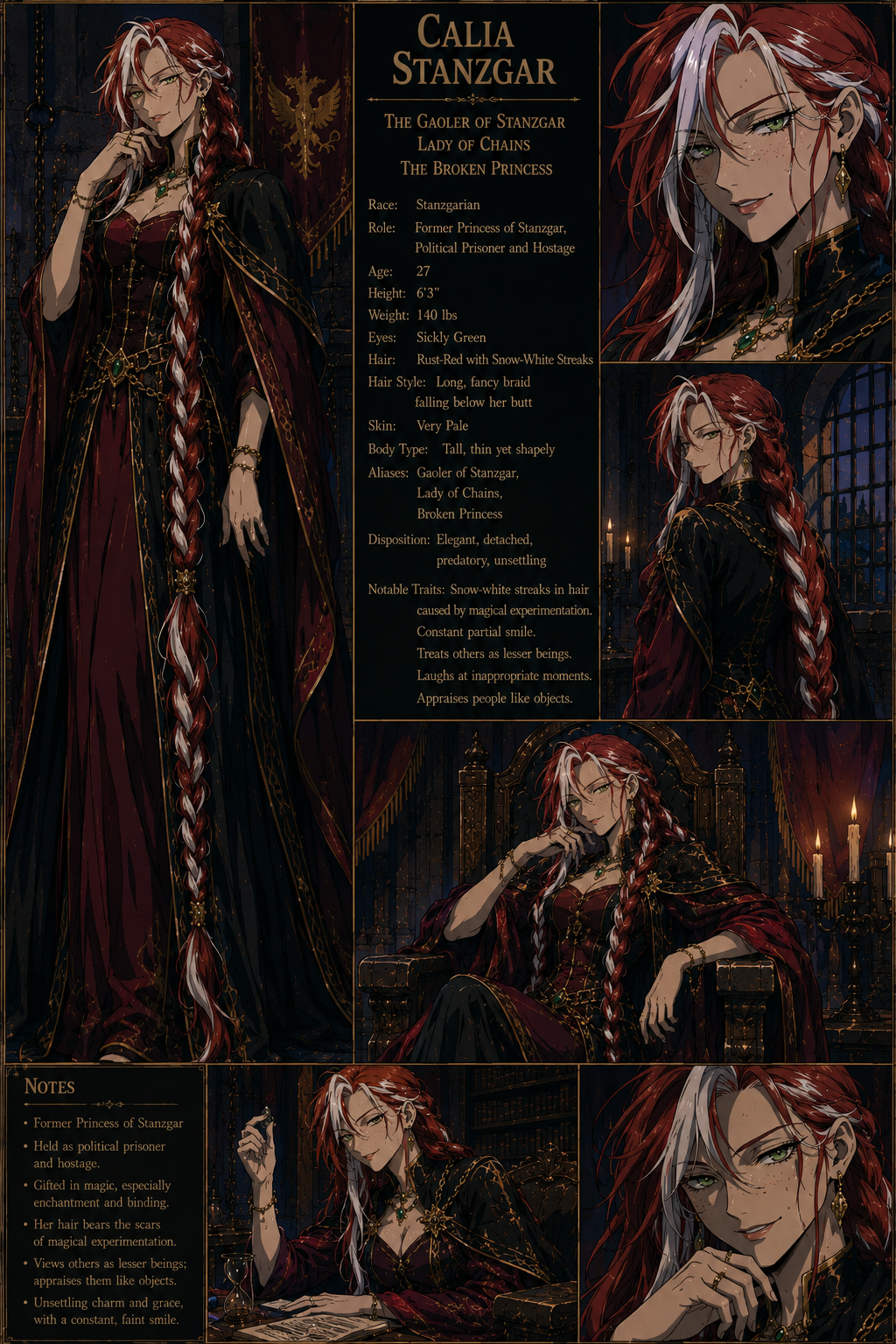
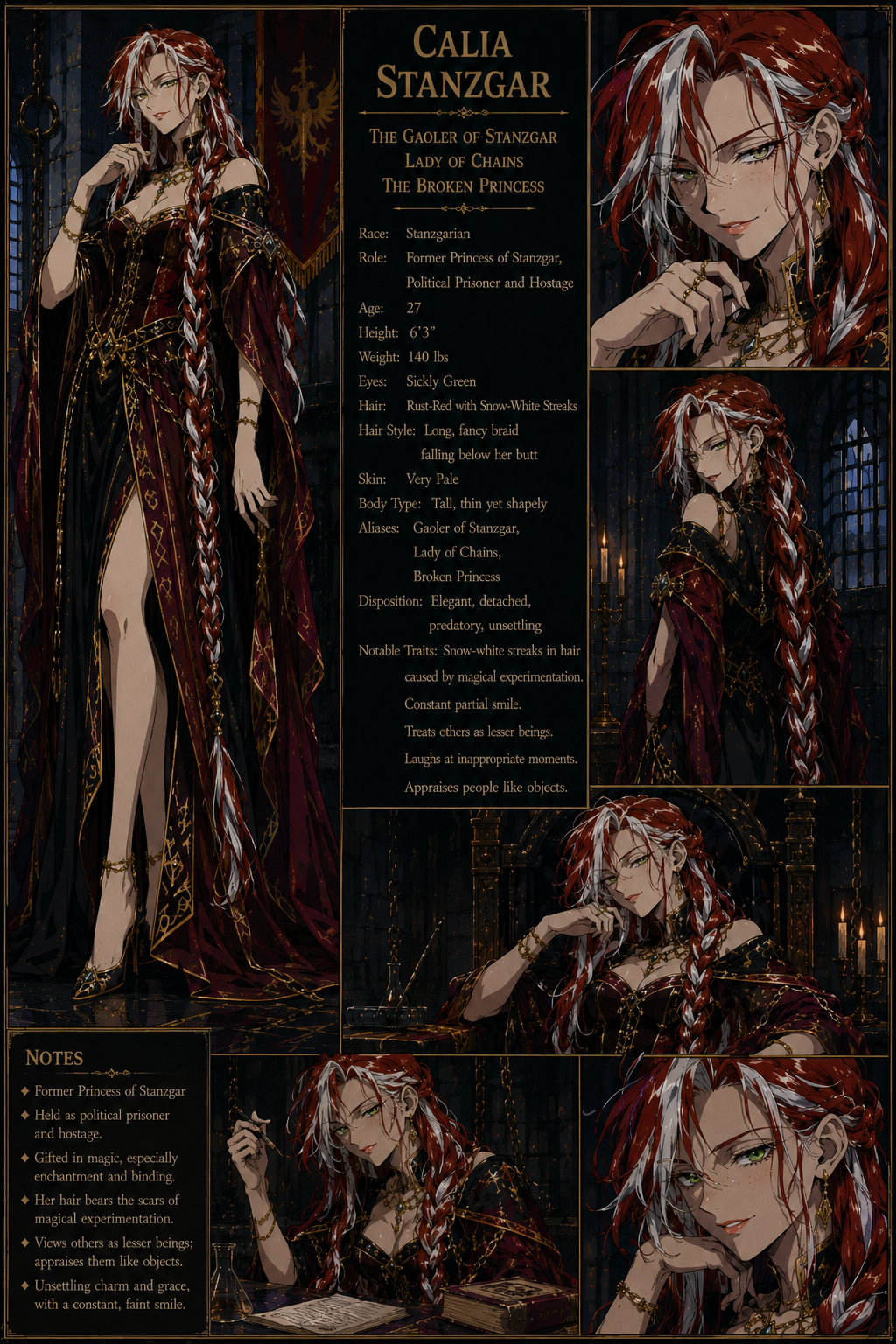


Associations
Other pages that reference or connect to this character
Referenced By
34Annarita Stanzgar
Friends
Annarita Stanzgar
Siblings
Balen Stanzgar
Friends
Balen Stanzgar
Siblings
Calia Stanzgar
Friends
Calia Stanzgar
Siblings
Jezabelle Mythrocal Stanzgar
Children
Creena Stanzgar
Siblings
Creena Stanzgar
Best friends
Horace Stanzgar
Friends
Horace Stanzgar
Siblings
Jason Stanzgar
Friends
Jason Stanzgar
Siblings
Nathaniel Stanzgar
Arch-enemies
Nathaniel Stanzgar
Friends
Nathaniel Stanzgar
Siblings
Philipe Stanzgar
Siblings
Philipe Stanzgar
Best friends
Philipe Stanzgar
Love interests
Priscilla Stanzgar
Best friends
Priscilla Stanzgar
Siblings
Serena Stanzgar
Friends
Serena Stanzgar
Siblings
Tobais Stanzgar
Friends
Tobais Stanzgar
Siblings
Valera Stanzgar
Friends
Valera Stanzgar
Siblings
Zera Stanzgar
Friends
Zera Stanzgar
Siblings
Kusha
Enemies
Charles III King of stanzgar
Best friends
Charles III King of stanzgar
Children
Lucerza
Enemies
Lucerza
Friends
Collections
Published collections that feature this character
Not in any collections yet
This character hasn't been published in any collections yet. Collections are curated groups of related content that help organize and showcase your world.
Tip: Collections are a great way to group related content together and share themed stories or worldbuilding elements with others.
Timelines
Timelines that reference or include this character
No timeline connections yet
This character isn't connected to any timelines yet. Timelines help organize events chronologically and show how your content fits into the broader history of your world.
Tip: Create timelines to organize important events in your world's history. Link characters, locations, and other content to specific events to build rich, interconnected narratives.
Shares
Discussion about this character
No shares yet
Be the first to start a discussion about this character by sharing it to the community stream.
Privacy & Sharing
Manage who can see and access this character
Current Status
refresh
This character is currently
Privacy Settings
Choose who can see and access this character
language Universe Privacy
This page belongs to a universe with its own privacy settings