

Categories
Dive Deeper
Page Stats
Navigation
Categories
Dive Deeper
Page Stats
Complete Details
All information about this character
Overview
Annarita Stanzgar
Annarita Stanzgar, known as Anna, the Jewel of Stanzgar, and Lady of the Elfin Wood, is a former princess of the old Stanzgarian royal family who now survives as a political captive within the new order that replaced her father’s rule. At twenty-eight, she presents herself as graceful, charming, and beautifully harmless, with light skin, deep blue eyes, strawberry-blonde hair, soft freckles, and a curvaceous figure she knows exactly how to display. Her beauty is not accidental to her identity; it is cultivated, maintained, and used with the same care another noble might give to a blade or treaty.
Raised during what should have been the height of her family’s power, Annarita grew up expecting the world to bend around royal blood, wealth, conquest, and courtly influence. Instead, civil war shattered that future, her father was killed in Darius Drachenbär’s raid on the palace, and the surviving Stanzgar family became valuable hostages in the hands of their enemies. Her marriage to Michel Drachenbär, now governor of Bleakwood, is both a political arrangement and a personal complication, tying her survival to the very family she distrusts.
Annarita is courtly, flirtatious, manipulative, and rarely direct. She speaks politely even when she is threatening someone, gives advice in ways that make others believe the thought was their own, and moves through social situations as if every glance, pause, and smile has been rehearsed. Publicly, she appears to have no political ambitions beyond maintaining her status and supporting her husband. Privately, she would gladly see the Drachenbär family destroyed, or else see Michel raised high enough that her own captivity becomes power by another name.
Anna, the jewel of stanzgar, Lady of the Elfin wood
Member of the Former Royal family of Stanzgar now a political Captive
28
female
Looks
none
Annarita wears her strawberry-blonde hair in elaborate braided styles that are intentionally impossible to arrange without assistance. Her hair is not simply “done”; it is constructed, woven, pinned, looped, and decorated in a way that makes her status visible before she ever speaks. The complexity of the style quietly announces that she has attendants, time, wealth, and the expectation of being looked at. For Annarita, this matters. Her appearance is part of her position, and her hair is one of the clearest signs that she is not merely beautiful, but cultivated.
Her preferred styles often involve layered braids, soft waves, jeweled pins, pearl strands, delicate chains, ribbons, or small ornaments worked into the hair so that it frames her face and draws attention to her neck, shoulders, and figure. She favors arrangements that look romantic and effortless from a distance, even though they require careful labor to maintain. A loose curl beside her cheek, a braid falling over one shoulder, or a jeweled strand catching the light may appear accidental, but with Annarita very little is truly accidental.
The style also serves a political purpose. As a captive noblewoman from the former royal family, Annarita uses beauty and presentation to remind others that she is still someone of consequence. Her hair preserves the image of the Jewel of Stanzgar even when her freedom has been taken from her. It lets her appear composed, desirable, and untouchable in rooms where she is anything but safe. In private, the need for others to help arrange it may also be a reminder of her dependence and confinement, but in public she turns that dependence into display. Her hair becomes a crown she is still allowed to wear.
Annarita’s hair is strawberry blonde, a soft mixture of warm gold, pale copper, and rose-tinted red. It is not the fiery red of a wanderer or the plain blonde common in many Stanzgarian lines, but something gentler and more luminous, giving her an immediately romantic and courtly appearance. In candlelight, it can appear warmer and almost copper-gold, while in daylight it takes on a lighter, peachy-blonde softness that pairs well with her fair skin, freckles, and deep blue eyes.
The color contributes heavily to her reputation as the Jewel of Stanzgar. It makes her look delicate without seeming weak, bright without seeming vulgar, and distinctive without crossing into anything truly strange. Annarita knows this and uses it carefully. Her elaborate braided styles are chosen to show off the color’s shifts, letting jeweled pins, pearls, blue ornaments, and seafoam fabrics draw out different tones in her hair.
Her strawberry-blonde hair also helps soften her more dangerous qualities. It gives her an approachable, almost storybook beauty that makes people underestimate how calculating she can be. In court, that is useful. The more she looks like an ornament, the easier it is for others to forget that she is listening, judging, and deciding where best to place the knife.
Annarita stands at 5'4", placing her on the shorter side of average for a Stanzgarian woman. She is not physically imposing, and she does not try to be. Her presence comes from posture, clothing, beauty, rank, and careful social control rather than height. In a room of soldiers, governors, courtiers, and Drachenbär rivals, she is rarely the largest person present, but she knows how to make herself difficult to overlook.
Her height works well with the image she cultivates. It allows her to seem graceful, approachable, and ornamental when that benefits her, especially beside taller or more martial figures. She can appear delicate without actually being helpless, charming without seeming openly threatening, and small enough that others may underestimate the weight of her attention. Annarita understands that being physically nonthreatening can be useful in court, where obvious danger is watched more carefully than beautiful softness.
She uses movement and dress to shape how her height is perceived. Tall hairstyles, structured gowns, fitted bodices, jeweled accessories, and deliberate posture all help extend her presence beyond her actual size. When she enters a room, she does not need to tower; she needs to be noticed, admired, and remembered. Her height may be modest, but Annarita has spent her life learning that status is often less about how much space one naturally occupies and more about how successfully one convinces others to make room.
Annarita weighs around 140 pounds, giving her a soft, curvaceous figure that suits the image she carefully cultivates. She is not built like a laborer, soldier, or traveler, and nothing about her body suggests a life of physical hardship. Instead, her weight reflects noble comfort, rich food, fine living, and deliberate presentation. She is slightly plump in a way that reads as health, wealth, and sensuality rather than excess.
Her figure is one of the tools she understands best. Annarita knows that others find her attractive, and she dresses, moves, and presents herself in ways that make that attraction difficult to ignore. Gowns are chosen to emphasize her hourglass shape, posture is controlled to draw attention where she wants it, and even small movements are often calculated to appear graceful, inviting, or harmless. She does not merely possess beauty; she manages it.
At court, her body becomes part of her political survival. In a world where her family has lost power and her own position depends heavily on perception, Annarita uses softness as armor. She appears ornamental, desirable, and nonthreatening, which encourages others to underestimate her. Her weight and figure help sell the role she plays: the beautiful captive noblewoman, the devoted wife, the harmless jewel. The truth, of course, is that Annarita is always watching who believes the performance.
Annarita’s most obvious identifying quality is not a scar or deformity, but the ethereal beauty that surrounds her. She has the sort of carefully cultivated loveliness that makes people remember her even when they cannot immediately name why. Her light skin, strawberry-blonde hair, deep blue eyes, soft freckles, and courtly grooming all combine into an appearance that feels almost unreal in the right light. This is a major part of why she is called the Jewel of Stanzgar.
Her light freckles are another recognizable feature, scattered subtly enough to soften her face rather than dominate it. They give her beauty a slightly natural, human quality, preventing her from looking too perfectly polished. Annarita likely knows this and uses it to her advantage, allowing the freckles to suggest innocence, warmth, or delicate charm even when her thoughts are far sharper than her expression.
She also has a beauty mark on her bosom, a more private identifying mark that adds to the intimate, carefully managed nature of her appearance. Like much about Annarita, it exists somewhere between natural feature and social weapon. She knows it is there, knows how others might react to it, and dresses in ways that can either conceal it completely or allow it to become part of the image she is presenting. In public, her identifying marks reinforce the same message: Annarita is beautiful, valuable, and never quite as harmless as she looks.
Annarita has a curvaceous, slightly plump body with a pronounced hourglass figure, the kind of softness associated with noble comfort, rich food, careful grooming, and a life largely removed from physical labor. She is not fragile or thin, nor does she cultivate the look of a warrior or traveler. Her body is part of the courtly image she presents: graceful, inviting, ornamental, and visibly well-kept.
She knows very well that others find her attractive, and she uses that knowledge with deliberate skill. Her gowns, posture, jewelry, and movement are all chosen to emphasize her figure without making the effort seem obvious. A fitted bodice, a draped sleeve, a turned shoulder, or the slow adjustment of a necklace can all become part of the performance. Annarita does not simply rely on beauty; she studies how people respond to it and adjusts accordingly.
Her softness is also deceptive. In court, looking dangerous can be a weakness, because dangerous people are watched closely. Annarita’s figure allows her to appear sensual, harmless, pampered, and politically contained, which is exactly the impression she often wants to give. Beneath that cultivated softness is a woman who understands statecraft, manipulation, and survival far better than many of the people admiring her realize.
Annarita has light skin, fair enough to suit the courtly image expected of a highborn Stanzgarian noblewoman, but softened by warmth, freckles, and careful grooming rather than appearing stark or severe. Her complexion is one of the features that supports her reputation as the Jewel of Stanzgar, pairing naturally with her strawberry-blonde hair, deep blue eyes, and seafoam-colored clothing.
Her skin has the look of someone raised in luxury rather than labor. It is protected, maintained, and intentionally presented, without the roughness, weathering, or sun-wear common among travelers, soldiers, or working Stanzgarians. The light freckles across her face add a gentler, more natural charm to an otherwise highly cultivated appearance, making her beauty feel less coldly perfect and more inviting.
Annarita is very aware of how her complexion works with color, jewelry, candlelight, and fabric. Pale green-blue silks, pearls, gold, and soft cosmetic touches all help her appear luminous and composed in public. Like most parts of her appearance, her skin tone is not merely a physical trait; it is part of the performance she uses to remain admired, underestimated, and socially dangerous.
Stanzgarian
Annarita’s eyes are a deep blue, rich enough to stand out against her light skin, strawberry-blonde hair, and soft freckles. They are one of the strongest features in her face, giving her beauty a cooler, more refined edge beneath the warmth of her hair and complexion. In candlelight or courtly settings, her eyes can appear darker and more dramatic, while in daylight they take on a clearer jewel-like quality that suits her reputation as the Jewel of Stanzgar.
She knows how to use her eyes socially. A lowered glance can make her seem demure, a lingering look can make someone feel chosen, and a cool stare can remind a person that courtly politeness is not the same as weakness. Annarita rarely wastes expression; even her gaze is managed, shifting between charm, innocence, interest, and quiet judgment depending on what the situation requires.
Her deep blue eyes also help sell the contradictions she lives by. They can make her appear romantic, wounded, and harmless when she wants sympathy, but they can just as easily become sharp and appraising when she is reading a room. Like much of Annarita’s beauty, they are both natural feature and practiced instrument, one more part of the careful performance that keeps her alive in a court where admiration and danger often look very similar.
Nature
Annarita’s prejudices are shaped by royal upbringing, imperial arrogance, political humiliation, and the collapse of the world she expected to inherit. She was raised during the final height of the old Stanzgarian royal family’s power, when her father’s victories over the Fengalin, orcs, and other rivals seemed to confirm that Stanzgarian rule was not merely strong, but inevitable. Even after that certainty shattered, Annarita never fully abandoned the assumptions it gave her. She still tends to judge other peoples by how useful, obedient, modern, or governable they appear through a Stanzgarian lens.
Her distrust of the Drachenbär family is the most personal and dangerous of her prejudices. To Annarita, the Drachenbärs are not simply political rivals; they are the family that destroyed her father’s reign, killed her father, seized control of her future, and reduced the old royal family to hostages, bargaining pieces, and arranged marriages. Even her marriage to Michel Drachenbär does not erase that. She may love, desire, or depend on Michel, but the name Drachenbär still carries the taste of captivity. Her feelings toward them are complicated by proximity, attraction, survival, and ambition, but beneath every polite smile is the knowledge that her life changed because they won.
Her view of the Talaran theocracy is colder and more contemptuous than fearful. Annarita sees Talara as weak because, despite its religious authority and long northern influence, it failed to maintain dominance once it provoked stronger forces. In her mind, faith-backed power that cannot survive war is not sacred; it is brittle. She may respect individual Talarans who prove cunning or useful, but as a political-religious body she views the theocracy as a decaying power that mistook cruelty and ceremony for strength.
Her prejudice toward the Fengalin and orcs is rooted in old Stanzgarian imperial thinking. She sees them as backward peoples standing outside the proper march of progress, order, wealth, and modern governance. On some days, she frames this in a patronizingly “benevolent” way, believing they should be uplifted and brought into Stanzgarian systems for their own good. On other days, especially when frustrated or frightened, she thinks they should simply submit. This inconsistency is part of the problem: her opinion shifts based less on justice or understanding than on mood, political convenience, and how threatened she feels.
Annarita also views the Northern Legions as relics of a dying past. She sees them as remnants of an older order that has outlived its usefulness, and she resents the way such forces can still shape events despite belonging, in her mind, to yesterday’s wars. To her, they should either accept the new political reality or disappear into history. That attitude is not entirely rational; it reflects her frustration with any old power that refuses to fall neatly into the future she wants.
Her feelings toward the new Stanzgarian order are the most conflicted. She finds it interesting, even impressive, because it represents power that worked: rebellion, consolidation, confederacy, new royal legitimacy, and survival after civil war. But she also hates that it exists at her family’s expense. Annarita can admire the machine while despising the hands that built it. Her prejudices are therefore not simple hatreds. They are the bitter remains of a royal worldview forced to survive inside the court of its conquerors.
Annarita has no known physical, magical, or chronic condition. Her health is generally stable, and there is nothing about her body or mind that marks her as afflicted in any formal sense. What she does carry is the strain of captivity, court politics, and constant social performance, but these are circumstances rather than conditions.
Living as a political captive has made her careful, indirect, and perpetually aware of danger. She often behaves as though every room is being watched and every word may later be used against her. This can make her seem tense beneath her polish, especially around the Drachenbär family, whose social rhythms she struggles to read. Still, Annarita would never describe this as weakness. To her, it is simply the cost of surviving beautifully in a court that would rather see her harmless.
Annarita’s mannerisms are deliberate, polished, and deeply court-trained. She rarely moves without considering how the movement will be seen, whether that means crossing a room, lowering her eyes, adjusting a sleeve, or reaching for a cup. Her gestures tend to be smooth and measured rather than quick, giving the impression that she is always composed, even when she is frightened, angry, or calculating her next move.
She speaks with courtly politeness at almost all times, often softening sharp opinions behind graceful phrasing. Annarita does not like being direct, partly because directness is dangerous for a political captive and partly because she prefers influence over confrontation. When she gives advice, she often frames it so carefully that the other person feels as though the idea was theirs all along. A suggestion from her may sound like a compliment, a question, or a passing observation, only for the listener to realize later that she guided the entire conversation.
Her body language is equally controlled. Annarita knows others find her attractive, and she uses that knowledge constantly. She turns slightly when standing so her figure is shown to advantage, lets fabric and jewelry draw the eye, and moves with a cultivated softness that makes her appear graceful, inviting, and harmless. Even stillness becomes part of the performance; she can sit like an ornament while quietly watching every expression in the room.
Around the Drachenbär family, however, her polish becomes more careful. She walks on eggshells socially, attentive to small shifts in mood, tone, and silence. The problem is that she cannot always read them as easily as she reads other nobles, which unsettles her. When uncertain, she becomes even more polite, more elegant, and more indirect, hiding tension behind charm. Annarita’s mannerisms are not merely habits; they are armor, bait, and camouflage all at once.
Annarita’s first and most immediate motivation is survival. She is a member of the former royal family of Stanzgar, now living as a political captive in the world made by her family’s enemies. Her beauty, manners, marriage, and social skill are not simply luxuries of noble life; they are the tools she uses to remain valuable enough to keep alive. Every smile, compliment, flirtation, and careful silence is part of that effort.
She is also driven by the need to maintain her political and social status. Annarita has lost the world she was born to inherit, but she refuses to become irrelevant. Even as a captive, she clings to the symbols and behaviors of rank: fine clothes, courtly speech, careful alliances, household authority, and the image of being too refined to discard. To her, status is not vanity alone. Status is protection, leverage, and proof that the name Stanzgar has not been reduced to a footnote in someone else’s victory.
Her husband Michel Drachenbär is another major motivation, though her feelings toward him are complicated by politics. She wants to see him succeed, partly out of affection and desire, partly because his rise strengthens her own position. If Michel becomes more powerful, Annarita becomes harder to ignore, harder to remove, and harder to treat as a conquered princess. In her darker private hopes, his success might even become the path by which the Drachenbär victory is turned back on itself.
Beneath all of this is Annarita’s refusal to accept humiliation as final. She may act ornamental, flirtatious, and harmless, but she is constantly searching for ways to convert captivity into influence. Whether that means preserving her family’s dignity, manipulating a household, strengthening Michel’s ambitions, or quietly imagining the fall of those who ruined her father’s reign, Annarita is motivated by the same central need: to survive beautifully, remain important, and someday make her captivity look like the first step of a victory rather than the end of one.
Annarita’s greatest flaw is that she is vain in a way that goes far beyond simple pride in her appearance. Beauty is one of her strongest tools, and she knows it, but she sometimes trusts it too much. She is used to being admired, desired, envied, and watched, and she can become unsettled when someone refuses to respond to her charm the way she expects. Her vanity is not empty-headed, but it is still dangerous; she can mistake being wanted for being safe, or being admired for being in control.
She is also indirect to a fault. Annarita almost never says plainly what she wants, what she fears, or what she intends. This habit has helped her survive as a political captive, but it also makes her frustrating and difficult to trust. She would rather guide, imply, flatter, seduce, provoke, or suggest than make a direct demand. In ordinary court politics, this makes her effective. In urgent situations, it can become a liability, causing confusion where clarity would serve her better.
Her inability to reliably read most of the Drachenbär family is one of her most dangerous weaknesses. Annarita is highly skilled at navigating old Stanzgarian court behavior, but the Drachenbärs do not always move according to the rules she understands. Their directness, confidence, or different social instincts can leave her uncertain, and uncertainty makes her anxious. Around them, she often overcompensates with excessive politeness, charm, or caution, walking on eggshells even when a firmer hand might serve her better.
Annarita is also manipulative enough that sincerity becomes difficult for her. Even when she genuinely loves Michel, cares for someone, or gives good advice, she often wraps the truth in performance. This can make her seem false even when she is being honest. Her habits of flirtation, misdirection, and social control are so deeply ingrained that she may not always recognize when she is using them on people who would have listened without being managed.
At her worst, Annarita is trapped by the worldview that raised her. She sees herself as refined, modern, and politically necessary, but she can be patronizing, classist, and imperial in how she judges others. She resents being treated as a captive, yet she still struggles to fully reject the systems of conquest, hierarchy, and domination that once benefited her family. That contradiction makes her compelling, but it also keeps her from seeing clearly: she hates the cage she is in, while still believing she was born to hold the key to someone else’s.
Annarita’s talents are courtly rather than martial, but that does not make them harmless. She is skilled at running a noble household, managing servants, arranging appearances, tracking social obligations, hosting gatherings, and making domestic order look effortless. In her hands, a household is not merely a residence; it is a political stage. Seating, invitations, gifts, clothing, music, meals, and overheard conversations can all become tools for shaping reputation and influence.
She also has a strong talent for statecraft, though she usually hides it behind charm and ornamental femininity. Annarita understands power, status, marriage politics, noble pride, and the uses of public perception. She may not command armies or openly argue policy, but she knows how to guide decisions indirectly, how to flatter someone into agreement, and how to make a suggestion feel like another person’s own idea. Her gift is not forceful leadership, but quiet redirection.
Her beauty is itself one of her practiced talents. Annarita knows how to look stunning, but more importantly, she knows how to make beauty useful. She understands clothing, posture, eye contact, timing, perfume, jewelry, lighting, and the precise amount of vulnerability or confidence to show in a given room. She can appear harmless, desirable, wounded, supportive, or unreachable depending on what will serve her best.
Annarita is also well trained in the classical arts expected of a highborn Stanzgarian noblewoman. She can likely sing, dance, play music, recite poetry, discuss literature, appreciate fine craftsmanship, and perform the social graces that mark elite refinement. These talents are not empty decoration. In noble society, art is another language of status, education, and control, and Annarita speaks it fluently.
Her most dangerous talent may be social patience. She can endure insult behind a smile, wait for someone else to expose themselves, and let others believe they are leading while she quietly adjusts the room around them. Annarita is not always as clever as she thinks she is, especially around the Drachenbär family, but within the kind of courtly world she understands, she is graceful, observant, and far more capable than her soft presentation suggests.
Annarita’s hobbies are indulgent, social, and deeply tied to the courtly world she was raised to inhabit. She enjoys tournaments, especially jousts and formal games, not only for the spectacle but for the politics around them. A tournament is never just a tournament to Annarita; it is a gathering of status, rivalry, flirtation, gossip, public display, and carefully measured loyalty. She enjoys watching who cheers for whom, who stands too close together, who loses gracefully, and who reveals more than they intended in victory.
She also enjoys reading salacious novels, particularly the sort that mix romance, scandal, forbidden affairs, and courtly intrigue. Such stories appeal to her because they turn danger, desire, and social manipulation into entertainment, letting her indulge in drama without risking herself directly. She would likely pretend her taste is ironic or merely amusing, but she reads them with genuine pleasure.
Her flirtations with Michel are another favored pastime, especially when they become public games of jealousy, temptation, and performance. Annarita enjoys watching her husband charm other women only to return to her at the end of the night, and she enjoys doing the same in reverse, leading others on just far enough to remind the room that she is desired before returning to Michel’s side. To her, this is not simple infidelity but a shared courtly game between them: a way of displaying confidence, possession, appetite, and mutual power.
Annarita also enjoys private revels, sensual gatherings, and luxurious social entertainments where rules loosen and status becomes part of the pleasure. These indulgences suit her taste for beauty, admiration, and controlled scandal. She likes environments where desire can be performed, watched, managed, and turned into influence. Even her pleasures are rarely without calculation.
At her most sincere, however, Annarita’s favorite indulgence is simply being adored by Michel and adoring him in return. Beneath the manipulation, vanity, and social theater, her attachment to him is one of the few things in her life that feels chosen rather than imposed. Her hobbies reveal her clearly: she likes beauty, danger, attention, games, and the thrill of appearing less serious than she truly is.
Annarita is flirty, manipulative, polished, and false by long practice, though not without depth beneath the performance. She was raised to survive and succeed in courts where beauty, manners, bloodline, and implication mattered more than honesty, and she has carried those lessons into captivity. Nearly everything about her public self is curated: her smile, her posture, her modesty, her flirtation, her helplessness, and even the moments when she appears most sincere.
At first glance, Annarita can seem like exactly what she wants others to see: a beautiful former princess, charming but harmless, vain but manageable, decorative enough to admire and politically contained enough to underestimate. This impression is intentional. She uses softness, sensuality, and courtly politeness as camouflage, making herself appear less dangerous than the bitter, ambitious, and observant woman beneath the silk and jewelry.
Her manipulation is usually subtle rather than forceful. Annarita prefers to guide people toward decisions while allowing them to believe they arrived there naturally. She flatters, suggests, teases, withdraws, rewards, and withholds depending on what the moment requires. Direct confrontation feels crude to her, and dangerous besides. She would rather win a room by changing its mood than by declaring her intent.
Yet Annarita is not simply empty or cruel. Much of her falseness comes from fear. She is a political captive, married into the family that destroyed her father’s reign, and constantly aware that survival depends on remaining valuable, beautiful, and useful. Her affection for Michel is one of the few parts of her life that feels genuinely chosen, though even there politics and desire are difficult to separate. At her core, Annarita is a woman who has turned performance into armor: vain because beauty keeps her relevant, manipulative because honesty can be fatal, and flirtatious because being wanted is often safer than being ignored.
Social
Annarita’s favorite food is honeyed venison with saffron cream and black bread, a dish that fits her upbringing as high Stanzgarian nobility. It is rich, refined, and unmistakably expensive without being delicate for its own sake. The venison provides the prestige of a noble hunt, the honey adds controlled sweetness, the saffron cream signals wealth and access to luxury trade goods, and the black bread grounds the dish in the darker, heartier grain traditions of Stanzgar.
For Annarita, this is not merely a favorite meal; it is a reminder of the world she was born into. It tastes like royal tables, winter feasts, polished silver, candlelit halls, hunting parties, and a court where her family still seemed untouchable. The dish carries nostalgia for the old Stanzgarian monarchy, but also pride. It is the kind of food that says power does not need to shout when it can season itself with saffron.
She likely prefers it prepared elegantly: thin slices of tender venison glazed with honey, served with a pale golden saffron cream sauce, dark bread dense enough to hold the richness, and perhaps sharp greens, preserved berries, or spiced root vegetables to cut through the sweetness. It is indulgent but not childish, sensual but still courtly, and very much the sort of meal Annarita would enjoy being seen eating.
There is also something revealing about the contrast. The dish is built around hunted meat dressed in sweetness and luxury, which mirrors Annarita herself more than she would admit. Beneath the silk, perfume, and courtly softness, there is still appetite, ambition, and old blood pride. Honeyed venison suits her because it is beautiful, costly, and civilized over something fundamentally wild.
the Talaran Dune Prowler
Annarita’s favorite weapons are concealed blades and poison, which suits her far better than any sword openly worn at the hip. She is not a battlefield fighter, and she has no interest in proving courage through fair combat. Fair combat is for soldiers, duelists, and people foolish enough to meet danger on terms someone else chose. Annarita prefers weapons that belong to court corridors, private chambers, dinner tables, jewelry boxes, and sleeves.
Concealed weapons appeal to her because they let her remain exactly what others expect her to be: beautiful, ornamental, soft-handed, and supposedly harmless. A small dagger hidden in a garter, hairpin, bodice, ring, fan, or sleeve suits her public image perfectly because it does not disturb the performance. The weapon is only revealed when the illusion has already done its work. To Annarita, a hidden blade is not just a tool of violence; it is a reminder that being underestimated can be made useful.
Poison is even more aligned with her temperament. It is indirect, patient, intimate, and difficult to accuse without proof. It can be delivered through hospitality, medicine, perfume, wine, cosmetics, or food, all the things a noblewoman is expected to understand and manage. Annarita would appreciate poison not as crude murder, but as a weapon of access and timing. It belongs to people who can wait, smile, and let the room believe nothing has happened until it is far too late.
Her preference for such weapons reveals how she thinks about power. Annarita does not want to overpower an enemy. She wants them comfortable, distracted, confident, and wrong. In her hands, beauty is the first concealment, politeness the second, and the weapon itself only the final detail. For a political captive surrounded by enemies, concealed weapons and poison are not merely favorites. They are the fantasy of control in a life where open force was taken from her.
Annarita would tell most people that her favorite possessions are her jewelry, gowns, ornaments, and fine things, and in a public sense that answer is almost believable. She loves beautiful objects, and she understands the power of being seen surrounded by wealth. Fine clothes and jewelry help preserve the image of the Jewel of Stanzgar, reminding others that even as a political captive, she is still noble, valuable, and difficult to dismiss.
Her true favorite possession, however, is a simple, sparsely ornamented ring given to her by her late father, Charles III, King of Stanzgar. Compared to her more elaborate pieces, the ring is almost plain, lacking the obvious splendor she usually favors. That is part of why it matters. It is not important because it dazzles others, but because it belonged to a life before defeat, captivity, and the collapse of her family’s power.
The ring is one of the few things Annarita owns that is not primarily part of a performance. Her gowns shape how others see her. Her jewels declare status. Her cosmetics, perfumes, and accessories help her survive courtly scrutiny. But the ring is private memory. It connects her to her father, to the old royal family, and to the version of herself who still believed the Stanzgar name was untouchable.
She likely keeps it close even when she does not openly display it. If she wears it, she may choose a hand or placement that lets it pass unnoticed among finer ornaments. If she hides it, it is kept somewhere secure, handled only in quiet moments. For Annarita, the ring is grief, legitimacy, love, and resentment all bound into one small object. She may dress herself in jewels to prove she is still worth looking at, but that plain ring is the one possession that proves she remembers who she was before someone else won.
Annarita’s favorite color is seafoam green, a soft blue-green shade that suits both her beauty and the image she carefully cultivates. It is delicate without seeming childish, expensive-looking without being loud, and unusual enough to make her stand apart from more predictable courtly colors. Against her light skin, strawberry-blonde hair, deep blue eyes, and freckles, seafoam green gives her a luminous, almost ethereal quality that supports her reputation as the Jewel of Stanzgar.
She likely favors the color in silks, ribbons, embroidered accents, gemstone settings, and gown linings, especially when paired with pearls, pale gold, or soft blue ornaments. Seafoam green lets her appear gentle, romantic, and refined while still drawing attention. It is not a color that dominates a room by force; it invites people to look closer, which is exactly the kind of power Annarita prefers.
The color also carries a subtle contradiction that fits her well. Seafoam green suggests freshness, grace, calm water, and delicate beauty, but Annarita herself is anything but simple or harmless. She uses soft colors the way she uses soft speech: to make danger look beautiful, controlled, and easy to underestimate. In her hands, seafoam green is not merely pretty. It is part of the performance, a color that makes captivity look like elegance and ambition look like charm.
Annarita’s occupation is noblewoman, though in her case the title carries less freedom than it once did. As a member of the former royal family of Stanzgar, she was raised for courtly life, dynastic marriage, household authority, political display, and the production of heirs. Little was expected of her in a practical trade sense, but a great deal was expected of her socially. She was meant to be beautiful, educated, fertile, loyal to her family’s interests, and useful in the quiet political ways noblewomen are often expected to be useful.
After her family’s fall, that role became more complicated. Annarita remains a noblewoman, but now under the shadow of captivity and political control. Her marriage to Michel Drachenbär makes her both a wife within the new ruling order and a living reminder of the old one. She is not expected to command armies or govern openly, yet her presence still matters. Her bloodline, beauty, manners, and ability to manage a household all make her valuable enough to preserve and dangerous enough to watch.
Her daily occupation is therefore one of performance and survival. She hosts, dresses, speaks, advises, flatters, observes, and maintains the image of a refined noble lady who accepts her place. Beneath that image, she works constantly to protect her status, strengthen Michel’s position, preserve what remains of Stanzgar royal dignity, and remain too useful to discard. Annarita’s occupation may simply be “noble,” but in practice she is a courtly operator: wife, hostage, ornament, advisor, and quiet political weapon.
Annarita publicly presents herself as having no serious political ambitions, opinions, or designs beyond the expected concerns of a noble wife. She smiles, speaks politely, supports her husband, attends to her household, and allows others to believe that courtly life, beauty, comfort, and status are enough to occupy her. This is intentional. As a political captive from the former royal family, Annarita understands that open ambition would make her a threat. It is safer for her to seem ornamental and harmless than openly ambitious.
Privately, Annarita is far more political than she admits. She would either like to see the Drachenbär family destroyed or see her husband, Michel Drachenbär, raised high enough that her own captivity becomes power by another name. These desires are contradictory, but Annarita lives inside contradiction. She distrusts the family that killed her father and broke the old royal house, yet she is married to Michel, desires him, supports him, and ties her own future to his success. If Michel rises, she rises with him; if he becomes king, then the old royal blood survives not by defeating the new order directly, but by joining itself to it.
Her politics are rooted in legitimacy, status, and survival. Annarita was raised to believe the Stanzgar name mattered, and she has never fully accepted that her family’s fall should be permanent. She does not necessarily dream of restoring the old kingdom exactly as it was, but she cannot tolerate being reduced to a beautiful hostage in someone else’s history. Every household arrangement, alliance, flirtation, rumor, and whispered suggestion becomes a way to preserve influence and test the walls of her cage.
She is careful never to say too much plainly. If pressed, Annarita will speak in vague terms about peace, stability, duty, and her husband’s future. Beneath that polished surface, however, she is always measuring who benefits, who can be moved, who can be tempted, and who might one day be useful. Her politics are not ideological in the public sense. They are personal, dynastic, and intimate: she wants to live, remain important, see Michel succeed, and ensure the name Stanzgar is never treated as something safely dead.
Annarita follows the Stanzgarian Church of the One, as expected of a noblewoman raised within the old royal court of Stanzgar. Her faith is not centered on devotion to one particular god, but on proper reverence toward the Stanzgarian pantheon as a unified divine order. To her, the Church is as much a structure of civilization as it is a matter of belief: it gives form to worship, keeps the gods properly acknowledged, and reinforces the image of a stable, cultured society.
Her practice is polished and public. Annarita knows the rites, attends the ceremonies expected of her, offers the correct prayers, and understands the social importance of being seen as properly reverent. She is not the sort to fall into wild religious passion or private mysticism; her faith is managed, elegant, and appropriate to her station. Like most things in her life, religion is partly sincere and partly performance.
The Church of the One also suits Annarita’s worldview because it treats divine power as something to be acknowledged, balanced, and carefully navigated rather than surrendered to blindly. She understands the gods as real and powerful, but not necessarily gentle or simple. Proper worship is, in her mind, a mark of refinement and prudence. Ignoring the gods would be foolish; giving oneself over too completely to any one power would be vulgar and dangerous.
As a political captive, religion also gives Annarita one more way to preserve continuity with the life she lost. The old royal family may have fallen, but the rites, prayers, feast days, mourning customs, and public ceremonies of Stanzgar remain familiar ground. When she participates in them, she is not merely worshipping. She is reminding the room that she was raised properly, that she still belongs to the highest traditions of Stanzgar, and that captivity has not made her common.
Annarita’s job is noble, though that word hides more than it explains. She does not have a trade, salary, or practical profession in the common sense. Her work is social, dynastic, and political: appearing properly, maintaining a household, supporting her husband, preserving status, producing heirs, and ensuring that her presence continues to matter within the courtly world around her.
As a former royal daughter, Annarita was raised for a life where being seen correctly was part of the job. She knows how to host, flatter, dress, speak, arrange servants, receive guests, attend ceremonies, and make a household reflect power. Even when she appears idle, she is often working through softer forms of influence: deciding who is invited, who is ignored, who is praised, who is made jealous, and who leaves a room believing they were clever enough to reach her desired conclusion on their own.
After becoming Michel Drachenbär’s wife, her job became even more complicated. She is expected to be a noble consort, a symbol of political settlement, and a beautiful reminder that the former royal family has been contained. Annarita plays that role carefully, but never passively. Her job may be listed simply as noble, but in practice she is a wife, hostage, household manager, courtly performer, dynastic asset, and quiet manipulator working to keep herself valuable.
History
Annarita was born in summer, a fitting season for someone associated with beauty, courtly display, warmth, and royal visibility. Her birth carries the feeling of garden parties, open halls, bright gowns, tournament banners, perfumed air, and long evenings where noble families gather to be admired as much as entertained. For Annarita, summer suits the image she cultivates: luminous, desirable, and difficult to ignore.
She likely treats her birthday as a social occasion rather than a private sentimental one. A proper celebration would involve fine food, music, flattering guests, gifts, beautiful clothing, and just enough spectacle to remind everyone of her rank. Even as a political captive, Annarita would not want the day to pass unnoticed. Being celebrated is another way of proving that she still matters.
In private, however, the day may carry a sharper edge. Each birthday is another year survived under the Drachenbär order, another year removed from the court where she was born to power, and another year spent turning captivity into something that looks like dignity. Annarita would never allow that bitterness to show too plainly. She would smile, accept gifts, wear something exquisite, and make the room remember why she was once called the Jewel of Stanzgar.
Annarita Stanzgar was born in the city of Stanzgar, in the Stanzgar River Valley, as one of the daughters of Charles III, King of Stanzgar, and Jezabelle Mythrocal Stanzgar. She grew up inside the old royal court during what should have been remembered as the height of her family’s power. The kingdom seemed ascendant, wealthy, organized, and victorious, with her father’s rule pressing outward against longtime rivals and troublesome neighbors. To a young Annarita, the world appeared to confirm everything she had been taught: that the Stanzgar name mattered, that royal blood carried weight, and that history belonged to those refined enough and ruthless enough to command it.
Her upbringing was shaped by conquest and courtly confidence. The Fengalin who resisted leaving their forest home had been scattered or placed under increasing pressure, with the expectation that they would eventually submit to Stanzgarian order. The orcs, long a thorn in her family’s side, had exhausted themselves in war and were annexed rather than welcomed as equals. Even Talara, once viewed as one of the great powers of the north, had weakened itself by provoking forces it could not fully control, awakening the danger of the Northern Legions. From Annarita’s perspective, these events were not tragedies, but proof that the old kingdom was modern, powerful, and destined to impose shape on a chaotic world.
That certainty did not survive the civil war. Internal strife slowly unraveled what outside enemies had failed to break, as an upstart from among River Road’s unlanded nobles began a rebellion that chipped away at loyalist strength. Even then, Annarita’s father did not seem doomed. Near the end of the war, he had nearly secured diplomatic and military support from the dwarves of Icesea, aid that might have crushed the rebellion and restored his position. Instead, Darius Drachenbär led a daring raid on the palace, and Charles III was killed before that future could arrive.
After her father’s death, the nobles who had remained loyal to him quickly ceded authority to the victorious rebel order, leaving Annarita and the surviving members of her family as political captives. They were too valuable to simply discard and too dangerous to leave free. What followed was a period of humiliation, uncertainty, and repeated threats against her family’s lives, as the former royal house became something to be ransomed, contained, married off, or used as proof that the old kingdom had truly fallen. For Annarita, this was the central wound of her life: she had been raised to be a jewel in the crown, only to become an ornament in someone else’s victory.
Eventually, the new emperor of Stanzgar arranged for Annarita to marry Michel Drachenbär, one of his sons and the governor of Bleakwood. The marriage was meant to bind the old royal bloodline to the new ruling house, turning a possible source of rebellion into a controlled dynastic asset. For Annarita, it was both captivity and opportunity. Michel belonged to the family she had every reason to hate, yet he also became her husband, lover, and the person whose success could secure her own survival. Through him, Annarita found a way to remain politically relevant, even if that relevance came inside a cage built by her enemies.
As the Lady of the Elfin Wood, Annarita now lives in the aftermath of her family’s defeat, outwardly polished and inwardly watchful. She presents herself as a beautiful noble wife, concerned with household affairs, fashion, flirtation, and courtly pleasures, while privately measuring every weakness in the Drachenbär order that holds her. She is not free, but she is not broken. Her life has become an act of survival through beauty, marriage, manipulation, and patience, driven by the hope that the name Stanzgar may yet rise again, whether through revenge, through Michel’s ascent, or through some subtler victory no one else sees coming.
Annarita’s education is high, but somewhat lacking in the way common to sheltered nobility. She was raised with the instruction expected of a royal daughter: languages, court etiquette, household management, dynastic history, religion, classical arts, literature, music, dance, genealogy, and the social rules that govern noble life. She can speak Stanzgarian, Forislar, and Dwarvish, and she was trained to move through courts with grace, recognize rank, host properly, and make herself appear cultivated in almost any formal setting.
Her education was designed to make her valuable, not independent. Annarita was taught how to be a royal daughter, noble wife, political ornament, household authority, and dynastic asset. She understands manners, presentation, alliances, bloodlines, gifts, ceremonies, and the subtle language of courtly insult and favor. In those areas, she is highly capable. She knows how to run a household, read a noble gathering, manage servants, and make a room feel as though it has arranged itself around her.
Where her education is lacking is in practical breadth. Annarita was not raised to understand ordinary hardship, manual labor, common politics, military logistics, or the lives of people outside elite society except as subjects to be managed. Her view of the world was filtered through royal expectation, imperial ambition, and the assumption that Stanzgarian civilization had the right to organize those beneath it. This left her polished, intelligent, and socially dangerous, but also arrogant and poorly prepared for the collapse of her family’s power.
Her time as a political captive has forced her to learn lessons no tutor ever intended. She has had to study the Drachenbär family, the new Stanzgarian order, the limits of her own charm, and the difference between being admired and being safe. In many ways, Annarita’s formal education made her beautiful and useful to a court; captivity taught her how little refinement matters when the court belongs to someone else.
Family
A Talaran Dune Prowler named Drixle
Notes
age is at the signing of the treaty of unity
Overview
Details about this character's overview
Annarita Stanzgar
Annarita Stanzgar, known as Anna, the Jewel of Stanzgar, and Lady of the Elfin Wood, is a former princess of the old Stanzgarian royal family who now survives as a political captive within the new order that replaced her father’s rule. At twenty-eight, she presents herself as graceful, charming, and beautifully harmless, with light skin, deep blue eyes, strawberry-blonde hair, soft freckles, and a curvaceous figure she knows exactly how to display. Her beauty is not accidental to her identity; it is cultivated, maintained, and used with the same care another noble might give to a blade or treaty.
Raised during what should have been the height of her family’s power, Annarita grew up expecting the world to bend around royal blood, wealth, conquest, and courtly influence. Instead, civil war shattered that future, her father was killed in Darius Drachenbär’s raid on the palace, and the surviving Stanzgar family became valuable hostages in the hands of their enemies. Her marriage to Michel Drachenbär, now governor of Bleakwood, is both a political arrangement and a personal complication, tying her survival to the very family she distrusts.
Annarita is courtly, flirtatious, manipulative, and rarely direct. She speaks politely even when she is threatening someone, gives advice in ways that make others believe the thought was their own, and moves through social situations as if every glance, pause, and smile has been rehearsed. Publicly, she appears to have no political ambitions beyond maintaining her status and supporting her husband. Privately, she would gladly see the Drachenbär family destroyed, or else see Michel raised high enough that her own captivity becomes power by another name.
Anna, the jewel of stanzgar, Lady of the Elfin wood
Member of the Former Royal family of Stanzgar now a political Captive
28
female
Looks
Details about this character's looks
none
Annarita wears her strawberry-blonde hair in elaborate braided styles that are intentionally impossible to arrange without assistance. Her hair is not simply “done”; it is constructed, woven, pinned, looped, and decorated in a way that makes her status visible before she ever speaks. The complexity of the style quietly announces that she has attendants, time, wealth, and the expectation of being looked at. For Annarita, this matters. Her appearance is part of her position, and her hair is one of the clearest signs that she is not merely beautiful, but cultivated.
Her preferred styles often involve layered braids, soft waves, jeweled pins, pearl strands, delicate chains, ribbons, or small ornaments worked into the hair so that it frames her face and draws attention to her neck, shoulders, and figure. She favors arrangements that look romantic and effortless from a distance, even though they require careful labor to maintain. A loose curl beside her cheek, a braid falling over one shoulder, or a jeweled strand catching the light may appear accidental, but with Annarita very little is truly accidental.
The style also serves a political purpose. As a captive noblewoman from the former royal family, Annarita uses beauty and presentation to remind others that she is still someone of consequence. Her hair preserves the image of the Jewel of Stanzgar even when her freedom has been taken from her. It lets her appear composed, desirable, and untouchable in rooms where she is anything but safe. In private, the need for others to help arrange it may also be a reminder of her dependence and confinement, but in public she turns that dependence into display. Her hair becomes a crown she is still allowed to wear.
Annarita’s hair is strawberry blonde, a soft mixture of warm gold, pale copper, and rose-tinted red. It is not the fiery red of a wanderer or the plain blonde common in many Stanzgarian lines, but something gentler and more luminous, giving her an immediately romantic and courtly appearance. In candlelight, it can appear warmer and almost copper-gold, while in daylight it takes on a lighter, peachy-blonde softness that pairs well with her fair skin, freckles, and deep blue eyes.
The color contributes heavily to her reputation as the Jewel of Stanzgar. It makes her look delicate without seeming weak, bright without seeming vulgar, and distinctive without crossing into anything truly strange. Annarita knows this and uses it carefully. Her elaborate braided styles are chosen to show off the color’s shifts, letting jeweled pins, pearls, blue ornaments, and seafoam fabrics draw out different tones in her hair.
Her strawberry-blonde hair also helps soften her more dangerous qualities. It gives her an approachable, almost storybook beauty that makes people underestimate how calculating she can be. In court, that is useful. The more she looks like an ornament, the easier it is for others to forget that she is listening, judging, and deciding where best to place the knife.
Annarita stands at 5'4", placing her on the shorter side of average for a Stanzgarian woman. She is not physically imposing, and she does not try to be. Her presence comes from posture, clothing, beauty, rank, and careful social control rather than height. In a room of soldiers, governors, courtiers, and Drachenbär rivals, she is rarely the largest person present, but she knows how to make herself difficult to overlook.
Her height works well with the image she cultivates. It allows her to seem graceful, approachable, and ornamental when that benefits her, especially beside taller or more martial figures. She can appear delicate without actually being helpless, charming without seeming openly threatening, and small enough that others may underestimate the weight of her attention. Annarita understands that being physically nonthreatening can be useful in court, where obvious danger is watched more carefully than beautiful softness.
She uses movement and dress to shape how her height is perceived. Tall hairstyles, structured gowns, fitted bodices, jeweled accessories, and deliberate posture all help extend her presence beyond her actual size. When she enters a room, she does not need to tower; she needs to be noticed, admired, and remembered. Her height may be modest, but Annarita has spent her life learning that status is often less about how much space one naturally occupies and more about how successfully one convinces others to make room.
Annarita weighs around 140 pounds, giving her a soft, curvaceous figure that suits the image she carefully cultivates. She is not built like a laborer, soldier, or traveler, and nothing about her body suggests a life of physical hardship. Instead, her weight reflects noble comfort, rich food, fine living, and deliberate presentation. She is slightly plump in a way that reads as health, wealth, and sensuality rather than excess.
Her figure is one of the tools she understands best. Annarita knows that others find her attractive, and she dresses, moves, and presents herself in ways that make that attraction difficult to ignore. Gowns are chosen to emphasize her hourglass shape, posture is controlled to draw attention where she wants it, and even small movements are often calculated to appear graceful, inviting, or harmless. She does not merely possess beauty; she manages it.
At court, her body becomes part of her political survival. In a world where her family has lost power and her own position depends heavily on perception, Annarita uses softness as armor. She appears ornamental, desirable, and nonthreatening, which encourages others to underestimate her. Her weight and figure help sell the role she plays: the beautiful captive noblewoman, the devoted wife, the harmless jewel. The truth, of course, is that Annarita is always watching who believes the performance.
Annarita’s most obvious identifying quality is not a scar or deformity, but the ethereal beauty that surrounds her. She has the sort of carefully cultivated loveliness that makes people remember her even when they cannot immediately name why. Her light skin, strawberry-blonde hair, deep blue eyes, soft freckles, and courtly grooming all combine into an appearance that feels almost unreal in the right light. This is a major part of why she is called the Jewel of Stanzgar.
Her light freckles are another recognizable feature, scattered subtly enough to soften her face rather than dominate it. They give her beauty a slightly natural, human quality, preventing her from looking too perfectly polished. Annarita likely knows this and uses it to her advantage, allowing the freckles to suggest innocence, warmth, or delicate charm even when her thoughts are far sharper than her expression.
She also has a beauty mark on her bosom, a more private identifying mark that adds to the intimate, carefully managed nature of her appearance. Like much about Annarita, it exists somewhere between natural feature and social weapon. She knows it is there, knows how others might react to it, and dresses in ways that can either conceal it completely or allow it to become part of the image she is presenting. In public, her identifying marks reinforce the same message: Annarita is beautiful, valuable, and never quite as harmless as she looks.
Annarita has a curvaceous, slightly plump body with a pronounced hourglass figure, the kind of softness associated with noble comfort, rich food, careful grooming, and a life largely removed from physical labor. She is not fragile or thin, nor does she cultivate the look of a warrior or traveler. Her body is part of the courtly image she presents: graceful, inviting, ornamental, and visibly well-kept.
She knows very well that others find her attractive, and she uses that knowledge with deliberate skill. Her gowns, posture, jewelry, and movement are all chosen to emphasize her figure without making the effort seem obvious. A fitted bodice, a draped sleeve, a turned shoulder, or the slow adjustment of a necklace can all become part of the performance. Annarita does not simply rely on beauty; she studies how people respond to it and adjusts accordingly.
Her softness is also deceptive. In court, looking dangerous can be a weakness, because dangerous people are watched closely. Annarita’s figure allows her to appear sensual, harmless, pampered, and politically contained, which is exactly the impression she often wants to give. Beneath that cultivated softness is a woman who understands statecraft, manipulation, and survival far better than many of the people admiring her realize.
Annarita has light skin, fair enough to suit the courtly image expected of a highborn Stanzgarian noblewoman, but softened by warmth, freckles, and careful grooming rather than appearing stark or severe. Her complexion is one of the features that supports her reputation as the Jewel of Stanzgar, pairing naturally with her strawberry-blonde hair, deep blue eyes, and seafoam-colored clothing.
Her skin has the look of someone raised in luxury rather than labor. It is protected, maintained, and intentionally presented, without the roughness, weathering, or sun-wear common among travelers, soldiers, or working Stanzgarians. The light freckles across her face add a gentler, more natural charm to an otherwise highly cultivated appearance, making her beauty feel less coldly perfect and more inviting.
Annarita is very aware of how her complexion works with color, jewelry, candlelight, and fabric. Pale green-blue silks, pearls, gold, and soft cosmetic touches all help her appear luminous and composed in public. Like most parts of her appearance, her skin tone is not merely a physical trait; it is part of the performance she uses to remain admired, underestimated, and socially dangerous.
Stanzgarian
Annarita’s eyes are a deep blue, rich enough to stand out against her light skin, strawberry-blonde hair, and soft freckles. They are one of the strongest features in her face, giving her beauty a cooler, more refined edge beneath the warmth of her hair and complexion. In candlelight or courtly settings, her eyes can appear darker and more dramatic, while in daylight they take on a clearer jewel-like quality that suits her reputation as the Jewel of Stanzgar.
She knows how to use her eyes socially. A lowered glance can make her seem demure, a lingering look can make someone feel chosen, and a cool stare can remind a person that courtly politeness is not the same as weakness. Annarita rarely wastes expression; even her gaze is managed, shifting between charm, innocence, interest, and quiet judgment depending on what the situation requires.
Her deep blue eyes also help sell the contradictions she lives by. They can make her appear romantic, wounded, and harmless when she wants sympathy, but they can just as easily become sharp and appraising when she is reading a room. Like much of Annarita’s beauty, they are both natural feature and practiced instrument, one more part of the careful performance that keeps her alive in a court where admiration and danger often look very similar.
Nature
Details about this character's nature
Annarita’s prejudices are shaped by royal upbringing, imperial arrogance, political humiliation, and the collapse of the world she expected to inherit. She was raised during the final height of the old Stanzgarian royal family’s power, when her father’s victories over the Fengalin, orcs, and other rivals seemed to confirm that Stanzgarian rule was not merely strong, but inevitable. Even after that certainty shattered, Annarita never fully abandoned the assumptions it gave her. She still tends to judge other peoples by how useful, obedient, modern, or governable they appear through a Stanzgarian lens.
Her distrust of the Drachenbär family is the most personal and dangerous of her prejudices. To Annarita, the Drachenbärs are not simply political rivals; they are the family that destroyed her father’s reign, killed her father, seized control of her future, and reduced the old royal family to hostages, bargaining pieces, and arranged marriages. Even her marriage to Michel Drachenbär does not erase that. She may love, desire, or depend on Michel, but the name Drachenbär still carries the taste of captivity. Her feelings toward them are complicated by proximity, attraction, survival, and ambition, but beneath every polite smile is the knowledge that her life changed because they won.
Her view of the Talaran theocracy is colder and more contemptuous than fearful. Annarita sees Talara as weak because, despite its religious authority and long northern influence, it failed to maintain dominance once it provoked stronger forces. In her mind, faith-backed power that cannot survive war is not sacred; it is brittle. She may respect individual Talarans who prove cunning or useful, but as a political-religious body she views the theocracy as a decaying power that mistook cruelty and ceremony for strength.
Her prejudice toward the Fengalin and orcs is rooted in old Stanzgarian imperial thinking. She sees them as backward peoples standing outside the proper march of progress, order, wealth, and modern governance. On some days, she frames this in a patronizingly “benevolent” way, believing they should be uplifted and brought into Stanzgarian systems for their own good. On other days, especially when frustrated or frightened, she thinks they should simply submit. This inconsistency is part of the problem: her opinion shifts based less on justice or understanding than on mood, political convenience, and how threatened she feels.
Annarita also views the Northern Legions as relics of a dying past. She sees them as remnants of an older order that has outlived its usefulness, and she resents the way such forces can still shape events despite belonging, in her mind, to yesterday’s wars. To her, they should either accept the new political reality or disappear into history. That attitude is not entirely rational; it reflects her frustration with any old power that refuses to fall neatly into the future she wants.
Her feelings toward the new Stanzgarian order are the most conflicted. She finds it interesting, even impressive, because it represents power that worked: rebellion, consolidation, confederacy, new royal legitimacy, and survival after civil war. But she also hates that it exists at her family’s expense. Annarita can admire the machine while despising the hands that built it. Her prejudices are therefore not simple hatreds. They are the bitter remains of a royal worldview forced to survive inside the court of its conquerors.
Annarita has no known physical, magical, or chronic condition. Her health is generally stable, and there is nothing about her body or mind that marks her as afflicted in any formal sense. What she does carry is the strain of captivity, court politics, and constant social performance, but these are circumstances rather than conditions.
Living as a political captive has made her careful, indirect, and perpetually aware of danger. She often behaves as though every room is being watched and every word may later be used against her. This can make her seem tense beneath her polish, especially around the Drachenbär family, whose social rhythms she struggles to read. Still, Annarita would never describe this as weakness. To her, it is simply the cost of surviving beautifully in a court that would rather see her harmless.
Annarita’s mannerisms are deliberate, polished, and deeply court-trained. She rarely moves without considering how the movement will be seen, whether that means crossing a room, lowering her eyes, adjusting a sleeve, or reaching for a cup. Her gestures tend to be smooth and measured rather than quick, giving the impression that she is always composed, even when she is frightened, angry, or calculating her next move.
She speaks with courtly politeness at almost all times, often softening sharp opinions behind graceful phrasing. Annarita does not like being direct, partly because directness is dangerous for a political captive and partly because she prefers influence over confrontation. When she gives advice, she often frames it so carefully that the other person feels as though the idea was theirs all along. A suggestion from her may sound like a compliment, a question, or a passing observation, only for the listener to realize later that she guided the entire conversation.
Her body language is equally controlled. Annarita knows others find her attractive, and she uses that knowledge constantly. She turns slightly when standing so her figure is shown to advantage, lets fabric and jewelry draw the eye, and moves with a cultivated softness that makes her appear graceful, inviting, and harmless. Even stillness becomes part of the performance; she can sit like an ornament while quietly watching every expression in the room.
Around the Drachenbär family, however, her polish becomes more careful. She walks on eggshells socially, attentive to small shifts in mood, tone, and silence. The problem is that she cannot always read them as easily as she reads other nobles, which unsettles her. When uncertain, she becomes even more polite, more elegant, and more indirect, hiding tension behind charm. Annarita’s mannerisms are not merely habits; they are armor, bait, and camouflage all at once.
Annarita’s first and most immediate motivation is survival. She is a member of the former royal family of Stanzgar, now living as a political captive in the world made by her family’s enemies. Her beauty, manners, marriage, and social skill are not simply luxuries of noble life; they are the tools she uses to remain valuable enough to keep alive. Every smile, compliment, flirtation, and careful silence is part of that effort.
She is also driven by the need to maintain her political and social status. Annarita has lost the world she was born to inherit, but she refuses to become irrelevant. Even as a captive, she clings to the symbols and behaviors of rank: fine clothes, courtly speech, careful alliances, household authority, and the image of being too refined to discard. To her, status is not vanity alone. Status is protection, leverage, and proof that the name Stanzgar has not been reduced to a footnote in someone else’s victory.
Her husband Michel Drachenbär is another major motivation, though her feelings toward him are complicated by politics. She wants to see him succeed, partly out of affection and desire, partly because his rise strengthens her own position. If Michel becomes more powerful, Annarita becomes harder to ignore, harder to remove, and harder to treat as a conquered princess. In her darker private hopes, his success might even become the path by which the Drachenbär victory is turned back on itself.
Beneath all of this is Annarita’s refusal to accept humiliation as final. She may act ornamental, flirtatious, and harmless, but she is constantly searching for ways to convert captivity into influence. Whether that means preserving her family’s dignity, manipulating a household, strengthening Michel’s ambitions, or quietly imagining the fall of those who ruined her father’s reign, Annarita is motivated by the same central need: to survive beautifully, remain important, and someday make her captivity look like the first step of a victory rather than the end of one.
Annarita’s greatest flaw is that she is vain in a way that goes far beyond simple pride in her appearance. Beauty is one of her strongest tools, and she knows it, but she sometimes trusts it too much. She is used to being admired, desired, envied, and watched, and she can become unsettled when someone refuses to respond to her charm the way she expects. Her vanity is not empty-headed, but it is still dangerous; she can mistake being wanted for being safe, or being admired for being in control.
She is also indirect to a fault. Annarita almost never says plainly what she wants, what she fears, or what she intends. This habit has helped her survive as a political captive, but it also makes her frustrating and difficult to trust. She would rather guide, imply, flatter, seduce, provoke, or suggest than make a direct demand. In ordinary court politics, this makes her effective. In urgent situations, it can become a liability, causing confusion where clarity would serve her better.
Her inability to reliably read most of the Drachenbär family is one of her most dangerous weaknesses. Annarita is highly skilled at navigating old Stanzgarian court behavior, but the Drachenbärs do not always move according to the rules she understands. Their directness, confidence, or different social instincts can leave her uncertain, and uncertainty makes her anxious. Around them, she often overcompensates with excessive politeness, charm, or caution, walking on eggshells even when a firmer hand might serve her better.
Annarita is also manipulative enough that sincerity becomes difficult for her. Even when she genuinely loves Michel, cares for someone, or gives good advice, she often wraps the truth in performance. This can make her seem false even when she is being honest. Her habits of flirtation, misdirection, and social control are so deeply ingrained that she may not always recognize when she is using them on people who would have listened without being managed.
At her worst, Annarita is trapped by the worldview that raised her. She sees herself as refined, modern, and politically necessary, but she can be patronizing, classist, and imperial in how she judges others. She resents being treated as a captive, yet she still struggles to fully reject the systems of conquest, hierarchy, and domination that once benefited her family. That contradiction makes her compelling, but it also keeps her from seeing clearly: she hates the cage she is in, while still believing she was born to hold the key to someone else’s.
Annarita’s talents are courtly rather than martial, but that does not make them harmless. She is skilled at running a noble household, managing servants, arranging appearances, tracking social obligations, hosting gatherings, and making domestic order look effortless. In her hands, a household is not merely a residence; it is a political stage. Seating, invitations, gifts, clothing, music, meals, and overheard conversations can all become tools for shaping reputation and influence.
She also has a strong talent for statecraft, though she usually hides it behind charm and ornamental femininity. Annarita understands power, status, marriage politics, noble pride, and the uses of public perception. She may not command armies or openly argue policy, but she knows how to guide decisions indirectly, how to flatter someone into agreement, and how to make a suggestion feel like another person’s own idea. Her gift is not forceful leadership, but quiet redirection.
Her beauty is itself one of her practiced talents. Annarita knows how to look stunning, but more importantly, she knows how to make beauty useful. She understands clothing, posture, eye contact, timing, perfume, jewelry, lighting, and the precise amount of vulnerability or confidence to show in a given room. She can appear harmless, desirable, wounded, supportive, or unreachable depending on what will serve her best.
Annarita is also well trained in the classical arts expected of a highborn Stanzgarian noblewoman. She can likely sing, dance, play music, recite poetry, discuss literature, appreciate fine craftsmanship, and perform the social graces that mark elite refinement. These talents are not empty decoration. In noble society, art is another language of status, education, and control, and Annarita speaks it fluently.
Her most dangerous talent may be social patience. She can endure insult behind a smile, wait for someone else to expose themselves, and let others believe they are leading while she quietly adjusts the room around them. Annarita is not always as clever as she thinks she is, especially around the Drachenbär family, but within the kind of courtly world she understands, she is graceful, observant, and far more capable than her soft presentation suggests.
Annarita’s hobbies are indulgent, social, and deeply tied to the courtly world she was raised to inhabit. She enjoys tournaments, especially jousts and formal games, not only for the spectacle but for the politics around them. A tournament is never just a tournament to Annarita; it is a gathering of status, rivalry, flirtation, gossip, public display, and carefully measured loyalty. She enjoys watching who cheers for whom, who stands too close together, who loses gracefully, and who reveals more than they intended in victory.
She also enjoys reading salacious novels, particularly the sort that mix romance, scandal, forbidden affairs, and courtly intrigue. Such stories appeal to her because they turn danger, desire, and social manipulation into entertainment, letting her indulge in drama without risking herself directly. She would likely pretend her taste is ironic or merely amusing, but she reads them with genuine pleasure.
Her flirtations with Michel are another favored pastime, especially when they become public games of jealousy, temptation, and performance. Annarita enjoys watching her husband charm other women only to return to her at the end of the night, and she enjoys doing the same in reverse, leading others on just far enough to remind the room that she is desired before returning to Michel’s side. To her, this is not simple infidelity but a shared courtly game between them: a way of displaying confidence, possession, appetite, and mutual power.
Annarita also enjoys private revels, sensual gatherings, and luxurious social entertainments where rules loosen and status becomes part of the pleasure. These indulgences suit her taste for beauty, admiration, and controlled scandal. She likes environments where desire can be performed, watched, managed, and turned into influence. Even her pleasures are rarely without calculation.
At her most sincere, however, Annarita’s favorite indulgence is simply being adored by Michel and adoring him in return. Beneath the manipulation, vanity, and social theater, her attachment to him is one of the few things in her life that feels chosen rather than imposed. Her hobbies reveal her clearly: she likes beauty, danger, attention, games, and the thrill of appearing less serious than she truly is.
Annarita is flirty, manipulative, polished, and false by long practice, though not without depth beneath the performance. She was raised to survive and succeed in courts where beauty, manners, bloodline, and implication mattered more than honesty, and she has carried those lessons into captivity. Nearly everything about her public self is curated: her smile, her posture, her modesty, her flirtation, her helplessness, and even the moments when she appears most sincere.
At first glance, Annarita can seem like exactly what she wants others to see: a beautiful former princess, charming but harmless, vain but manageable, decorative enough to admire and politically contained enough to underestimate. This impression is intentional. She uses softness, sensuality, and courtly politeness as camouflage, making herself appear less dangerous than the bitter, ambitious, and observant woman beneath the silk and jewelry.
Her manipulation is usually subtle rather than forceful. Annarita prefers to guide people toward decisions while allowing them to believe they arrived there naturally. She flatters, suggests, teases, withdraws, rewards, and withholds depending on what the moment requires. Direct confrontation feels crude to her, and dangerous besides. She would rather win a room by changing its mood than by declaring her intent.
Yet Annarita is not simply empty or cruel. Much of her falseness comes from fear. She is a political captive, married into the family that destroyed her father’s reign, and constantly aware that survival depends on remaining valuable, beautiful, and useful. Her affection for Michel is one of the few parts of her life that feels genuinely chosen, though even there politics and desire are difficult to separate. At her core, Annarita is a woman who has turned performance into armor: vain because beauty keeps her relevant, manipulative because honesty can be fatal, and flirtatious because being wanted is often safer than being ignored.
Social
Details about this character's social
Annarita’s favorite food is honeyed venison with saffron cream and black bread, a dish that fits her upbringing as high Stanzgarian nobility. It is rich, refined, and unmistakably expensive without being delicate for its own sake. The venison provides the prestige of a noble hunt, the honey adds controlled sweetness, the saffron cream signals wealth and access to luxury trade goods, and the black bread grounds the dish in the darker, heartier grain traditions of Stanzgar.
For Annarita, this is not merely a favorite meal; it is a reminder of the world she was born into. It tastes like royal tables, winter feasts, polished silver, candlelit halls, hunting parties, and a court where her family still seemed untouchable. The dish carries nostalgia for the old Stanzgarian monarchy, but also pride. It is the kind of food that says power does not need to shout when it can season itself with saffron.
She likely prefers it prepared elegantly: thin slices of tender venison glazed with honey, served with a pale golden saffron cream sauce, dark bread dense enough to hold the richness, and perhaps sharp greens, preserved berries, or spiced root vegetables to cut through the sweetness. It is indulgent but not childish, sensual but still courtly, and very much the sort of meal Annarita would enjoy being seen eating.
There is also something revealing about the contrast. The dish is built around hunted meat dressed in sweetness and luxury, which mirrors Annarita herself more than she would admit. Beneath the silk, perfume, and courtly softness, there is still appetite, ambition, and old blood pride. Honeyed venison suits her because it is beautiful, costly, and civilized over something fundamentally wild.
the Talaran Dune Prowler
Annarita’s favorite weapons are concealed blades and poison, which suits her far better than any sword openly worn at the hip. She is not a battlefield fighter, and she has no interest in proving courage through fair combat. Fair combat is for soldiers, duelists, and people foolish enough to meet danger on terms someone else chose. Annarita prefers weapons that belong to court corridors, private chambers, dinner tables, jewelry boxes, and sleeves.
Concealed weapons appeal to her because they let her remain exactly what others expect her to be: beautiful, ornamental, soft-handed, and supposedly harmless. A small dagger hidden in a garter, hairpin, bodice, ring, fan, or sleeve suits her public image perfectly because it does not disturb the performance. The weapon is only revealed when the illusion has already done its work. To Annarita, a hidden blade is not just a tool of violence; it is a reminder that being underestimated can be made useful.
Poison is even more aligned with her temperament. It is indirect, patient, intimate, and difficult to accuse without proof. It can be delivered through hospitality, medicine, perfume, wine, cosmetics, or food, all the things a noblewoman is expected to understand and manage. Annarita would appreciate poison not as crude murder, but as a weapon of access and timing. It belongs to people who can wait, smile, and let the room believe nothing has happened until it is far too late.
Her preference for such weapons reveals how she thinks about power. Annarita does not want to overpower an enemy. She wants them comfortable, distracted, confident, and wrong. In her hands, beauty is the first concealment, politeness the second, and the weapon itself only the final detail. For a political captive surrounded by enemies, concealed weapons and poison are not merely favorites. They are the fantasy of control in a life where open force was taken from her.
Annarita would tell most people that her favorite possessions are her jewelry, gowns, ornaments, and fine things, and in a public sense that answer is almost believable. She loves beautiful objects, and she understands the power of being seen surrounded by wealth. Fine clothes and jewelry help preserve the image of the Jewel of Stanzgar, reminding others that even as a political captive, she is still noble, valuable, and difficult to dismiss.
Her true favorite possession, however, is a simple, sparsely ornamented ring given to her by her late father, Charles III, King of Stanzgar. Compared to her more elaborate pieces, the ring is almost plain, lacking the obvious splendor she usually favors. That is part of why it matters. It is not important because it dazzles others, but because it belonged to a life before defeat, captivity, and the collapse of her family’s power.
The ring is one of the few things Annarita owns that is not primarily part of a performance. Her gowns shape how others see her. Her jewels declare status. Her cosmetics, perfumes, and accessories help her survive courtly scrutiny. But the ring is private memory. It connects her to her father, to the old royal family, and to the version of herself who still believed the Stanzgar name was untouchable.
She likely keeps it close even when she does not openly display it. If she wears it, she may choose a hand or placement that lets it pass unnoticed among finer ornaments. If she hides it, it is kept somewhere secure, handled only in quiet moments. For Annarita, the ring is grief, legitimacy, love, and resentment all bound into one small object. She may dress herself in jewels to prove she is still worth looking at, but that plain ring is the one possession that proves she remembers who she was before someone else won.
Annarita’s favorite color is seafoam green, a soft blue-green shade that suits both her beauty and the image she carefully cultivates. It is delicate without seeming childish, expensive-looking without being loud, and unusual enough to make her stand apart from more predictable courtly colors. Against her light skin, strawberry-blonde hair, deep blue eyes, and freckles, seafoam green gives her a luminous, almost ethereal quality that supports her reputation as the Jewel of Stanzgar.
She likely favors the color in silks, ribbons, embroidered accents, gemstone settings, and gown linings, especially when paired with pearls, pale gold, or soft blue ornaments. Seafoam green lets her appear gentle, romantic, and refined while still drawing attention. It is not a color that dominates a room by force; it invites people to look closer, which is exactly the kind of power Annarita prefers.
The color also carries a subtle contradiction that fits her well. Seafoam green suggests freshness, grace, calm water, and delicate beauty, but Annarita herself is anything but simple or harmless. She uses soft colors the way she uses soft speech: to make danger look beautiful, controlled, and easy to underestimate. In her hands, seafoam green is not merely pretty. It is part of the performance, a color that makes captivity look like elegance and ambition look like charm.
Annarita’s occupation is noblewoman, though in her case the title carries less freedom than it once did. As a member of the former royal family of Stanzgar, she was raised for courtly life, dynastic marriage, household authority, political display, and the production of heirs. Little was expected of her in a practical trade sense, but a great deal was expected of her socially. She was meant to be beautiful, educated, fertile, loyal to her family’s interests, and useful in the quiet political ways noblewomen are often expected to be useful.
After her family’s fall, that role became more complicated. Annarita remains a noblewoman, but now under the shadow of captivity and political control. Her marriage to Michel Drachenbär makes her both a wife within the new ruling order and a living reminder of the old one. She is not expected to command armies or govern openly, yet her presence still matters. Her bloodline, beauty, manners, and ability to manage a household all make her valuable enough to preserve and dangerous enough to watch.
Her daily occupation is therefore one of performance and survival. She hosts, dresses, speaks, advises, flatters, observes, and maintains the image of a refined noble lady who accepts her place. Beneath that image, she works constantly to protect her status, strengthen Michel’s position, preserve what remains of Stanzgar royal dignity, and remain too useful to discard. Annarita’s occupation may simply be “noble,” but in practice she is a courtly operator: wife, hostage, ornament, advisor, and quiet political weapon.
Annarita publicly presents herself as having no serious political ambitions, opinions, or designs beyond the expected concerns of a noble wife. She smiles, speaks politely, supports her husband, attends to her household, and allows others to believe that courtly life, beauty, comfort, and status are enough to occupy her. This is intentional. As a political captive from the former royal family, Annarita understands that open ambition would make her a threat. It is safer for her to seem ornamental and harmless than openly ambitious.
Privately, Annarita is far more political than she admits. She would either like to see the Drachenbär family destroyed or see her husband, Michel Drachenbär, raised high enough that her own captivity becomes power by another name. These desires are contradictory, but Annarita lives inside contradiction. She distrusts the family that killed her father and broke the old royal house, yet she is married to Michel, desires him, supports him, and ties her own future to his success. If Michel rises, she rises with him; if he becomes king, then the old royal blood survives not by defeating the new order directly, but by joining itself to it.
Her politics are rooted in legitimacy, status, and survival. Annarita was raised to believe the Stanzgar name mattered, and she has never fully accepted that her family’s fall should be permanent. She does not necessarily dream of restoring the old kingdom exactly as it was, but she cannot tolerate being reduced to a beautiful hostage in someone else’s history. Every household arrangement, alliance, flirtation, rumor, and whispered suggestion becomes a way to preserve influence and test the walls of her cage.
She is careful never to say too much plainly. If pressed, Annarita will speak in vague terms about peace, stability, duty, and her husband’s future. Beneath that polished surface, however, she is always measuring who benefits, who can be moved, who can be tempted, and who might one day be useful. Her politics are not ideological in the public sense. They are personal, dynastic, and intimate: she wants to live, remain important, see Michel succeed, and ensure the name Stanzgar is never treated as something safely dead.
Annarita follows the Stanzgarian Church of the One, as expected of a noblewoman raised within the old royal court of Stanzgar. Her faith is not centered on devotion to one particular god, but on proper reverence toward the Stanzgarian pantheon as a unified divine order. To her, the Church is as much a structure of civilization as it is a matter of belief: it gives form to worship, keeps the gods properly acknowledged, and reinforces the image of a stable, cultured society.
Her practice is polished and public. Annarita knows the rites, attends the ceremonies expected of her, offers the correct prayers, and understands the social importance of being seen as properly reverent. She is not the sort to fall into wild religious passion or private mysticism; her faith is managed, elegant, and appropriate to her station. Like most things in her life, religion is partly sincere and partly performance.
The Church of the One also suits Annarita’s worldview because it treats divine power as something to be acknowledged, balanced, and carefully navigated rather than surrendered to blindly. She understands the gods as real and powerful, but not necessarily gentle or simple. Proper worship is, in her mind, a mark of refinement and prudence. Ignoring the gods would be foolish; giving oneself over too completely to any one power would be vulgar and dangerous.
As a political captive, religion also gives Annarita one more way to preserve continuity with the life she lost. The old royal family may have fallen, but the rites, prayers, feast days, mourning customs, and public ceremonies of Stanzgar remain familiar ground. When she participates in them, she is not merely worshipping. She is reminding the room that she was raised properly, that she still belongs to the highest traditions of Stanzgar, and that captivity has not made her common.
Annarita’s job is noble, though that word hides more than it explains. She does not have a trade, salary, or practical profession in the common sense. Her work is social, dynastic, and political: appearing properly, maintaining a household, supporting her husband, preserving status, producing heirs, and ensuring that her presence continues to matter within the courtly world around her.
As a former royal daughter, Annarita was raised for a life where being seen correctly was part of the job. She knows how to host, flatter, dress, speak, arrange servants, receive guests, attend ceremonies, and make a household reflect power. Even when she appears idle, she is often working through softer forms of influence: deciding who is invited, who is ignored, who is praised, who is made jealous, and who leaves a room believing they were clever enough to reach her desired conclusion on their own.
After becoming Michel Drachenbär’s wife, her job became even more complicated. She is expected to be a noble consort, a symbol of political settlement, and a beautiful reminder that the former royal family has been contained. Annarita plays that role carefully, but never passively. Her job may be listed simply as noble, but in practice she is a wife, hostage, household manager, courtly performer, dynastic asset, and quiet manipulator working to keep herself valuable.
History
Details about this character's history
Annarita was born in summer, a fitting season for someone associated with beauty, courtly display, warmth, and royal visibility. Her birth carries the feeling of garden parties, open halls, bright gowns, tournament banners, perfumed air, and long evenings where noble families gather to be admired as much as entertained. For Annarita, summer suits the image she cultivates: luminous, desirable, and difficult to ignore.
She likely treats her birthday as a social occasion rather than a private sentimental one. A proper celebration would involve fine food, music, flattering guests, gifts, beautiful clothing, and just enough spectacle to remind everyone of her rank. Even as a political captive, Annarita would not want the day to pass unnoticed. Being celebrated is another way of proving that she still matters.
In private, however, the day may carry a sharper edge. Each birthday is another year survived under the Drachenbär order, another year removed from the court where she was born to power, and another year spent turning captivity into something that looks like dignity. Annarita would never allow that bitterness to show too plainly. She would smile, accept gifts, wear something exquisite, and make the room remember why she was once called the Jewel of Stanzgar.
Annarita Stanzgar was born in the city of Stanzgar, in the Stanzgar River Valley, as one of the daughters of Charles III, King of Stanzgar, and Jezabelle Mythrocal Stanzgar. She grew up inside the old royal court during what should have been remembered as the height of her family’s power. The kingdom seemed ascendant, wealthy, organized, and victorious, with her father’s rule pressing outward against longtime rivals and troublesome neighbors. To a young Annarita, the world appeared to confirm everything she had been taught: that the Stanzgar name mattered, that royal blood carried weight, and that history belonged to those refined enough and ruthless enough to command it.
Her upbringing was shaped by conquest and courtly confidence. The Fengalin who resisted leaving their forest home had been scattered or placed under increasing pressure, with the expectation that they would eventually submit to Stanzgarian order. The orcs, long a thorn in her family’s side, had exhausted themselves in war and were annexed rather than welcomed as equals. Even Talara, once viewed as one of the great powers of the north, had weakened itself by provoking forces it could not fully control, awakening the danger of the Northern Legions. From Annarita’s perspective, these events were not tragedies, but proof that the old kingdom was modern, powerful, and destined to impose shape on a chaotic world.
That certainty did not survive the civil war. Internal strife slowly unraveled what outside enemies had failed to break, as an upstart from among River Road’s unlanded nobles began a rebellion that chipped away at loyalist strength. Even then, Annarita’s father did not seem doomed. Near the end of the war, he had nearly secured diplomatic and military support from the dwarves of Icesea, aid that might have crushed the rebellion and restored his position. Instead, Darius Drachenbär led a daring raid on the palace, and Charles III was killed before that future could arrive.
After her father’s death, the nobles who had remained loyal to him quickly ceded authority to the victorious rebel order, leaving Annarita and the surviving members of her family as political captives. They were too valuable to simply discard and too dangerous to leave free. What followed was a period of humiliation, uncertainty, and repeated threats against her family’s lives, as the former royal house became something to be ransomed, contained, married off, or used as proof that the old kingdom had truly fallen. For Annarita, this was the central wound of her life: she had been raised to be a jewel in the crown, only to become an ornament in someone else’s victory.
Eventually, the new emperor of Stanzgar arranged for Annarita to marry Michel Drachenbär, one of his sons and the governor of Bleakwood. The marriage was meant to bind the old royal bloodline to the new ruling house, turning a possible source of rebellion into a controlled dynastic asset. For Annarita, it was both captivity and opportunity. Michel belonged to the family she had every reason to hate, yet he also became her husband, lover, and the person whose success could secure her own survival. Through him, Annarita found a way to remain politically relevant, even if that relevance came inside a cage built by her enemies.
As the Lady of the Elfin Wood, Annarita now lives in the aftermath of her family’s defeat, outwardly polished and inwardly watchful. She presents herself as a beautiful noble wife, concerned with household affairs, fashion, flirtation, and courtly pleasures, while privately measuring every weakness in the Drachenbär order that holds her. She is not free, but she is not broken. Her life has become an act of survival through beauty, marriage, manipulation, and patience, driven by the hope that the name Stanzgar may yet rise again, whether through revenge, through Michel’s ascent, or through some subtler victory no one else sees coming.
Annarita’s education is high, but somewhat lacking in the way common to sheltered nobility. She was raised with the instruction expected of a royal daughter: languages, court etiquette, household management, dynastic history, religion, classical arts, literature, music, dance, genealogy, and the social rules that govern noble life. She can speak Stanzgarian, Forislar, and Dwarvish, and she was trained to move through courts with grace, recognize rank, host properly, and make herself appear cultivated in almost any formal setting.
Her education was designed to make her valuable, not independent. Annarita was taught how to be a royal daughter, noble wife, political ornament, household authority, and dynastic asset. She understands manners, presentation, alliances, bloodlines, gifts, ceremonies, and the subtle language of courtly insult and favor. In those areas, she is highly capable. She knows how to run a household, read a noble gathering, manage servants, and make a room feel as though it has arranged itself around her.
Where her education is lacking is in practical breadth. Annarita was not raised to understand ordinary hardship, manual labor, common politics, military logistics, or the lives of people outside elite society except as subjects to be managed. Her view of the world was filtered through royal expectation, imperial ambition, and the assumption that Stanzgarian civilization had the right to organize those beneath it. This left her polished, intelligent, and socially dangerous, but also arrogant and poorly prepared for the collapse of her family’s power.
Her time as a political captive has forced her to learn lessons no tutor ever intended. She has had to study the Drachenbär family, the new Stanzgarian order, the limits of her own charm, and the difference between being admired and being safe. In many ways, Annarita’s formal education made her beautiful and useful to a court; captivity taught her how little refinement matters when the court belongs to someone else.
Family
Details about this character's family
A Talaran Dune Prowler named Drixle
Inventory
Details about this character's inventory
No inventory information yet
This section doesn't have any information filled in yet.
Changelog
Details about this character's changelog
No changelog information yet
This section doesn't have any information filled in yet.
Notes
Details about this character's notes
age is at the signing of the treaty of unity
Gallery
Images and visual content for this character
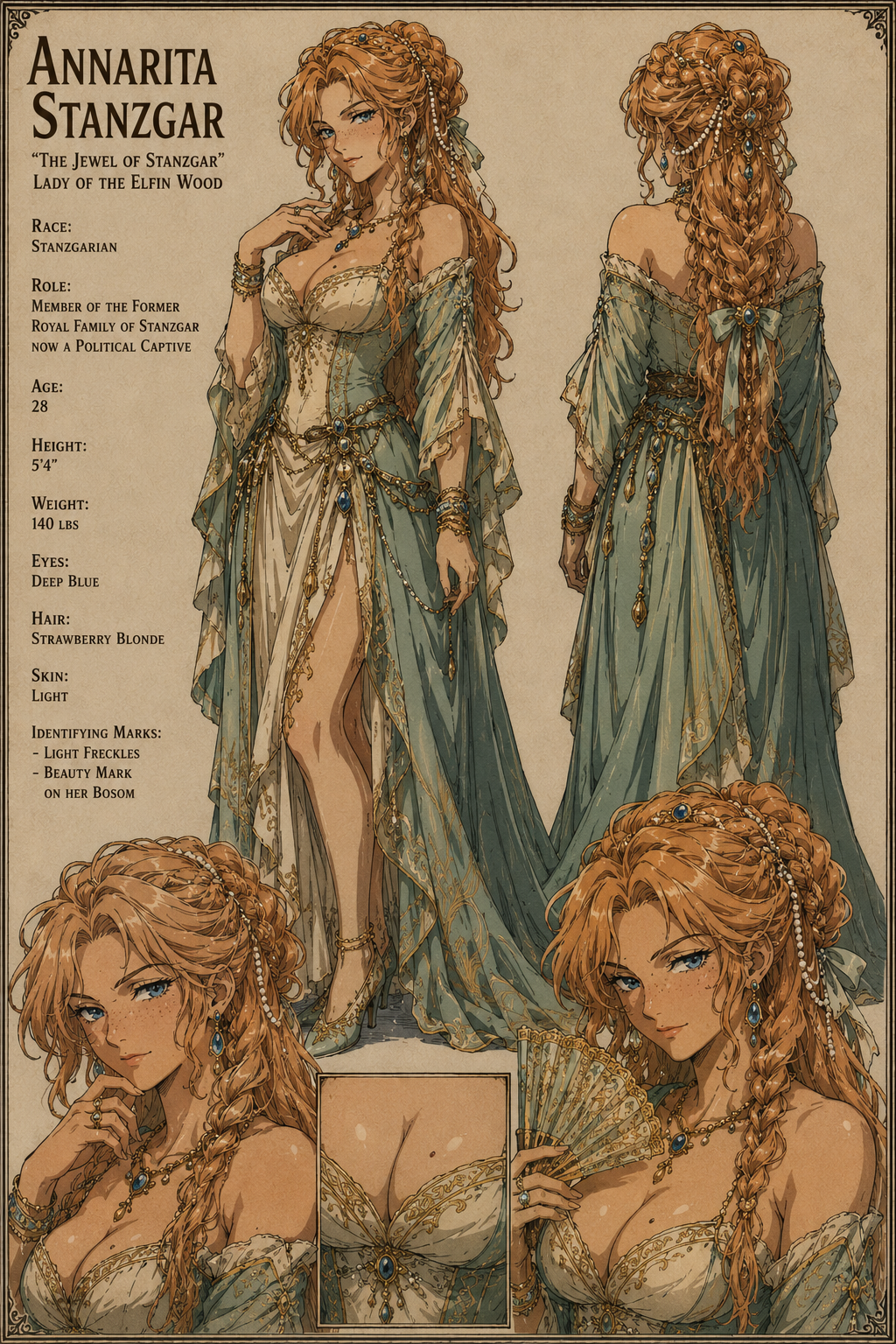


Associations
Other pages that reference or connect to this character
Referenced By
34Michel Drachenbär
Spouses
Michel Drachenbär
Love interests
Balen Stanzgar
Friends
Balen Stanzgar
Siblings
Calia Stanzgar
Friends
Calia Stanzgar
Siblings
Calia Stanzgar
Love interests
Jezabelle Mythrocal Stanzgar
Children
Creena Stanzgar
Friends
Creena Stanzgar
Siblings
Horace Stanzgar
Friends
Horace Stanzgar
Siblings
Jason Stanzgar
Friends
Jason Stanzgar
Siblings
Nendara
Best friends
Nendara
Love interests
Nathaniel Stanzgar
Friends
Nathaniel Stanzgar
Siblings
Philipe Stanzgar
Siblings
Blaine Talakar Mardrein
Friends
Priscilla Stanzgar
Friends
Priscilla Stanzgar
Siblings
Brìde Ceanadach
Friends
Serena Stanzgar
Friends
Serena Stanzgar
Siblings
Tobais Stanzgar
Friends
Tobais Stanzgar
Siblings
Valera Stanzgar
Friends
Valera Stanzgar
Siblings
Zera Stanzgar
Friends
Zera Stanzgar
Siblings
Charles III King of stanzgar
Friends
Charles III King of stanzgar
Children
Lucerza
Friends
Collections
Published collections that feature this character
Not in any collections yet
This character hasn't been published in any collections yet. Collections are curated groups of related content that help organize and showcase your world.
Tip: Collections are a great way to group related content together and share themed stories or worldbuilding elements with others.
Timelines
Timelines that reference or include this character
No timeline connections yet
This character isn't connected to any timelines yet. Timelines help organize events chronologically and show how your content fits into the broader history of your world.
Tip: Create timelines to organize important events in your world's history. Link characters, locations, and other content to specific events to build rich, interconnected narratives.
Shares
Discussion about this character
No shares yet
Be the first to start a discussion about this character by sharing it to the community stream.
Privacy & Sharing
Manage who can see and access this character
Current Status
refresh
This character is currently
Privacy Settings
Choose who can see and access this character
language Universe Privacy
This page belongs to a universe with its own privacy settings