
Categories
Dive Deeper
Page Stats
Navigation
Categories
Dive Deeper
Page Stats
Complete Details
All information about this character
Overview
Charles III King of stanzgar
Charles III, the Last King of Stanzgar, is a weathered and imposing old monarch whose frailty is more performance than truth. At sixty-two, he stands around six feet tall, slightly hunched beneath the weight of age, robes, armor, fur, crown, and paranoia, but the stoop hides a body still far stronger than it should be. His greying hair is slicked back, his long beard falls heavily over his chest, and a scar runs from his left eye down his cheek, marking a face that already looks carved by suspicion, command, and years of hard rule.
His eyes are one of his most unsettling features: once an electric blue, they show the creeping sickly green signs of arcanium poisoning, as though the magic used to preserve and strengthen him is beginning to leak through his humanity. He looks like a king who should be declining, yet when angered or forced into battle, the illusion breaks. The old man beneath the crown is still capable of terrible violence.
Charles dresses with the heavy grandeur of Stanzgarian royalty: layered robes, fur-lined cloaks, armor beneath court finery, geometric ornamentation, and carefully displayed symbols of wealth and authority. He carries himself like a ruler who expects obedience not because it is earned in the moment, but because the world itself ought to recognize his claim. Even when seated, gazing from his throne, he feels watchful and dangerous, as if measuring enemies that may or may not exist.
He is calculating, politically sharp, and sometimes loudly jovial in a way that feels more unsettling than warm. He may speak proudly and enthusiastically about his children’s accomplishments, even while chastising them for undignified behavior, and then drift into outbursts at unseen threats or imagined betrayals. His public manner can shift between fatherly pride, royal command, strategic enthusiasm, and paranoid fury with little warning.
In battle, Charles is not the weakened relic his enemies hoped to find. Calia’s rejuvenation experiments restored and enhanced much of his old strength, allowing him to wield Zorngeprägt, the massive ceremonial greatsword called Tempered Fury by the common people. With that blade in hand, Charles becomes the full contradiction of his final years: an aging king kept unnaturally powerful, wrapped in royal grandeur, burning with ambition, and already being hollowed by the poison of the very magic meant to save him.
Last king of stanzgar
ruiner king
betrayer king
Former king of the Kingdom of Stanzgar
62
Male
Looks
Charles III wears a long, full beard, thick and heavily greying with age. It is one of the most defining parts of his appearance, giving him the grave, old-king presence expected of the last monarch of Stanzgar. The beard falls low over his chest, making him look ancient, dignified, and severe, even though his body is far stronger than his age and posture suggest.
His beard adds to the contradiction of his final years. At first glance, it makes him seem like an aging ruler in decline: weathered, burdened, and perhaps past his prime. But that impression is misleading. Beneath the old beard and hunched royal bearing is a man restored by dangerous magic, still capable of terrible violence and still strong enough to wield Zorngeprägt in battle.
He also has a habit of stroking his beard, especially when thinking, judging, or watching others from his throne. This mannerism makes him appear contemplative and kingly, but as his paranoia worsens, the same gesture can become unsettling: a slow, repetitive motion while his eyes fix on some suspected enemy, real or imagined. His beard is not just a sign of age; it becomes part of his royal mask, hiding the volatility beneath.
Charles III wears his greying hair slicked back, keeping it controlled and away from his face in a style that reinforces his royal severity. It is practical, formal, and deliberate, the kind of grooming expected from a king who wants every part of his appearance to communicate authority. Even as age and arcanium poisoning begin to mark him, his hair remains carefully managed rather than neglected.
The slicked-back style also suits the image of a man trying to hold himself together. Charles is not a wild old king with tangled hair and open madness. He is still disciplined, still proud, still aware of how power must look. His hair helps preserve that image: clean lines, exposed brow, crown set clearly above his face, and nothing softening the intensity of his stare.
In visual terms, the style emphasizes his scar, his electric-blue eyes touched by sickly green, and the hard planes of his weathered face. It makes him look less like a kindly elder and more like a ruler carved into shape by ambition, paranoia, and royal expectation. Even when slightly hunched, Charles looks composed, intentional, and dangerous.
Charles III’s hair is greying, with the original darker or fairer Stanzgarian tones mostly overtaken by age. The grey gives him the unmistakable look of an old king: experienced, weathered, and burdened by decades of rule, war, ambition, and suspicion. It pairs naturally with his long beard, making his whole appearance feel heavy with history.
The greying hair also helps sell the deception of his body. At a glance, Charles appears to be an aging monarch in decline, slightly hunched and marked by time. His hair supports that image, suggesting frailty and late-life deterioration. But this is misleading. Beneath the grey hair and old-king presentation is a man whose strength has been unnaturally restored by Calia’s experiments.
This contrast makes his hair color important. The grey says age, but his body says otherwise. When Charles rises from the throne or takes up Zorngeprägt, the contradiction becomes unsettling: he looks like a man who should be weakening, yet moves with the power of someone far younger and far more dangerous. His greying hair becomes part of the illusion—an old king’s mask stretched over something magic has refused to let fade.
Charles III stands around 6 feet tall, though his slight hunch often makes him appear shorter and more physically diminished than he truly is. At first glance, he can seem like an aging king bent by time, courtly burdens, war, and illness. That impression is useful, but incomplete.
His posture hides the fact that Charles is far from weak. Thanks to Calia’s rejuvenation experiments, his body retains far more strength than a man of sixty-two should reasonably possess. When seated on his throne or moving slowly through the palace, he may appear old, heavy, and worn down. But when he straightens, reaches for a weapon, or erupts into sudden motion, the deception becomes obvious: there is still a dangerous amount of power beneath the stoop.
His height helps preserve his authority even in decline. Six feet places him at the upper end of common Stanzgarian height, giving him a naturally commanding frame without making him monstrous or exaggerated. Combined with his long beard, heavy royal clothing, scarred face, and unnatural vitality, Charles feels like a king who should have faded into old age but refused to let nature take what he still considered his.
Charles III weighs around 190 pounds, giving him a solid but not overly bulky frame. On paper, this is a reasonable weight for a six-foot Stanzgarian man, especially one of royal upbringing who trained in swordsmanship and spent time at the Battle Academy. Visually, however, his posture and age complicate the impression. He appears more frail and hunched than the number suggests, as though the years have folded some of his strength inward.
That appearance is misleading. Calia’s rejuvenation experiments restored and enhanced much of his physical power, meaning Charles carries far more strength than his age, grey hair, and weathered face imply. He may look like an old king in decline when seated beneath robes and furs, but his body is still capable of sudden violence, heavy movement, and the impossible sight of wielding Zorngeprägt one-handed during his final battle.
His weight therefore supports the contradiction at the center of his final years. He is not massive like a brute, nor wasted like a dying elder. He is solid, weathered, and unnaturally preserved: a king whose body should have been surrendering to age, but instead became another weapon in his refusal to let go.
Charles III’s most obvious identifying mark is the scar running from his left eye down his cheek. It cuts through the weathered authority of his face and gives him the look of a man who has not merely ruled from behind walls, but survived violence personally. Combined with his long greying beard, slicked-back hair, and severe expression, the scar makes his face immediately recognizable.
His eyes are another major identifying feature. They are an intense electric blue, but by the time of his death they show the telltale creep of sickly green, a sign of arcanium poisoning either worsening or beginning to recede after Calia’s experiments. That mixture of bright blue and unhealthy green makes his gaze unsettling, especially when he is staring from his throne, watching shadows, or fixing on someone he has decided might be an enemy.
His posture also marks him. Charles appears slightly hunched, giving the impression of age and decline, but this hides a body still far stronger than it should be. Those who mistake the hunch for weakness are likely to misjudge him badly. When he straightens or moves with sudden strength, the contrast becomes disturbing: the old king’s body does not match the old king’s face.
The final identifying detail is the strange contradiction of his whole presence. He looks like a weathered, aging monarch: scarred, greying, bearded, and worn by rule. Yet beneath that is unnatural vitality, paranoia, and dangerous restored strength. Charles III is recognizable not only by one scar or one feature, but by the sense that age has marked him without truly being allowed to claim him.
Charles III appears frail and hunched with age, but that impression is deceptive. At first glance, he looks like an old king whose body has begun to bend under the weight of time, rule, war, illness, and paranoia. His posture is slightly stooped, his movements can seem measured or heavy, and his long greying beard and weathered face make him look like a man approaching the end of his strength.
In truth, Charles is far stronger than he appears. Calia’s arcane rejuvenation experiments restored and enhanced much of his youthful physical power, leaving him with a body that no longer matches the expectations created by his age. Beneath the robes, furs, and royal trappings is a man still capable of sudden violence, hard movement, and frightening strength. The clearest proof is his ability to wield Zorngeprägt, a massive ceremonial greatsword, even one-handed during his final battle.
His body type therefore works best as a contradiction: aged in appearance, dangerous in function. He does not look like a young warrior or a visibly muscular brute. He looks like a king in decline until the moment he moves like someone who is not declining at all. That mismatch makes him unsettling. Charles’s body has the shape of age, but the force of something preserved, sharpened, and made wrong by magic.
Charles III has fair but weathered skin, fitting his Stanzgarian heritage while also showing the strain of age, rule, war, and exposure. His complexion is light, but not soft or untouched. It has the worn quality of a man who has spent decades carrying royal burdens, leading a kingdom through conflict, and refusing to retreat fully into comfortable old age.
His weathering is important because Charles should not look like a pampered palace relic. Even seated on a throne in robes and regalia, his skin carries the marks of a harder life: lines, roughness, old stress, and the scar running from his left eye down his cheek. He looks like a king who has endured, not merely inherited.
The fair tone also makes the signs of arcanium poisoning more visible. The creeping sickly green in his electric-blue eyes would stand out sharply against his pale, aged face, giving him an increasingly unnatural look by the end of his life. His skin helps sell the contradiction of him: an old, weathered king on the surface, but one whose body has been unnaturally strengthened beneath that aging exterior.
Stanzgarian
Charles III’s eyes are a striking electric blue, bright and unusually vivid even in old age. They are one of his most arresting features, carrying a sharp, piercing quality that makes him hard to look away from when his attention settles on someone. In quieter moments, that blue can still suggest intelligence, authority, and the force of the man he once was in his prime.
What makes them especially notable, however, is the sickly green creep beginning to show within them—the telltale sign of arcanium poisoning taking hold, or perhaps in some moments receding under the effects of Calia’s experiments. That green does not fully replace the blue, but intrudes into it, creating an unnatural and unsettling contrast that hints something is wrong beneath the surface.
The result is a gaze that feels both regal and deeply troubling. His eyes can still project command, calculation, and strength, but they also carry the look of a man being altered by forces he chose to embrace. By the end of his life, they would likely be remembered not just as beautiful or intense, but as haunting—the eyes of a king whose power had begun to twist him.
Nature
Charles III sees many of Stanzgar’s neighbors as inferior peoples, useful only when they can be controlled, exploited, or made to kneel. His worldview is deeply imperial and hierarchical: Stanzgar, in his mind, is not merely one power among many, but the rightful center of a restored order. Other peoples may have strength, land, resources, or military value, but he does not truly view them as equals.
He also looks down on many of his supposed allies. To Charles, the rulers of River Road, Edgewood, and other neighboring powers are weak for remaining divided, cautious, or transactional when they could be part of a unified Stanzgarian future. He does not see their independence as legitimate so much as wasteful fragmentation, especially when those lands are tied to his family’s ancestral vision. This makes him willing to use diplomacy, war, or betrayal if he believes it will force history back into the shape he wants.
The dwarves are one of the few peoples he may partly exempt from this contempt, though even that respect is complicated. Charles wants full acceptance into dwarven politics and clearly values dwarven power, craft, artifacts, and legitimacy. He respects them because they possess strength he cannot dismiss, not necessarily because he believes in equality between peoples. In his mind, dwarven approval is something to earn because it would elevate Stanzgar, not because he sees the dwarves as moral peers.
His hatred of Darius Drachenbär is especially personal. Charles despises him not only as a rebel, but because Darius is loved by the people in a way Charles either cannot understand or cannot forgive. To Charles, loyalty should flow from crown, conquest, bloodline, and rightful authority. Darius represents something more dangerous: popular affection, moral outrage, and the possibility that the people might choose a different vision of Stanzgar over their king.
By the end of his life, these prejudices are worsened by paranoia and arcanium poisoning. Charles begins seeing enemies everywhere: foreign peoples, old allies, rebellious nobles, beloved rivals, and even shadows within his own court. His prejudice is therefore not only arrogance; it becomes part of his collapse. He cannot accept that others might oppose him for legitimate reasons. If they resist, they must be weak, lesser, jealous, traitorous, or corrupted. That certainty helps make him the Ruiner King: a ruler so convinced of his right to dominate that he destroys the loyalty he needed most.
Charles III suffers from arcanium poisoning, brought on or worsened by the dangerous magical processes used to preserve and strengthen him. By the time of his death, the condition is visible in his eyes: the original electric blue has begun to show a sickly green creep, marking the intrusion of unstable magic into his body. Whether the poisoning is advancing or partially receding because of Calia’s experiments, the effect is the same: Charles no longer looks entirely untouched by the forces keeping him powerful.
He is also in far better physical shape than a man of his age should be. At sixty-two, he appears hunched, greying, and weathered, but this aging exterior hides a body restored and enhanced by arcane rejuvenation. His strength, endurance, and ability to wield Zorngeprägt—even one-handed in his final battle—make it clear that Calia’s work did more than preserve him. It pushed him past natural decline, though at a serious cost.
The most important added condition is his growing paranoia. By the end of his life, Charles is beginning to see enemies in every shadow. This is partly political, partly psychological, and likely worsened by arcanium poisoning and the strain of magical alteration. His suspicion becomes more than caution. He erupts at unseen threats, distrusts allies, fixates on betrayal, and interprets opposition as weakness, treason, or conspiracy.
So his conditions can be summarized as: arcanium poisoning, unnatural physical rejuvenation, and worsening paranoia. Together, they make him tragic and dangerous: an aging king given back his strength, but not his clarity.
beard stroking, gazing out from his throne, outbursts at no one, will talk enthusiastically about his childCharles III carries himself like a man who has spent decades expecting the room to bend around him. Even when seated, slightly hunched upon his throne, he has a heavy, watchful presence, often gazing outward as if judging not only the people before him, but the future they are failing to deliver. His stillness can feel deliberate and kingly at first, but by the end of his life it becomes more unsettling, as though he is listening for threats no one else can hear.
One of his most recognizable habits is stroking his long beard while thinking, judging, or restraining anger. In calmer moments, the gesture makes him seem contemplative, almost grandfatherly or scholarly. In darker moments, it becomes a warning sign: a slow, repetitive motion paired with electric-blue eyes touched by sickly green, suggesting that his thoughts are turning toward suspicion, punishment, or some imagined betrayal.
He is prone to outbursts at no one, especially as paranoia begins to overtake him. These may come as sudden accusations, half-spoken commands, or angry remarks directed toward empty corners, absent enemies, or threats he believes are forming just beyond sight. The court may learn to endure these moments quietly, pretending not to notice the king arguing with shadows while understanding that the danger is very real if his attention turns toward them.
Despite this, Charles can also become loudly and unsettlingly jovial. He may speak with enthusiasm about war plans, artifacts, old ambitions, or the accomplishments of his children, shifting into genuine paternal pride with surprising warmth. He enjoys boasting about his children’s talents, especially Calia’s brilliance or Balen’s strength, but this pride often comes tangled with criticism. He can praise them in one breath and admonish them for undignified habits in the next, as if affection and royal correction are the same duty.
His manner is therefore full of contradictions: fatherly but severe, jovial but frightening, calculating but increasingly unstable. Charles can appear like a proper old king one moment, a proud parent the next, and then suddenly a paranoid tyrant staring into the dark. The most unsettling thing about him is not that he has lost all control, but that he retains enough control for people to fear what he might decide when the madness and the monarch agree.ren and their accomplishments even while admonishing them for undignified habits
Charles III is driven by the desire to restore and expand the power of Stanzgar, not merely as a kingdom, but as the rightful center of the old Stanzgarian world. He wants to see the original Stanzgarian holdings reunited under his family’s rule, especially Stanzgar, River Road, and Edgewood returned to one country. To Charles, their division is not normal politics; it is historical injury. Reunification is not just ambition to him, but correction.
He is also motivated by expansion northward. Charles wants to return to the North and subjugate the imperial remnants there, reclaiming the dignity and power lost when earlier Stanzgarian armies were pushed back. His fixation on artifacts of power comes from this same desire. He does not want Stanzgar to merely survive among stronger forces; he wants tools, legions, weapons, and magic powerful enough to make Stanzgar impossible to deny.
Full acceptance into dwarven politics is another major goal. Charles respects the dwarves more than most neighboring peoples, partly because their strength, craft, citadels, and ancient authority are too significant to dismiss. Being accepted into their political world would not only benefit Stanzgar materially, but also validate Charles’s vision of his kingdom as a power worthy of standing beside the oldest and strongest forces on the mainland.
On a more personal level, Charles is motivated by legacy. Born the fourth son, he was never meant to be king, and when the crown was thrust upon him, he became determined not to be remembered as an accidental monarch. His wars, artifacts, legions, alliances, betrayals, and experiments all come from the same hunger: to prove that history had not made a mistake by placing the crown on his head.
By the end of his life, these motivations are warped by paranoia, arcanium poisoning, and fear of being overshadowed. His hatred of Darius Drachenbär is not only political; Darius represents the possibility that the people might love a rebel more than their king. Charles wants power, unity, and conquest, but beneath those goals is a wounded need to be obeyed, respected, and remembered as the ruler who made Stanzgar whole again.
Charles III’s greatest flaw is his willingness to win no matter the cost. He is not a careless fool or a simple tyrant; he is politically sharp enough to understand consequences, which makes his worst decisions even more damning. When Charles decides that something is necessary for Stanzgar’s future, he becomes willing to justify almost anything: conquest, betrayal, forced subjugation, dangerous artifacts, magical experimentation, and the sacrifice of trust that a king should have protected.
His betrayal of the orcs shows this clearly. Charles accepted their aid against the Fengalin, then turned on them once they were weakened, choosing to destroy an old enemy, avoid payment, and rewrite the outcome in Stanzgar’s favor. It was a practical decision in the coldest sense, but also one that poisoned his legitimacy. To some, including Darius Drachenbär, it proved that Charles’s vision of Stanzgarian greatness had become rotten at the root.
He is also deeply prejudiced. Charles sees neighboring peoples as inferior, allies as weak, and resistance as something to be crushed rather than understood. The dwarves may be a partial exception, but largely because their power is too great for him to dismiss. This arrogance narrows his judgment. He does not easily recognize when others oppose him out of principle, grief, fear, or legitimate outrage. In his mind, opposition becomes weakness, jealousy, treason, or rebellion against the natural order.
His ambition is made worse by paranoia. By the end of his life, Charles begins seeing enemies in every shadow, and this suspicion corrodes his ability to rule. A cautious king can survive plots; a paranoid king starts creating them by treating everyone as if betrayal is inevitable. His outbursts, fixation on enemies, resentment of Darius’s popularity, and growing distrust all make him more dangerous to the people closest to him.
Another flaw is his dependence on power he does not fully control. His search for artifacts and his willingness to let Calia experiment on his body come from the same desperate impulse: he wants strength badly enough to accept tools that damage him. The rejuvenation restores his body, but at a cost to his mind and humanity. Charles wants to be the king who refuses decline, but that refusal helps turn him into the very kind of ruler people fear enough to overthrow.
His love for his children is also compromised by royal expectation. He can be genuinely proud of them, enthusiastic about their talents, and emotionally attached in his own way, but he still treats them as extensions of dynasty, dignity, and power. He praises them, uses them, admonishes them, and relies on them, often without fully seeing the damage his ambitions are doing to them.
At his worst, Charles III mistakes domination for unity and fear for loyalty. He wants to rebuild Stanzgar, but he cannot accept that a country held together by betrayal, superiority, and forced obedience may already be broken. That is what makes him the Ruiner King: not a weak monarch who failed by accident, but a capable king whose strengths became catastrophic because he believed victory could excuse anything.
Charles III is a capable and dangerous man, even before Calia’s experiments return much of his youthful strength. In his younger days, he was a master swordsman, trained well enough that age alone did not erase the instincts of footwork, timing, balance, and controlled violence. By the time of his final battle, those old skills combine with unnatural rejuvenation, allowing him to wield Zorngeprägt with terrifying effectiveness despite its ceremonial weight.
He is also a competent tactician. Charles understands armies, positioning, pressure, morale, and the use of force as a political tool. His war against the Fengalin may have dragged on without a decisive final break, but it was not because he lacked military understanding. He knew how to sustain campaigns, apply pressure, and use outside intervention when opportunity appeared. His later betrayal of the orcs was monstrous, but it also shows his ability to recognize weakness and act on it ruthlessly.
Politically, Charles is savvy and ambitious. He understands legitimacy, alliances, hereditary claims, old grievances, the importance of artifacts, and the symbolic power of reunification. He knows that Stanzgar, River Road, and Edgewood are not just pieces of land, but parts of a larger historical argument. His talent lies in seeing how military force, royal image, ancient claims, and diplomatic positioning can all be made to serve one vision of restored Stanzgarian greatness.
He can wield magic better than many nobles or soldiers, though not at the level of a true battle mage. His summoning magic and arcane knowledge give him additional tools, especially when combined with artifacts, dwarven craft, and Calia’s research. Charles is not defined by magic the way Calia is, but he understands enough to value it, exploit it, and incorporate it into his rule.
One of his more personal talents is presence. Charles can look like a true old king when he chooses: grand, weathered, commanding, and filled with history. He can be loud and jovial, proud of his children, frightening in anger, and compelling enough to make others believe in the scale of his ambitions. His tragedy is that these talents were real. He had the mind, training, will, and force of personality to be remembered as a great king—but his hunger for victory turned those gifts toward ruin.
Charles III’s hobbies reflect a mind that never fully leaves the throne, even in private. He enjoys memory games, especially the sort that test recall, pattern recognition, sequence, and strategic association. For a king obsessed with history, old claims, military planning, and political positioning, these are not merely idle amusements. They are exercises in control: proof that his mind can still order details, hold names, remember debts, and track enemies across years.
He also enjoys war game simulations, which suit both his military education and his expansionist ambitions. These games allow him to replay old campaigns, test imagined invasions, reconsider lost opportunities, and plan for future wars without immediately committing armies. In healthier years, this may have been a useful royal habit. Later in life, as paranoia worsened, the same simulations likely became darker, more obsessive, and more personal, filled with imagined betrayals, encirclements, and enemies who always had to be outmaneuvered.
Charles also spends time pacing the halls of the palace. This may have begun as ordinary restlessness or a king’s habit of thinking while walking, but near the end of his life it becomes more unsettling. He walks through his own halls like a man patrolling a fortress under siege, listening for threats, revisiting old decisions, and watching the shadows of a kingdom he believes is slipping from his grasp.
His wife, Jezabelle Mythrocal Stanzgar, is listed among his hobbies in a way that suggests genuine affection, attachment, and private comfort. For all his ambition and cruelty, Charles does seem to love his family in his own warped fashion, and Jezabelle may be one of the few people who can still pull him toward warmth rather than suspicion. Time with her is likely one of the few indulgences that is not directly about conquest, statecraft, or legacy.
Taken together, Charles’s hobbies reveal a king who cannot truly rest. Even his games are about memory, war, planning, and control. His private life has moments of affection and simplicity, but his mind is always circling power, enemies, history, and the fear that if he stops moving, Stanzgar itself will slip beyond his reach.
Charles III is calculating, commanding, and increasingly unstable, with a loud and sometimes jovial manner that becomes more unsettling the longer one spends around him. He is not cold in the quiet, emotionless sense. He can laugh, boast, praise his children, speak with enthusiasm, and fill a room with the force of his personality. The problem is that his warmth never feels entirely safe. His good humor can turn toward accusation, suspicion, or royal fury with little warning.
At his best, Charles is a capable ruler with a strategic mind, strong memory, real political instinct, and an ability to think in terms of history rather than merely the present moment. He sees claims, alliances, old borders, military strength, and symbolic legitimacy as pieces of one larger board. He is not stupid, nor is he merely mad. His danger comes from the fact that his ambitions are backed by real intelligence and the will to act on them.
He also has a powerful paternal streak, though it is tangled with dynasty and expectation. Charles can speak proudly of his children’s accomplishments, sometimes with genuine affection, but he still sees them as part of the royal project: heirs, tools, symbols, weapons, and continuations of his house. He loves them, but he does not always separate love from usefulness, dignity, or obedience.
As arcanium poisoning, age, stress, and Calia’s experiments take their toll, Charles becomes increasingly paranoid. He begins to see enemies everywhere: in neighboring peoples, old allies, rebels, popular rivals, and even shadows in his own palace. This does not erase his intelligence; it corrupts it. His mind still draws connections, but more and more of those connections lead to betrayal.
Charles’s personality is therefore a dangerous mixture of kingly grandeur, family pride, strategic brilliance, imperial arrogance, and unraveling suspicion. He can seem like a jovial old monarch one moment and the Ruiner King the next: a man who wanted to restore Stanzgar so badly that he stopped noticing how much of it he was destroying.
Social
Charles III’s favorite food is simple, hearty stew, despite his wife’s insistence that he should enjoy the full breadth of the palace kitchens and their staff. For a king with access to rare ingredients, refined dishes, imported delicacies, and formal feasts, his private preference is surprisingly plain. When he is not hosting a party, banquet, or official meal, Charles would rather eat something warm, filling, and almost peasant-like than be surrounded by elaborate court cuisine.
This preference says something important about him. Charles is ambitious, proud, and grand in his politics, but his personal tastes are not always ornamental. A thick stew of meat, rice or grain, river vegetables, broth, and heavy seasoning would appeal to him because it is direct, nourishing, and practical. It is food that sustains rather than performs.
There is also a nostalgic quality to it. Simple stew may remind him of military camps, younger years, hunting lodges, Battle Academy meals, or the older Stanzgarian idea that strength is built from plain things used well. It fits the part of Charles that sees himself not merely as a palace king, but as a ruler forged by discipline, war, and hard necessity.
At court, he may tolerate rich dishes, ceremonial courses, and the grand meals expected of royalty. In private, however, Charles prefers a bowl of honest stew: hot, heavy, familiar, and without pretense. For a man whose reign became tangled in betrayal, paranoia, artifacts, and unnatural power, there is something almost tragic in the simplicity of that preference.
Charles III’s favorite animal is the salamander, though in his case this refers not to an ordinary lizard, but to a fire-aligned elemental creature. It is a fitting choice for him: dangerous, enduring, difficult to truly tame, and closely associated with heat, destruction, and controlled power. Charles is not drawn to gentle or comforting creatures. He admires things that can survive fire, wield it, and make others respect the danger they represent.
The salamander also reflects the image Charles wants for himself as king. Like a fire elemental, he sees himself as a force meant to burn weakness away, harden what remains, and reshape the world through pressure. This connects naturally to his ambitions for Stanzgar: reunification, conquest, northern expansion, and the subjugation of enemies he considers lesser or disloyal. To Charles, power is not valuable because it is safe. It is valuable because it can be directed.
Its symbolism also pairs strongly with Zorngeprägt. The greatsword’s burning edge, magma-like coating, and fire-born magical effects make the salamander feel almost like the living counterpart to his favored weapon. Both represent heat under command, old magic, and the dangerous belief that destructive forces can be mastered by will alone.
There is a darker irony in the choice. Charles admires the salamander because it embodies controlled fire, but his reign proves that not all fire remains controlled. His hunger for artifacts, conquest, arcane rejuvenation, and military dominance eventually burns away the loyalty and legitimacy he needed most. The salamander is therefore not just his favorite creature; it is a quiet symbol of the king himself: powerful, radiant, dangerous, and never as containable as he believed.
Charles III’s favorite weapon is Zorngeprägt, a massive single-edged greatsword also called Tempered Fury by the common people. Though originally meant to be ceremonial, it is far more than a symbol of kingship. Forged from orichalcum, silver inlay, and the same arcane-canceling substance used in mage slayers, Zorngeprägt is one of the most dangerous and mysterious blades associated with the Stanzgarian royal line.
The weapon suits Charles perfectly because it embodies the contradictions of his reign. It is royal, ancient, beautifully crafted, and ceremonial in origin, but also brutally destructive when wielded. Its single edge can heat to such extreme temperatures that it forms a magma-like coating, allowing it to cut through armor and structures with terrifying ease. At the same time, the geometric patterns pressed into the sides of the blade pulse with arcane-canceling power, letting its wielder block, repel, or even cut through spells and defensive enchantments.
For Charles, Zorngeprägt is not merely a weapon; it is proof of the kind of power he believes Stanzgar should command. It carries dwarven legacy, ancient unity, primal magic, anti-magic force, and royal authority all in one object. A lesser king might keep such a blade mounted above a throne as a relic. Charles wants to wield it, master it, and make it answer his will.
Its weight also matters. At nearly fifteen pounds, Zorngeprägt is far too heavy to be a practical battlefield sword for most people, which makes Charles’s use of it especially striking. During his final battle, after Calia’s experiments restored much of his strength, he was able to wield the blade one-handed. That image captures his final years perfectly: an old king made unnaturally powerful, standing with a ceremonial weapon that had become terrifyingly real.
Zorngeprägt is the ideal favorite weapon for Charles because it is not subtle, humble, or safe. It is heat, fury, history, royal legitimacy, dwarven mystery, and anti-magic violence bound into steel. Like Charles himself, it was meant to symbolize unity and authority, but in his hands it became a weapon of ruin.
Charles III’s favorite possession is a necklace handmade by his children for one of his birthdays. It is not richly adorned, not expertly crafted, and not the sort of object a king would normally display as a treasure of the royal house. In fact, it looks somewhat silly: uneven, sentimental, and clearly made by children rather than jewelers.
That is exactly why it matters to him.
For all his ambition, cruelty, paranoia, and obsession with Stanzgarian greatness, Charles does genuinely love his family in his own flawed and possessive way. The necklace reminds him of his children not as heirs, political tools, disappointments, weapons, or extensions of dynasty, but as children who once made something for their father because they loved him. It belongs to a softer version of his life, before rebellion, betrayal, arcanium poisoning, and the collapse of everything he tried to build.
The contrast is important. Charles possesses royal regalia, artifacts of power, military symbols, and Zorngeprägt itself, but his favorite possession is not the grandest or most useful thing he owns. It is small, personal, and almost embarrassingly plain. That makes it one of the few objects capable of reaching the man beneath the king.
He likely keeps it private rather than wearing it openly at court. Publicly, it would seem undignified, maybe even ridiculous. Privately, it is precious. In a life increasingly consumed by conquest, paranoia, and the need to appear unbreakable, the necklace is proof that Charles was once simply a father, and that some part of him still wants to believe that mattered.
Charles III’s favorite color is yellow, a choice that fits both the older warmth of the man he once was and the harsher brilliance of the king he became. Yellow can be cheerful, familial, and almost humble when tied to candlelight, harvest grain, simple food, children’s gifts, and warm palace rooms. That side of the color suits the Charles who loved his wife, spoke proudly of his children, and privately preferred hearty stew over elaborate royal cuisine.
But yellow also has a sharper meaning for him. It is the color of gold, royal light, banners, old claims, and power made visible. For a king obsessed with restoring Stanzgar’s ancestral holdings and proving his reign worthy of history, yellow carries the feeling of legitimacy and wealth without being as soft as pure gold ornamentation. It is bright enough to demand attention and warm enough to disguise ambition as grandeur.
There is also an unsettling edge to it by the end of his life. Against his fair, weathered skin, greying hair, electric-blue eyes, and the sickly green creep of arcanium poisoning, yellow can begin to feel feverish rather than warm. It becomes the color of candlelit paranoia, old maps under lamplight, heated metal, and a king pacing palace halls while imagining enemies in every shadow.
For Charles, yellow is therefore both warmth and warning. It reflects the father, the king, the builder of legacy, and the man whose desire to make Stanzgar shine eventually burned too hot.
Charles III’s occupation is King of Stanzgar, though his reign is defined less by simple rulership and more by ambition, expansion, and eventual ruin. He was not born expecting the throne, but after the deaths of his older brothers, the crown fell to him and transformed him from a lesser royal son into the central figure of Stanzgarian power.
As king, Charles was responsible for ruling the Kingdom of Stanzgar, managing noble factions, directing military policy, maintaining alliances, and pursuing the interests of his royal house. He understood the office seriously, but his understanding of kingship was aggressive and expansionist. To him, a king was not merely a caretaker of inherited lands. A king was supposed to restore, strengthen, conquer, and correct history.
Much of his reign was spent chasing that vision. He sought artifacts of power, strengthened his legions, pushed toward the reunification of Stanzgar’s ancestral holdings, and waged war beyond Edgewood. His rule became increasingly tied to military ambition, dwarven recognition, magical weapons, and the belief that Stanzgar could become a mainland power great enough to force its rivals and neighbors into submission.
By the end of his life, the title of king had become inseparable from his decline. Charles was still ruler in name and force, but paranoia, arcanium poisoning, rebellion, and his own willingness to win at any cost had hollowed the office around him. He remained King of Stanzgar until his death, but history remembers him more bitterly as the Last King, the Ruiner King, and the Betrayer King: a monarch who tried to make Stanzgar whole, and instead helped break it.
Charles III’s politics are built around expansion, reunification, and royal supremacy. He wants to see the Kingdom of Stanzgar restored to what he considers its rightful historical shape, with Stanzgar, River Road, and Edgewood reunited under one crown. To him, these lands do not represent separate political futures so much as broken pieces of an older whole. Their independence feels like an error of history that a strong king should correct.
He is not a ruler who believes in balance between equal neighbors. Charles sees nearby peoples and rival states as weaker, lesser, or misguided for remaining outside Stanzgarian control. Alliances are useful, but only so long as they serve Stanzgar’s rise. When allies become inconvenient, costly, or weakened enough to exploit, Charles is willing to turn on them if he believes the gain is worth it. His betrayal of the orcs after the Fengalin war is the clearest example of this: he saw a chance to destroy an old enemy, avoid paying the promised price, and expand Stanzgar’s power all at once.
His politics are also deeply tied to legitimacy. Because he was born the fourth son and never expected to inherit the throne, Charles seems determined to prove that history was right to make him king. He wants artifacts, legions, dwarven recognition, northern campaigns, and conquered enemies because all of them would prove that his reign was not accidental or lesser. He wants Stanzgar to become undeniable, and himself with it.
Over time, this ambition curdles into paranoia. By the end of his life, Charles sees enemies everywhere: rebels, weak allies, foreign peoples, rival claimants, popular figures like Darius Drachenbär, and shadows within his own palace. Politically, he becomes less able to distinguish caution from betrayal or disagreement from treason. He still thinks strategically, but his judgment is increasingly poisoned by fear and suspicion.
In the end, Charles’s politics are the politics of a king who mistakes domination for unity. He wants one Stanzgar, strong and whole, but he is willing to burn trust, break alliances, and force obedience to create it. That is why history remembers him not only as the Last King of Stanzgar, but as the Ruiner King and Betrayer King: a monarch whose dream of reunification helped destroy the very kingdom he meant to glorify.
Charles III worships the Stanzgarian pantheon through the Church of the One, as expected of a king of Stanzgar. His faith is formal, royal, and deeply tied to legitimacy. He acknowledges the gods as active powers within the world and participates in the rites, ceremonies, offerings, and public observances required of his station. For Charles, religion is not merely private belief; it is part of kingship, order, and the structure that holds Stanzgarian civilization together.
His worship is likely practical rather than humble. Charles does not approach the gods as a meek servant seeking comfort. He treats divine power much the way he treats political power, ancient artifacts, dwarven recognition, and military force: as something real, dangerous, and necessary to respect, but also something that must be understood and positioned correctly. The gods are not ignored, because ignoring them would be foolish. They are honored because proper reverence helps preserve balance, legitimacy, and royal authority.
This fits the Stanzgarian religious mindset well. The Church of the One does not demand exclusive devotion to a single deity, but structured acknowledgment of the pantheon as a unified divine order. Charles would observe that structure because it reinforces the idea that power must be organized, named, and placed within hierarchy. A king who honors the full pantheon presents himself as a ruler standing within the proper order of the world.
By the end of his life, however, Charles’s religion likely becomes strained by paranoia and ambition. He may still perform the rites and speak the proper words, but his hunger for artifacts, arcane rejuvenation, conquest, and restored greatness pushes him toward a dangerous belief that divine order and royal will should align because he is the rightful king. In that sense, his faith does not soften him. It becomes another pillar supporting his certainty that Stanzgar was meant to rise, and that he was meant to force history back into its proper shape.
Charles III’s job is King of Stanzgar, the ruler of the old Kingdom of Stanzgar and the last monarch to hold that title before Darius Drachenbär’s rebellion ended the line’s rule. His position placed him at the center of royal authority, military command, diplomacy, succession, law, court politics, and the long-standing ambitions of the Stanzgarian royal family.
In practice, Charles treated kingship as an active and expansionist duty. He was not content to merely maintain the kingdom he inherited. He sought artifacts of power, strengthened his legions, pursued greater acceptance among the dwarves, planned for northern campaigns, and pushed toward the reunification of the old Stanzgarian holdings: Stanzgar, River Road, and Edgewood. To him, being king meant restoring what had been divided and forcing Stanzgar back into greatness.
His job also made him the face of every decision that later destroyed his legacy. The war against the Fengalin, the alliance with the orcs, the betrayal that followed, the increasing dependence on Calia’s magical innovations, and the brutality that pushed Darius Drachenbär into rebellion all became part of his reign. Charles ruled with intelligence and force, but also with arrogance, prejudice, and an increasing willingness to treat victory as justification.
By the end, his job as king had become inseparable from his titles as Last King, Ruiner King, and Betrayer King. He remained ruler until his death, but the office had curdled around him. Charles III’s job was to preserve and strengthen Stanzgar; his tragedy is that he pursued that duty so ruthlessly that he helped bring the kingdom he loved to its end.
History
Charles III was born in late spring, a fitting season for a king whose life began far from the throne but eventually grew into ambition, expansion, and ruin. Late spring carries the feeling of rising warmth, open roads, military musters, fresh growth, and the promise of harvest still ahead. It suits the younger Charles especially: not yet the old paranoid monarch, but a fourth son with a future that seemed useful, comfortable, and politically important without necessarily being central to history.
His birthday likely became more significant after he unexpectedly inherited the crown. As king, it would have been marked by formal court observances, gifts, feasts, religious acknowledgment, and political theater. Nobles would use the occasion to display loyalty, secure favor, or remind him of their usefulness. Charles, being politically sharp, would understand all of that perfectly. A royal birthday is never only a celebration; it is also a measurement of power.
In private, though, Charles may have preferred something simpler. His favorite possession—a handmade necklace from his children—suggests that birthdays mattered most to him when they touched the father beneath the king. The grand feasts and ceremonial gifts belonged to the crown, but a silly, imperfect present from his children could reach something more personal.
Late spring also has a tragic edge for him. It is a season of growth before overgrowth, promise before heat, and ambition before consequence. Charles’s life followed a similar pattern: what began as renewal and possibility eventually hardened into conquest, paranoia, and collapse.
Charles III was born in the city of Stanzgar, in the Stanzgar River Valley, as the fourth son of the Stanzgar royal line. In his youth, it seemed unlikely that he would ever take the throne. He was royal, educated, and politically useful, but not expected to become the central figure of his house. His marriage to Jezabelle Mythrocal of the River Lands was arranged as a political alliance, and by most expectations, Charles and Jezabelle might have lived comfortably as important but secondary members of the royal family.
For a time, that life suited him. Charles was well educated, trained at the Battle Academy, and developed into a capable swordsman, tactician, and political thinker. His marriage to Jezabelle also seems to have become more than a dry arrangement; the two were genuinely attached, and Charles’s later affection for his children suggests that family remained one of the few soft places in an otherwise hardening life.
That future changed when his older brothers were lost to disease and war. The crown, once distant, was suddenly thrust onto him, and Charles became Charles III, King of Stanzgar. Whether from insecurity, ambition, duty, or the need to prove that history had not made a mistake, Charles threw himself into kingship with intensity. He wanted Stanzgar to be more than secure. He wanted it restored, expanded, and recognized as a dominant mainland power.
To achieve this, Charles spent years seeking artifacts of power like those that had once driven Stanzgarian armies out of the north. He strengthened his legions, pursued magical and military advantage, and became increasingly obsessed with tools that could make Stanzgar impossible to challenge. This eventually led him into war against the Fengalin beyond Edgewood. The war dragged on for years, with Stanzgar neither truly losing nor gaining the decisive victory Charles needed to break Fengalin resistance.
When the orcish war machine to the south offered aid in exchange for a portion of conquered lands, Charles accepted. The orcs threw themselves into the conflict and helped shift the war’s outcome, but their own strength was badly depleted in the process. Charles then saw an opportunity. Rather than honor the agreement, he marched his armies into orcish lands after the Fengalin’s defeat, both to avoid paying the promised price and to crush an old enemy while they were weakened. This betrayal gave him victory, but it also poisoned his reputation and created the moral wound that would later help fuel rebellion.
Among those horrified by Charles’s actions was Darius Drachenbär, whose rebellion would eventually bring the old kingdom down. As unrest grew, Charles’s health and judgment began to weaken with age, pressure, and arcanium poisoning. Desperate to preserve his strength, he allowed his daughter Calia Stanzgar to perform arcane rejuvenation experiments on his body. These restored and even enhanced much of his physical power, but at the cost of worsening his paranoia and loosening his grip on sanity.
By the time Darius led his famous assault on the palace, he did not find a feeble old king waiting to die. He found Charles unnaturally restored, still dangerous, and capable of wielding Zorngeprägt one-handed despite its tremendous ceremonial weight. Their final battle lasted nearly thirty minutes, with Darius barely prevailing through clever tactics and overwhelming numbers rather than simple superiority.
Charles died at sixty-two, remembered not as the unlikely fourth son who rose to the throne, nor only as the father who treasured a silly necklace made by his children, but as the Last King of Stanzgar, the Ruiner King, and the Betrayer King. His reign began with the possibility of restoration, but ended in rebellion, blood, betrayal, and the collapse of the kingdom he had tried so ruthlessly to make whole.
Charles III was very well educated, as expected of a royal son of the Stanzgar line, even one not originally expected to inherit the throne. As the fourth son, his education was likely designed to make him useful to the dynasty rather than prepare him directly for kingship: diplomacy, law, history, languages, court etiquette, military theory, noble politics, and the practical workings of Stanzgarian power. He was not raised as an idle prince. He was raised to serve the house, strengthen its alliances, and understand the machinery of rule.
He also spent time at the Battle Academy, which shaped him beyond ordinary court learning. There, Charles would have studied tactics, command, logistics, battlefield discipline, and the use of organized force. His later competence as a tactician and his skill as a swordsman both fit this background. Even before becoming king, he understood war not simply as violence, but as a tool of policy, pressure, and historical correction.
His education also included languages and cultural knowledge, especially Stanzgarian, Dwarvish, Forislar, and Talaran. This gave him the ability to deal with neighboring peoples, foreign powers, and the dwarves whose recognition he deeply desired. His interest in artifacts of power, old northern defeats, and dwarven politics suggests that he was also historically literate and aware of the symbolic weight behind ancient weapons, lost claims, and old alliances.
What makes Charles dangerous is that he was educated enough to know exactly what he was doing. His worst decisions did not come from ignorance. He understood treaties, legitimacy, military risk, political optics, and the consequences of betrayal. When he turned on the orcs, pursued artifacts, and allowed Calia to experiment on his body, he was not acting as an untrained fool. He was a learned, capable king who convinced himself that knowledge and necessity justified almost anything.
In the end, Charles’s education gave him the tools to become either a strong restorer or a catastrophic ruler. He had the learning, discipline, tactical training, and political awareness to guide Stanzgar wisely. But because that education was joined to ambition, prejudice, paranoia, and a willingness to win at any cost, it helped make him something far worse: a king who understood power well enough to misuse it brilliantly.
Family
Charles III keeps a battle-trained gryphon and a small combat-trained gargoyle, both of which suit him far better than ordinary royal pets would. These are not soft companion animals kept for comfort or decoration. They are living symbols of status, danger, control, and martial power, exactly the kind of creatures a king like Charles would value.
The gryphon is the more publicly impressive of the two. A battle-trained gryphon carries obvious royal weight: it suggests wealth, military prestige, dominance over dangerous beasts, and the ability to command something most people would fear. For Charles, owning such a creature reinforces the image of a king who does not merely sit behind walls, but surrounds himself with power that can take the field.
The gargoyle is smaller, but perhaps more telling. A combat-trained gargoyle feels like a palace creature: watchful, hard to read, useful in enclosed spaces, and well suited to guarding halls, chambers, rooftops, or hidden approaches. It fits Charles’s later paranoia especially well. As he begins to see enemies in every shadow, a small stone-like protector that can wait silently nearby would become more than a pet. It would be reassurance made animate.
Together, these creatures reflect Charles’s relationship with the world around him. He favors beings that are loyal, useful, dangerous, and difficult for ordinary people to control. Even his pets are extensions of kingship and suspicion: one suited to war and royal display, the other to vigilance and defense. Like much of Charles’s life, they are affection filtered through power.
Inventory
Notes
Charles III’s listed age, sixty-two, is his age at the time of his death. By that point, he appeared to be an aging, weathered, increasingly paranoid monarch, but his body was no longer aging in an entirely natural way. He had allowed his daughter Calia Stanzgar to experiment on him, using arcane rejuvenation to restore much of the physical strength of his youth and possibly push him beyond what he had been capable of even in earlier life.
The cost of this restoration was significant. Calia’s experiments helped return Charles’s strength, endurance, and ability to fight, but they also contributed to minor sanity slippage and worsened the instability already growing in him. By the end of his life, he was beginning to see enemies in every shadow, suffering from arcanium poisoning, and becoming increasingly ruled by suspicion. This makes his final battle with Darius Drachenbär especially important: Darius did not find a frail old king waiting to die, but a magically restored monarch still capable of terrifying violence.
Charles III and Jezabelle Mythrocal Stanzgar had twenty-two children in total, though only thirteen are listed among the surviving children tied to his profile. Of those twenty-two, nine died: six during the rebellion, one in infancy, and two from disease. This heavy loss should color the Stanzgar royal family’s history. Charles was not only a king who lost his throne; he was a father who watched a large royal household be broken by illness, war, and political collapse.
His love for his children should remain part of his characterization, even though it is tangled with dynasty, pride, and expectation. The handmade necklace they gave him for one of his birthdays matters because it shows that beneath the titles Last King, Ruiner King, and Betrayer King, there was still a man who valued his family in a personal way. That does not soften his crimes, but it makes him more tragic and more human.
Charles’s final image should always carry this contradiction: an aging king who should have been weakening, restored by his daughter’s dangerous magic; a father who loved his children, yet used their talents in ways that helped ruin them; a monarch who wanted to reunify and strengthen Stanzgar, but whose paranoia, prejudice, and willingness to win at any cost helped bring the old kingdom to its end.
Overview
Details about this character's overview
Charles III King of stanzgar
Charles III, the Last King of Stanzgar, is a weathered and imposing old monarch whose frailty is more performance than truth. At sixty-two, he stands around six feet tall, slightly hunched beneath the weight of age, robes, armor, fur, crown, and paranoia, but the stoop hides a body still far stronger than it should be. His greying hair is slicked back, his long beard falls heavily over his chest, and a scar runs from his left eye down his cheek, marking a face that already looks carved by suspicion, command, and years of hard rule.
His eyes are one of his most unsettling features: once an electric blue, they show the creeping sickly green signs of arcanium poisoning, as though the magic used to preserve and strengthen him is beginning to leak through his humanity. He looks like a king who should be declining, yet when angered or forced into battle, the illusion breaks. The old man beneath the crown is still capable of terrible violence.
Charles dresses with the heavy grandeur of Stanzgarian royalty: layered robes, fur-lined cloaks, armor beneath court finery, geometric ornamentation, and carefully displayed symbols of wealth and authority. He carries himself like a ruler who expects obedience not because it is earned in the moment, but because the world itself ought to recognize his claim. Even when seated, gazing from his throne, he feels watchful and dangerous, as if measuring enemies that may or may not exist.
He is calculating, politically sharp, and sometimes loudly jovial in a way that feels more unsettling than warm. He may speak proudly and enthusiastically about his children’s accomplishments, even while chastising them for undignified behavior, and then drift into outbursts at unseen threats or imagined betrayals. His public manner can shift between fatherly pride, royal command, strategic enthusiasm, and paranoid fury with little warning.
In battle, Charles is not the weakened relic his enemies hoped to find. Calia’s rejuvenation experiments restored and enhanced much of his old strength, allowing him to wield Zorngeprägt, the massive ceremonial greatsword called Tempered Fury by the common people. With that blade in hand, Charles becomes the full contradiction of his final years: an aging king kept unnaturally powerful, wrapped in royal grandeur, burning with ambition, and already being hollowed by the poison of the very magic meant to save him.
Last king of stanzgar
ruiner king
betrayer king
Former king of the Kingdom of Stanzgar
62
Male
Looks
Details about this character's looks
Charles III wears a long, full beard, thick and heavily greying with age. It is one of the most defining parts of his appearance, giving him the grave, old-king presence expected of the last monarch of Stanzgar. The beard falls low over his chest, making him look ancient, dignified, and severe, even though his body is far stronger than his age and posture suggest.
His beard adds to the contradiction of his final years. At first glance, it makes him seem like an aging ruler in decline: weathered, burdened, and perhaps past his prime. But that impression is misleading. Beneath the old beard and hunched royal bearing is a man restored by dangerous magic, still capable of terrible violence and still strong enough to wield Zorngeprägt in battle.
He also has a habit of stroking his beard, especially when thinking, judging, or watching others from his throne. This mannerism makes him appear contemplative and kingly, but as his paranoia worsens, the same gesture can become unsettling: a slow, repetitive motion while his eyes fix on some suspected enemy, real or imagined. His beard is not just a sign of age; it becomes part of his royal mask, hiding the volatility beneath.
Charles III wears his greying hair slicked back, keeping it controlled and away from his face in a style that reinforces his royal severity. It is practical, formal, and deliberate, the kind of grooming expected from a king who wants every part of his appearance to communicate authority. Even as age and arcanium poisoning begin to mark him, his hair remains carefully managed rather than neglected.
The slicked-back style also suits the image of a man trying to hold himself together. Charles is not a wild old king with tangled hair and open madness. He is still disciplined, still proud, still aware of how power must look. His hair helps preserve that image: clean lines, exposed brow, crown set clearly above his face, and nothing softening the intensity of his stare.
In visual terms, the style emphasizes his scar, his electric-blue eyes touched by sickly green, and the hard planes of his weathered face. It makes him look less like a kindly elder and more like a ruler carved into shape by ambition, paranoia, and royal expectation. Even when slightly hunched, Charles looks composed, intentional, and dangerous.
Charles III’s hair is greying, with the original darker or fairer Stanzgarian tones mostly overtaken by age. The grey gives him the unmistakable look of an old king: experienced, weathered, and burdened by decades of rule, war, ambition, and suspicion. It pairs naturally with his long beard, making his whole appearance feel heavy with history.
The greying hair also helps sell the deception of his body. At a glance, Charles appears to be an aging monarch in decline, slightly hunched and marked by time. His hair supports that image, suggesting frailty and late-life deterioration. But this is misleading. Beneath the grey hair and old-king presentation is a man whose strength has been unnaturally restored by Calia’s experiments.
This contrast makes his hair color important. The grey says age, but his body says otherwise. When Charles rises from the throne or takes up Zorngeprägt, the contradiction becomes unsettling: he looks like a man who should be weakening, yet moves with the power of someone far younger and far more dangerous. His greying hair becomes part of the illusion—an old king’s mask stretched over something magic has refused to let fade.
Charles III stands around 6 feet tall, though his slight hunch often makes him appear shorter and more physically diminished than he truly is. At first glance, he can seem like an aging king bent by time, courtly burdens, war, and illness. That impression is useful, but incomplete.
His posture hides the fact that Charles is far from weak. Thanks to Calia’s rejuvenation experiments, his body retains far more strength than a man of sixty-two should reasonably possess. When seated on his throne or moving slowly through the palace, he may appear old, heavy, and worn down. But when he straightens, reaches for a weapon, or erupts into sudden motion, the deception becomes obvious: there is still a dangerous amount of power beneath the stoop.
His height helps preserve his authority even in decline. Six feet places him at the upper end of common Stanzgarian height, giving him a naturally commanding frame without making him monstrous or exaggerated. Combined with his long beard, heavy royal clothing, scarred face, and unnatural vitality, Charles feels like a king who should have faded into old age but refused to let nature take what he still considered his.
Charles III weighs around 190 pounds, giving him a solid but not overly bulky frame. On paper, this is a reasonable weight for a six-foot Stanzgarian man, especially one of royal upbringing who trained in swordsmanship and spent time at the Battle Academy. Visually, however, his posture and age complicate the impression. He appears more frail and hunched than the number suggests, as though the years have folded some of his strength inward.
That appearance is misleading. Calia’s rejuvenation experiments restored and enhanced much of his physical power, meaning Charles carries far more strength than his age, grey hair, and weathered face imply. He may look like an old king in decline when seated beneath robes and furs, but his body is still capable of sudden violence, heavy movement, and the impossible sight of wielding Zorngeprägt one-handed during his final battle.
His weight therefore supports the contradiction at the center of his final years. He is not massive like a brute, nor wasted like a dying elder. He is solid, weathered, and unnaturally preserved: a king whose body should have been surrendering to age, but instead became another weapon in his refusal to let go.
Charles III’s most obvious identifying mark is the scar running from his left eye down his cheek. It cuts through the weathered authority of his face and gives him the look of a man who has not merely ruled from behind walls, but survived violence personally. Combined with his long greying beard, slicked-back hair, and severe expression, the scar makes his face immediately recognizable.
His eyes are another major identifying feature. They are an intense electric blue, but by the time of his death they show the telltale creep of sickly green, a sign of arcanium poisoning either worsening or beginning to recede after Calia’s experiments. That mixture of bright blue and unhealthy green makes his gaze unsettling, especially when he is staring from his throne, watching shadows, or fixing on someone he has decided might be an enemy.
His posture also marks him. Charles appears slightly hunched, giving the impression of age and decline, but this hides a body still far stronger than it should be. Those who mistake the hunch for weakness are likely to misjudge him badly. When he straightens or moves with sudden strength, the contrast becomes disturbing: the old king’s body does not match the old king’s face.
The final identifying detail is the strange contradiction of his whole presence. He looks like a weathered, aging monarch: scarred, greying, bearded, and worn by rule. Yet beneath that is unnatural vitality, paranoia, and dangerous restored strength. Charles III is recognizable not only by one scar or one feature, but by the sense that age has marked him without truly being allowed to claim him.
Charles III appears frail and hunched with age, but that impression is deceptive. At first glance, he looks like an old king whose body has begun to bend under the weight of time, rule, war, illness, and paranoia. His posture is slightly stooped, his movements can seem measured or heavy, and his long greying beard and weathered face make him look like a man approaching the end of his strength.
In truth, Charles is far stronger than he appears. Calia’s arcane rejuvenation experiments restored and enhanced much of his youthful physical power, leaving him with a body that no longer matches the expectations created by his age. Beneath the robes, furs, and royal trappings is a man still capable of sudden violence, hard movement, and frightening strength. The clearest proof is his ability to wield Zorngeprägt, a massive ceremonial greatsword, even one-handed during his final battle.
His body type therefore works best as a contradiction: aged in appearance, dangerous in function. He does not look like a young warrior or a visibly muscular brute. He looks like a king in decline until the moment he moves like someone who is not declining at all. That mismatch makes him unsettling. Charles’s body has the shape of age, but the force of something preserved, sharpened, and made wrong by magic.
Charles III has fair but weathered skin, fitting his Stanzgarian heritage while also showing the strain of age, rule, war, and exposure. His complexion is light, but not soft or untouched. It has the worn quality of a man who has spent decades carrying royal burdens, leading a kingdom through conflict, and refusing to retreat fully into comfortable old age.
His weathering is important because Charles should not look like a pampered palace relic. Even seated on a throne in robes and regalia, his skin carries the marks of a harder life: lines, roughness, old stress, and the scar running from his left eye down his cheek. He looks like a king who has endured, not merely inherited.
The fair tone also makes the signs of arcanium poisoning more visible. The creeping sickly green in his electric-blue eyes would stand out sharply against his pale, aged face, giving him an increasingly unnatural look by the end of his life. His skin helps sell the contradiction of him: an old, weathered king on the surface, but one whose body has been unnaturally strengthened beneath that aging exterior.
Stanzgarian
Charles III’s eyes are a striking electric blue, bright and unusually vivid even in old age. They are one of his most arresting features, carrying a sharp, piercing quality that makes him hard to look away from when his attention settles on someone. In quieter moments, that blue can still suggest intelligence, authority, and the force of the man he once was in his prime.
What makes them especially notable, however, is the sickly green creep beginning to show within them—the telltale sign of arcanium poisoning taking hold, or perhaps in some moments receding under the effects of Calia’s experiments. That green does not fully replace the blue, but intrudes into it, creating an unnatural and unsettling contrast that hints something is wrong beneath the surface.
The result is a gaze that feels both regal and deeply troubling. His eyes can still project command, calculation, and strength, but they also carry the look of a man being altered by forces he chose to embrace. By the end of his life, they would likely be remembered not just as beautiful or intense, but as haunting—the eyes of a king whose power had begun to twist him.
Nature
Details about this character's nature
Charles III sees many of Stanzgar’s neighbors as inferior peoples, useful only when they can be controlled, exploited, or made to kneel. His worldview is deeply imperial and hierarchical: Stanzgar, in his mind, is not merely one power among many, but the rightful center of a restored order. Other peoples may have strength, land, resources, or military value, but he does not truly view them as equals.
He also looks down on many of his supposed allies. To Charles, the rulers of River Road, Edgewood, and other neighboring powers are weak for remaining divided, cautious, or transactional when they could be part of a unified Stanzgarian future. He does not see their independence as legitimate so much as wasteful fragmentation, especially when those lands are tied to his family’s ancestral vision. This makes him willing to use diplomacy, war, or betrayal if he believes it will force history back into the shape he wants.
The dwarves are one of the few peoples he may partly exempt from this contempt, though even that respect is complicated. Charles wants full acceptance into dwarven politics and clearly values dwarven power, craft, artifacts, and legitimacy. He respects them because they possess strength he cannot dismiss, not necessarily because he believes in equality between peoples. In his mind, dwarven approval is something to earn because it would elevate Stanzgar, not because he sees the dwarves as moral peers.
His hatred of Darius Drachenbär is especially personal. Charles despises him not only as a rebel, but because Darius is loved by the people in a way Charles either cannot understand or cannot forgive. To Charles, loyalty should flow from crown, conquest, bloodline, and rightful authority. Darius represents something more dangerous: popular affection, moral outrage, and the possibility that the people might choose a different vision of Stanzgar over their king.
By the end of his life, these prejudices are worsened by paranoia and arcanium poisoning. Charles begins seeing enemies everywhere: foreign peoples, old allies, rebellious nobles, beloved rivals, and even shadows within his own court. His prejudice is therefore not only arrogance; it becomes part of his collapse. He cannot accept that others might oppose him for legitimate reasons. If they resist, they must be weak, lesser, jealous, traitorous, or corrupted. That certainty helps make him the Ruiner King: a ruler so convinced of his right to dominate that he destroys the loyalty he needed most.
Charles III suffers from arcanium poisoning, brought on or worsened by the dangerous magical processes used to preserve and strengthen him. By the time of his death, the condition is visible in his eyes: the original electric blue has begun to show a sickly green creep, marking the intrusion of unstable magic into his body. Whether the poisoning is advancing or partially receding because of Calia’s experiments, the effect is the same: Charles no longer looks entirely untouched by the forces keeping him powerful.
He is also in far better physical shape than a man of his age should be. At sixty-two, he appears hunched, greying, and weathered, but this aging exterior hides a body restored and enhanced by arcane rejuvenation. His strength, endurance, and ability to wield Zorngeprägt—even one-handed in his final battle—make it clear that Calia’s work did more than preserve him. It pushed him past natural decline, though at a serious cost.
The most important added condition is his growing paranoia. By the end of his life, Charles is beginning to see enemies in every shadow. This is partly political, partly psychological, and likely worsened by arcanium poisoning and the strain of magical alteration. His suspicion becomes more than caution. He erupts at unseen threats, distrusts allies, fixates on betrayal, and interprets opposition as weakness, treason, or conspiracy.
So his conditions can be summarized as: arcanium poisoning, unnatural physical rejuvenation, and worsening paranoia. Together, they make him tragic and dangerous: an aging king given back his strength, but not his clarity.
beard stroking, gazing out from his throne, outbursts at no one, will talk enthusiastically about his childCharles III carries himself like a man who has spent decades expecting the room to bend around him. Even when seated, slightly hunched upon his throne, he has a heavy, watchful presence, often gazing outward as if judging not only the people before him, but the future they are failing to deliver. His stillness can feel deliberate and kingly at first, but by the end of his life it becomes more unsettling, as though he is listening for threats no one else can hear.
One of his most recognizable habits is stroking his long beard while thinking, judging, or restraining anger. In calmer moments, the gesture makes him seem contemplative, almost grandfatherly or scholarly. In darker moments, it becomes a warning sign: a slow, repetitive motion paired with electric-blue eyes touched by sickly green, suggesting that his thoughts are turning toward suspicion, punishment, or some imagined betrayal.
He is prone to outbursts at no one, especially as paranoia begins to overtake him. These may come as sudden accusations, half-spoken commands, or angry remarks directed toward empty corners, absent enemies, or threats he believes are forming just beyond sight. The court may learn to endure these moments quietly, pretending not to notice the king arguing with shadows while understanding that the danger is very real if his attention turns toward them.
Despite this, Charles can also become loudly and unsettlingly jovial. He may speak with enthusiasm about war plans, artifacts, old ambitions, or the accomplishments of his children, shifting into genuine paternal pride with surprising warmth. He enjoys boasting about his children’s talents, especially Calia’s brilliance or Balen’s strength, but this pride often comes tangled with criticism. He can praise them in one breath and admonish them for undignified habits in the next, as if affection and royal correction are the same duty.
His manner is therefore full of contradictions: fatherly but severe, jovial but frightening, calculating but increasingly unstable. Charles can appear like a proper old king one moment, a proud parent the next, and then suddenly a paranoid tyrant staring into the dark. The most unsettling thing about him is not that he has lost all control, but that he retains enough control for people to fear what he might decide when the madness and the monarch agree.ren and their accomplishments even while admonishing them for undignified habits
Charles III is driven by the desire to restore and expand the power of Stanzgar, not merely as a kingdom, but as the rightful center of the old Stanzgarian world. He wants to see the original Stanzgarian holdings reunited under his family’s rule, especially Stanzgar, River Road, and Edgewood returned to one country. To Charles, their division is not normal politics; it is historical injury. Reunification is not just ambition to him, but correction.
He is also motivated by expansion northward. Charles wants to return to the North and subjugate the imperial remnants there, reclaiming the dignity and power lost when earlier Stanzgarian armies were pushed back. His fixation on artifacts of power comes from this same desire. He does not want Stanzgar to merely survive among stronger forces; he wants tools, legions, weapons, and magic powerful enough to make Stanzgar impossible to deny.
Full acceptance into dwarven politics is another major goal. Charles respects the dwarves more than most neighboring peoples, partly because their strength, craft, citadels, and ancient authority are too significant to dismiss. Being accepted into their political world would not only benefit Stanzgar materially, but also validate Charles’s vision of his kingdom as a power worthy of standing beside the oldest and strongest forces on the mainland.
On a more personal level, Charles is motivated by legacy. Born the fourth son, he was never meant to be king, and when the crown was thrust upon him, he became determined not to be remembered as an accidental monarch. His wars, artifacts, legions, alliances, betrayals, and experiments all come from the same hunger: to prove that history had not made a mistake by placing the crown on his head.
By the end of his life, these motivations are warped by paranoia, arcanium poisoning, and fear of being overshadowed. His hatred of Darius Drachenbär is not only political; Darius represents the possibility that the people might love a rebel more than their king. Charles wants power, unity, and conquest, but beneath those goals is a wounded need to be obeyed, respected, and remembered as the ruler who made Stanzgar whole again.
Charles III’s greatest flaw is his willingness to win no matter the cost. He is not a careless fool or a simple tyrant; he is politically sharp enough to understand consequences, which makes his worst decisions even more damning. When Charles decides that something is necessary for Stanzgar’s future, he becomes willing to justify almost anything: conquest, betrayal, forced subjugation, dangerous artifacts, magical experimentation, and the sacrifice of trust that a king should have protected.
His betrayal of the orcs shows this clearly. Charles accepted their aid against the Fengalin, then turned on them once they were weakened, choosing to destroy an old enemy, avoid payment, and rewrite the outcome in Stanzgar’s favor. It was a practical decision in the coldest sense, but also one that poisoned his legitimacy. To some, including Darius Drachenbär, it proved that Charles’s vision of Stanzgarian greatness had become rotten at the root.
He is also deeply prejudiced. Charles sees neighboring peoples as inferior, allies as weak, and resistance as something to be crushed rather than understood. The dwarves may be a partial exception, but largely because their power is too great for him to dismiss. This arrogance narrows his judgment. He does not easily recognize when others oppose him out of principle, grief, fear, or legitimate outrage. In his mind, opposition becomes weakness, jealousy, treason, or rebellion against the natural order.
His ambition is made worse by paranoia. By the end of his life, Charles begins seeing enemies in every shadow, and this suspicion corrodes his ability to rule. A cautious king can survive plots; a paranoid king starts creating them by treating everyone as if betrayal is inevitable. His outbursts, fixation on enemies, resentment of Darius’s popularity, and growing distrust all make him more dangerous to the people closest to him.
Another flaw is his dependence on power he does not fully control. His search for artifacts and his willingness to let Calia experiment on his body come from the same desperate impulse: he wants strength badly enough to accept tools that damage him. The rejuvenation restores his body, but at a cost to his mind and humanity. Charles wants to be the king who refuses decline, but that refusal helps turn him into the very kind of ruler people fear enough to overthrow.
His love for his children is also compromised by royal expectation. He can be genuinely proud of them, enthusiastic about their talents, and emotionally attached in his own way, but he still treats them as extensions of dynasty, dignity, and power. He praises them, uses them, admonishes them, and relies on them, often without fully seeing the damage his ambitions are doing to them.
At his worst, Charles III mistakes domination for unity and fear for loyalty. He wants to rebuild Stanzgar, but he cannot accept that a country held together by betrayal, superiority, and forced obedience may already be broken. That is what makes him the Ruiner King: not a weak monarch who failed by accident, but a capable king whose strengths became catastrophic because he believed victory could excuse anything.
Charles III is a capable and dangerous man, even before Calia’s experiments return much of his youthful strength. In his younger days, he was a master swordsman, trained well enough that age alone did not erase the instincts of footwork, timing, balance, and controlled violence. By the time of his final battle, those old skills combine with unnatural rejuvenation, allowing him to wield Zorngeprägt with terrifying effectiveness despite its ceremonial weight.
He is also a competent tactician. Charles understands armies, positioning, pressure, morale, and the use of force as a political tool. His war against the Fengalin may have dragged on without a decisive final break, but it was not because he lacked military understanding. He knew how to sustain campaigns, apply pressure, and use outside intervention when opportunity appeared. His later betrayal of the orcs was monstrous, but it also shows his ability to recognize weakness and act on it ruthlessly.
Politically, Charles is savvy and ambitious. He understands legitimacy, alliances, hereditary claims, old grievances, the importance of artifacts, and the symbolic power of reunification. He knows that Stanzgar, River Road, and Edgewood are not just pieces of land, but parts of a larger historical argument. His talent lies in seeing how military force, royal image, ancient claims, and diplomatic positioning can all be made to serve one vision of restored Stanzgarian greatness.
He can wield magic better than many nobles or soldiers, though not at the level of a true battle mage. His summoning magic and arcane knowledge give him additional tools, especially when combined with artifacts, dwarven craft, and Calia’s research. Charles is not defined by magic the way Calia is, but he understands enough to value it, exploit it, and incorporate it into his rule.
One of his more personal talents is presence. Charles can look like a true old king when he chooses: grand, weathered, commanding, and filled with history. He can be loud and jovial, proud of his children, frightening in anger, and compelling enough to make others believe in the scale of his ambitions. His tragedy is that these talents were real. He had the mind, training, will, and force of personality to be remembered as a great king—but his hunger for victory turned those gifts toward ruin.
Charles III’s hobbies reflect a mind that never fully leaves the throne, even in private. He enjoys memory games, especially the sort that test recall, pattern recognition, sequence, and strategic association. For a king obsessed with history, old claims, military planning, and political positioning, these are not merely idle amusements. They are exercises in control: proof that his mind can still order details, hold names, remember debts, and track enemies across years.
He also enjoys war game simulations, which suit both his military education and his expansionist ambitions. These games allow him to replay old campaigns, test imagined invasions, reconsider lost opportunities, and plan for future wars without immediately committing armies. In healthier years, this may have been a useful royal habit. Later in life, as paranoia worsened, the same simulations likely became darker, more obsessive, and more personal, filled with imagined betrayals, encirclements, and enemies who always had to be outmaneuvered.
Charles also spends time pacing the halls of the palace. This may have begun as ordinary restlessness or a king’s habit of thinking while walking, but near the end of his life it becomes more unsettling. He walks through his own halls like a man patrolling a fortress under siege, listening for threats, revisiting old decisions, and watching the shadows of a kingdom he believes is slipping from his grasp.
His wife, Jezabelle Mythrocal Stanzgar, is listed among his hobbies in a way that suggests genuine affection, attachment, and private comfort. For all his ambition and cruelty, Charles does seem to love his family in his own warped fashion, and Jezabelle may be one of the few people who can still pull him toward warmth rather than suspicion. Time with her is likely one of the few indulgences that is not directly about conquest, statecraft, or legacy.
Taken together, Charles’s hobbies reveal a king who cannot truly rest. Even his games are about memory, war, planning, and control. His private life has moments of affection and simplicity, but his mind is always circling power, enemies, history, and the fear that if he stops moving, Stanzgar itself will slip beyond his reach.
Charles III is calculating, commanding, and increasingly unstable, with a loud and sometimes jovial manner that becomes more unsettling the longer one spends around him. He is not cold in the quiet, emotionless sense. He can laugh, boast, praise his children, speak with enthusiasm, and fill a room with the force of his personality. The problem is that his warmth never feels entirely safe. His good humor can turn toward accusation, suspicion, or royal fury with little warning.
At his best, Charles is a capable ruler with a strategic mind, strong memory, real political instinct, and an ability to think in terms of history rather than merely the present moment. He sees claims, alliances, old borders, military strength, and symbolic legitimacy as pieces of one larger board. He is not stupid, nor is he merely mad. His danger comes from the fact that his ambitions are backed by real intelligence and the will to act on them.
He also has a powerful paternal streak, though it is tangled with dynasty and expectation. Charles can speak proudly of his children’s accomplishments, sometimes with genuine affection, but he still sees them as part of the royal project: heirs, tools, symbols, weapons, and continuations of his house. He loves them, but he does not always separate love from usefulness, dignity, or obedience.
As arcanium poisoning, age, stress, and Calia’s experiments take their toll, Charles becomes increasingly paranoid. He begins to see enemies everywhere: in neighboring peoples, old allies, rebels, popular rivals, and even shadows in his own palace. This does not erase his intelligence; it corrupts it. His mind still draws connections, but more and more of those connections lead to betrayal.
Charles’s personality is therefore a dangerous mixture of kingly grandeur, family pride, strategic brilliance, imperial arrogance, and unraveling suspicion. He can seem like a jovial old monarch one moment and the Ruiner King the next: a man who wanted to restore Stanzgar so badly that he stopped noticing how much of it he was destroying.
Social
Details about this character's social
Charles III’s favorite food is simple, hearty stew, despite his wife’s insistence that he should enjoy the full breadth of the palace kitchens and their staff. For a king with access to rare ingredients, refined dishes, imported delicacies, and formal feasts, his private preference is surprisingly plain. When he is not hosting a party, banquet, or official meal, Charles would rather eat something warm, filling, and almost peasant-like than be surrounded by elaborate court cuisine.
This preference says something important about him. Charles is ambitious, proud, and grand in his politics, but his personal tastes are not always ornamental. A thick stew of meat, rice or grain, river vegetables, broth, and heavy seasoning would appeal to him because it is direct, nourishing, and practical. It is food that sustains rather than performs.
There is also a nostalgic quality to it. Simple stew may remind him of military camps, younger years, hunting lodges, Battle Academy meals, or the older Stanzgarian idea that strength is built from plain things used well. It fits the part of Charles that sees himself not merely as a palace king, but as a ruler forged by discipline, war, and hard necessity.
At court, he may tolerate rich dishes, ceremonial courses, and the grand meals expected of royalty. In private, however, Charles prefers a bowl of honest stew: hot, heavy, familiar, and without pretense. For a man whose reign became tangled in betrayal, paranoia, artifacts, and unnatural power, there is something almost tragic in the simplicity of that preference.
Charles III’s favorite animal is the salamander, though in his case this refers not to an ordinary lizard, but to a fire-aligned elemental creature. It is a fitting choice for him: dangerous, enduring, difficult to truly tame, and closely associated with heat, destruction, and controlled power. Charles is not drawn to gentle or comforting creatures. He admires things that can survive fire, wield it, and make others respect the danger they represent.
The salamander also reflects the image Charles wants for himself as king. Like a fire elemental, he sees himself as a force meant to burn weakness away, harden what remains, and reshape the world through pressure. This connects naturally to his ambitions for Stanzgar: reunification, conquest, northern expansion, and the subjugation of enemies he considers lesser or disloyal. To Charles, power is not valuable because it is safe. It is valuable because it can be directed.
Its symbolism also pairs strongly with Zorngeprägt. The greatsword’s burning edge, magma-like coating, and fire-born magical effects make the salamander feel almost like the living counterpart to his favored weapon. Both represent heat under command, old magic, and the dangerous belief that destructive forces can be mastered by will alone.
There is a darker irony in the choice. Charles admires the salamander because it embodies controlled fire, but his reign proves that not all fire remains controlled. His hunger for artifacts, conquest, arcane rejuvenation, and military dominance eventually burns away the loyalty and legitimacy he needed most. The salamander is therefore not just his favorite creature; it is a quiet symbol of the king himself: powerful, radiant, dangerous, and never as containable as he believed.
Charles III’s favorite weapon is Zorngeprägt, a massive single-edged greatsword also called Tempered Fury by the common people. Though originally meant to be ceremonial, it is far more than a symbol of kingship. Forged from orichalcum, silver inlay, and the same arcane-canceling substance used in mage slayers, Zorngeprägt is one of the most dangerous and mysterious blades associated with the Stanzgarian royal line.
The weapon suits Charles perfectly because it embodies the contradictions of his reign. It is royal, ancient, beautifully crafted, and ceremonial in origin, but also brutally destructive when wielded. Its single edge can heat to such extreme temperatures that it forms a magma-like coating, allowing it to cut through armor and structures with terrifying ease. At the same time, the geometric patterns pressed into the sides of the blade pulse with arcane-canceling power, letting its wielder block, repel, or even cut through spells and defensive enchantments.
For Charles, Zorngeprägt is not merely a weapon; it is proof of the kind of power he believes Stanzgar should command. It carries dwarven legacy, ancient unity, primal magic, anti-magic force, and royal authority all in one object. A lesser king might keep such a blade mounted above a throne as a relic. Charles wants to wield it, master it, and make it answer his will.
Its weight also matters. At nearly fifteen pounds, Zorngeprägt is far too heavy to be a practical battlefield sword for most people, which makes Charles’s use of it especially striking. During his final battle, after Calia’s experiments restored much of his strength, he was able to wield the blade one-handed. That image captures his final years perfectly: an old king made unnaturally powerful, standing with a ceremonial weapon that had become terrifyingly real.
Zorngeprägt is the ideal favorite weapon for Charles because it is not subtle, humble, or safe. It is heat, fury, history, royal legitimacy, dwarven mystery, and anti-magic violence bound into steel. Like Charles himself, it was meant to symbolize unity and authority, but in his hands it became a weapon of ruin.
Charles III’s favorite possession is a necklace handmade by his children for one of his birthdays. It is not richly adorned, not expertly crafted, and not the sort of object a king would normally display as a treasure of the royal house. In fact, it looks somewhat silly: uneven, sentimental, and clearly made by children rather than jewelers.
That is exactly why it matters to him.
For all his ambition, cruelty, paranoia, and obsession with Stanzgarian greatness, Charles does genuinely love his family in his own flawed and possessive way. The necklace reminds him of his children not as heirs, political tools, disappointments, weapons, or extensions of dynasty, but as children who once made something for their father because they loved him. It belongs to a softer version of his life, before rebellion, betrayal, arcanium poisoning, and the collapse of everything he tried to build.
The contrast is important. Charles possesses royal regalia, artifacts of power, military symbols, and Zorngeprägt itself, but his favorite possession is not the grandest or most useful thing he owns. It is small, personal, and almost embarrassingly plain. That makes it one of the few objects capable of reaching the man beneath the king.
He likely keeps it private rather than wearing it openly at court. Publicly, it would seem undignified, maybe even ridiculous. Privately, it is precious. In a life increasingly consumed by conquest, paranoia, and the need to appear unbreakable, the necklace is proof that Charles was once simply a father, and that some part of him still wants to believe that mattered.
Charles III’s favorite color is yellow, a choice that fits both the older warmth of the man he once was and the harsher brilliance of the king he became. Yellow can be cheerful, familial, and almost humble when tied to candlelight, harvest grain, simple food, children’s gifts, and warm palace rooms. That side of the color suits the Charles who loved his wife, spoke proudly of his children, and privately preferred hearty stew over elaborate royal cuisine.
But yellow also has a sharper meaning for him. It is the color of gold, royal light, banners, old claims, and power made visible. For a king obsessed with restoring Stanzgar’s ancestral holdings and proving his reign worthy of history, yellow carries the feeling of legitimacy and wealth without being as soft as pure gold ornamentation. It is bright enough to demand attention and warm enough to disguise ambition as grandeur.
There is also an unsettling edge to it by the end of his life. Against his fair, weathered skin, greying hair, electric-blue eyes, and the sickly green creep of arcanium poisoning, yellow can begin to feel feverish rather than warm. It becomes the color of candlelit paranoia, old maps under lamplight, heated metal, and a king pacing palace halls while imagining enemies in every shadow.
For Charles, yellow is therefore both warmth and warning. It reflects the father, the king, the builder of legacy, and the man whose desire to make Stanzgar shine eventually burned too hot.
Charles III’s occupation is King of Stanzgar, though his reign is defined less by simple rulership and more by ambition, expansion, and eventual ruin. He was not born expecting the throne, but after the deaths of his older brothers, the crown fell to him and transformed him from a lesser royal son into the central figure of Stanzgarian power.
As king, Charles was responsible for ruling the Kingdom of Stanzgar, managing noble factions, directing military policy, maintaining alliances, and pursuing the interests of his royal house. He understood the office seriously, but his understanding of kingship was aggressive and expansionist. To him, a king was not merely a caretaker of inherited lands. A king was supposed to restore, strengthen, conquer, and correct history.
Much of his reign was spent chasing that vision. He sought artifacts of power, strengthened his legions, pushed toward the reunification of Stanzgar’s ancestral holdings, and waged war beyond Edgewood. His rule became increasingly tied to military ambition, dwarven recognition, magical weapons, and the belief that Stanzgar could become a mainland power great enough to force its rivals and neighbors into submission.
By the end of his life, the title of king had become inseparable from his decline. Charles was still ruler in name and force, but paranoia, arcanium poisoning, rebellion, and his own willingness to win at any cost had hollowed the office around him. He remained King of Stanzgar until his death, but history remembers him more bitterly as the Last King, the Ruiner King, and the Betrayer King: a monarch who tried to make Stanzgar whole, and instead helped break it.
Charles III’s politics are built around expansion, reunification, and royal supremacy. He wants to see the Kingdom of Stanzgar restored to what he considers its rightful historical shape, with Stanzgar, River Road, and Edgewood reunited under one crown. To him, these lands do not represent separate political futures so much as broken pieces of an older whole. Their independence feels like an error of history that a strong king should correct.
He is not a ruler who believes in balance between equal neighbors. Charles sees nearby peoples and rival states as weaker, lesser, or misguided for remaining outside Stanzgarian control. Alliances are useful, but only so long as they serve Stanzgar’s rise. When allies become inconvenient, costly, or weakened enough to exploit, Charles is willing to turn on them if he believes the gain is worth it. His betrayal of the orcs after the Fengalin war is the clearest example of this: he saw a chance to destroy an old enemy, avoid paying the promised price, and expand Stanzgar’s power all at once.
His politics are also deeply tied to legitimacy. Because he was born the fourth son and never expected to inherit the throne, Charles seems determined to prove that history was right to make him king. He wants artifacts, legions, dwarven recognition, northern campaigns, and conquered enemies because all of them would prove that his reign was not accidental or lesser. He wants Stanzgar to become undeniable, and himself with it.
Over time, this ambition curdles into paranoia. By the end of his life, Charles sees enemies everywhere: rebels, weak allies, foreign peoples, rival claimants, popular figures like Darius Drachenbär, and shadows within his own palace. Politically, he becomes less able to distinguish caution from betrayal or disagreement from treason. He still thinks strategically, but his judgment is increasingly poisoned by fear and suspicion.
In the end, Charles’s politics are the politics of a king who mistakes domination for unity. He wants one Stanzgar, strong and whole, but he is willing to burn trust, break alliances, and force obedience to create it. That is why history remembers him not only as the Last King of Stanzgar, but as the Ruiner King and Betrayer King: a monarch whose dream of reunification helped destroy the very kingdom he meant to glorify.
Charles III worships the Stanzgarian pantheon through the Church of the One, as expected of a king of Stanzgar. His faith is formal, royal, and deeply tied to legitimacy. He acknowledges the gods as active powers within the world and participates in the rites, ceremonies, offerings, and public observances required of his station. For Charles, religion is not merely private belief; it is part of kingship, order, and the structure that holds Stanzgarian civilization together.
His worship is likely practical rather than humble. Charles does not approach the gods as a meek servant seeking comfort. He treats divine power much the way he treats political power, ancient artifacts, dwarven recognition, and military force: as something real, dangerous, and necessary to respect, but also something that must be understood and positioned correctly. The gods are not ignored, because ignoring them would be foolish. They are honored because proper reverence helps preserve balance, legitimacy, and royal authority.
This fits the Stanzgarian religious mindset well. The Church of the One does not demand exclusive devotion to a single deity, but structured acknowledgment of the pantheon as a unified divine order. Charles would observe that structure because it reinforces the idea that power must be organized, named, and placed within hierarchy. A king who honors the full pantheon presents himself as a ruler standing within the proper order of the world.
By the end of his life, however, Charles’s religion likely becomes strained by paranoia and ambition. He may still perform the rites and speak the proper words, but his hunger for artifacts, arcane rejuvenation, conquest, and restored greatness pushes him toward a dangerous belief that divine order and royal will should align because he is the rightful king. In that sense, his faith does not soften him. It becomes another pillar supporting his certainty that Stanzgar was meant to rise, and that he was meant to force history back into its proper shape.
Charles III’s job is King of Stanzgar, the ruler of the old Kingdom of Stanzgar and the last monarch to hold that title before Darius Drachenbär’s rebellion ended the line’s rule. His position placed him at the center of royal authority, military command, diplomacy, succession, law, court politics, and the long-standing ambitions of the Stanzgarian royal family.
In practice, Charles treated kingship as an active and expansionist duty. He was not content to merely maintain the kingdom he inherited. He sought artifacts of power, strengthened his legions, pursued greater acceptance among the dwarves, planned for northern campaigns, and pushed toward the reunification of the old Stanzgarian holdings: Stanzgar, River Road, and Edgewood. To him, being king meant restoring what had been divided and forcing Stanzgar back into greatness.
His job also made him the face of every decision that later destroyed his legacy. The war against the Fengalin, the alliance with the orcs, the betrayal that followed, the increasing dependence on Calia’s magical innovations, and the brutality that pushed Darius Drachenbär into rebellion all became part of his reign. Charles ruled with intelligence and force, but also with arrogance, prejudice, and an increasing willingness to treat victory as justification.
By the end, his job as king had become inseparable from his titles as Last King, Ruiner King, and Betrayer King. He remained ruler until his death, but the office had curdled around him. Charles III’s job was to preserve and strengthen Stanzgar; his tragedy is that he pursued that duty so ruthlessly that he helped bring the kingdom he loved to its end.
History
Details about this character's history
Charles III was born in late spring, a fitting season for a king whose life began far from the throne but eventually grew into ambition, expansion, and ruin. Late spring carries the feeling of rising warmth, open roads, military musters, fresh growth, and the promise of harvest still ahead. It suits the younger Charles especially: not yet the old paranoid monarch, but a fourth son with a future that seemed useful, comfortable, and politically important without necessarily being central to history.
His birthday likely became more significant after he unexpectedly inherited the crown. As king, it would have been marked by formal court observances, gifts, feasts, religious acknowledgment, and political theater. Nobles would use the occasion to display loyalty, secure favor, or remind him of their usefulness. Charles, being politically sharp, would understand all of that perfectly. A royal birthday is never only a celebration; it is also a measurement of power.
In private, though, Charles may have preferred something simpler. His favorite possession—a handmade necklace from his children—suggests that birthdays mattered most to him when they touched the father beneath the king. The grand feasts and ceremonial gifts belonged to the crown, but a silly, imperfect present from his children could reach something more personal.
Late spring also has a tragic edge for him. It is a season of growth before overgrowth, promise before heat, and ambition before consequence. Charles’s life followed a similar pattern: what began as renewal and possibility eventually hardened into conquest, paranoia, and collapse.
Charles III was born in the city of Stanzgar, in the Stanzgar River Valley, as the fourth son of the Stanzgar royal line. In his youth, it seemed unlikely that he would ever take the throne. He was royal, educated, and politically useful, but not expected to become the central figure of his house. His marriage to Jezabelle Mythrocal of the River Lands was arranged as a political alliance, and by most expectations, Charles and Jezabelle might have lived comfortably as important but secondary members of the royal family.
For a time, that life suited him. Charles was well educated, trained at the Battle Academy, and developed into a capable swordsman, tactician, and political thinker. His marriage to Jezabelle also seems to have become more than a dry arrangement; the two were genuinely attached, and Charles’s later affection for his children suggests that family remained one of the few soft places in an otherwise hardening life.
That future changed when his older brothers were lost to disease and war. The crown, once distant, was suddenly thrust onto him, and Charles became Charles III, King of Stanzgar. Whether from insecurity, ambition, duty, or the need to prove that history had not made a mistake, Charles threw himself into kingship with intensity. He wanted Stanzgar to be more than secure. He wanted it restored, expanded, and recognized as a dominant mainland power.
To achieve this, Charles spent years seeking artifacts of power like those that had once driven Stanzgarian armies out of the north. He strengthened his legions, pursued magical and military advantage, and became increasingly obsessed with tools that could make Stanzgar impossible to challenge. This eventually led him into war against the Fengalin beyond Edgewood. The war dragged on for years, with Stanzgar neither truly losing nor gaining the decisive victory Charles needed to break Fengalin resistance.
When the orcish war machine to the south offered aid in exchange for a portion of conquered lands, Charles accepted. The orcs threw themselves into the conflict and helped shift the war’s outcome, but their own strength was badly depleted in the process. Charles then saw an opportunity. Rather than honor the agreement, he marched his armies into orcish lands after the Fengalin’s defeat, both to avoid paying the promised price and to crush an old enemy while they were weakened. This betrayal gave him victory, but it also poisoned his reputation and created the moral wound that would later help fuel rebellion.
Among those horrified by Charles’s actions was Darius Drachenbär, whose rebellion would eventually bring the old kingdom down. As unrest grew, Charles’s health and judgment began to weaken with age, pressure, and arcanium poisoning. Desperate to preserve his strength, he allowed his daughter Calia Stanzgar to perform arcane rejuvenation experiments on his body. These restored and even enhanced much of his physical power, but at the cost of worsening his paranoia and loosening his grip on sanity.
By the time Darius led his famous assault on the palace, he did not find a feeble old king waiting to die. He found Charles unnaturally restored, still dangerous, and capable of wielding Zorngeprägt one-handed despite its tremendous ceremonial weight. Their final battle lasted nearly thirty minutes, with Darius barely prevailing through clever tactics and overwhelming numbers rather than simple superiority.
Charles died at sixty-two, remembered not as the unlikely fourth son who rose to the throne, nor only as the father who treasured a silly necklace made by his children, but as the Last King of Stanzgar, the Ruiner King, and the Betrayer King. His reign began with the possibility of restoration, but ended in rebellion, blood, betrayal, and the collapse of the kingdom he had tried so ruthlessly to make whole.
Charles III was very well educated, as expected of a royal son of the Stanzgar line, even one not originally expected to inherit the throne. As the fourth son, his education was likely designed to make him useful to the dynasty rather than prepare him directly for kingship: diplomacy, law, history, languages, court etiquette, military theory, noble politics, and the practical workings of Stanzgarian power. He was not raised as an idle prince. He was raised to serve the house, strengthen its alliances, and understand the machinery of rule.
He also spent time at the Battle Academy, which shaped him beyond ordinary court learning. There, Charles would have studied tactics, command, logistics, battlefield discipline, and the use of organized force. His later competence as a tactician and his skill as a swordsman both fit this background. Even before becoming king, he understood war not simply as violence, but as a tool of policy, pressure, and historical correction.
His education also included languages and cultural knowledge, especially Stanzgarian, Dwarvish, Forislar, and Talaran. This gave him the ability to deal with neighboring peoples, foreign powers, and the dwarves whose recognition he deeply desired. His interest in artifacts of power, old northern defeats, and dwarven politics suggests that he was also historically literate and aware of the symbolic weight behind ancient weapons, lost claims, and old alliances.
What makes Charles dangerous is that he was educated enough to know exactly what he was doing. His worst decisions did not come from ignorance. He understood treaties, legitimacy, military risk, political optics, and the consequences of betrayal. When he turned on the orcs, pursued artifacts, and allowed Calia to experiment on his body, he was not acting as an untrained fool. He was a learned, capable king who convinced himself that knowledge and necessity justified almost anything.
In the end, Charles’s education gave him the tools to become either a strong restorer or a catastrophic ruler. He had the learning, discipline, tactical training, and political awareness to guide Stanzgar wisely. But because that education was joined to ambition, prejudice, paranoia, and a willingness to win at any cost, it helped make him something far worse: a king who understood power well enough to misuse it brilliantly.
Family
Details about this character's family
Charles III keeps a battle-trained gryphon and a small combat-trained gargoyle, both of which suit him far better than ordinary royal pets would. These are not soft companion animals kept for comfort or decoration. They are living symbols of status, danger, control, and martial power, exactly the kind of creatures a king like Charles would value.
The gryphon is the more publicly impressive of the two. A battle-trained gryphon carries obvious royal weight: it suggests wealth, military prestige, dominance over dangerous beasts, and the ability to command something most people would fear. For Charles, owning such a creature reinforces the image of a king who does not merely sit behind walls, but surrounds himself with power that can take the field.
The gargoyle is smaller, but perhaps more telling. A combat-trained gargoyle feels like a palace creature: watchful, hard to read, useful in enclosed spaces, and well suited to guarding halls, chambers, rooftops, or hidden approaches. It fits Charles’s later paranoia especially well. As he begins to see enemies in every shadow, a small stone-like protector that can wait silently nearby would become more than a pet. It would be reassurance made animate.
Together, these creatures reflect Charles’s relationship with the world around him. He favors beings that are loyal, useful, dangerous, and difficult for ordinary people to control. Even his pets are extensions of kingship and suspicion: one suited to war and royal display, the other to vigilance and defense. Like much of Charles’s life, they are affection filtered through power.
Inventory
Details about this character's inventory
Changelog
Details about this character's changelog
No changelog information yet
This section doesn't have any information filled in yet.
Notes
Details about this character's notes
Charles III’s listed age, sixty-two, is his age at the time of his death. By that point, he appeared to be an aging, weathered, increasingly paranoid monarch, but his body was no longer aging in an entirely natural way. He had allowed his daughter Calia Stanzgar to experiment on him, using arcane rejuvenation to restore much of the physical strength of his youth and possibly push him beyond what he had been capable of even in earlier life.
The cost of this restoration was significant. Calia’s experiments helped return Charles’s strength, endurance, and ability to fight, but they also contributed to minor sanity slippage and worsened the instability already growing in him. By the end of his life, he was beginning to see enemies in every shadow, suffering from arcanium poisoning, and becoming increasingly ruled by suspicion. This makes his final battle with Darius Drachenbär especially important: Darius did not find a frail old king waiting to die, but a magically restored monarch still capable of terrifying violence.
Charles III and Jezabelle Mythrocal Stanzgar had twenty-two children in total, though only thirteen are listed among the surviving children tied to his profile. Of those twenty-two, nine died: six during the rebellion, one in infancy, and two from disease. This heavy loss should color the Stanzgar royal family’s history. Charles was not only a king who lost his throne; he was a father who watched a large royal household be broken by illness, war, and political collapse.
His love for his children should remain part of his characterization, even though it is tangled with dynasty, pride, and expectation. The handmade necklace they gave him for one of his birthdays matters because it shows that beneath the titles Last King, Ruiner King, and Betrayer King, there was still a man who valued his family in a personal way. That does not soften his crimes, but it makes him more tragic and more human.
Charles’s final image should always carry this contradiction: an aging king who should have been weakening, restored by his daughter’s dangerous magic; a father who loved his children, yet used their talents in ways that helped ruin them; a monarch who wanted to reunify and strengthen Stanzgar, but whose paranoia, prejudice, and willingness to win at any cost helped bring the old kingdom to its end.
Gallery
Images and visual content for this character
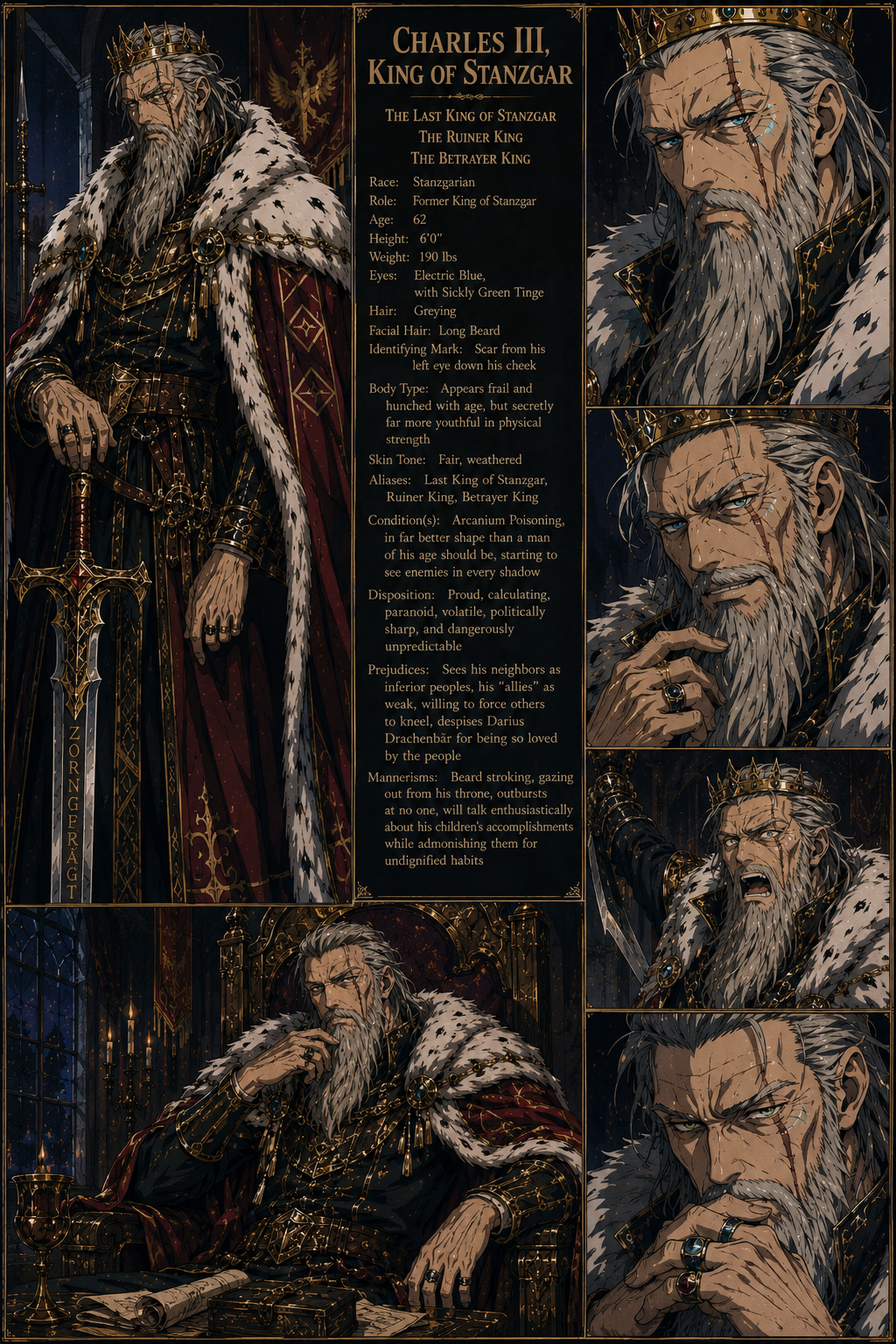


Associations
Other pages that reference or connect to this character
Referenced By
21Annarita Stanzgar
Fathers
Balen Stanzgar
Fathers
Calia Stanzgar
Fathers
Jezabelle Mythrocal Stanzgar
Spouses
Jezabelle Mythrocal Stanzgar
Love interests
Creena Stanzgar
Fathers
Horace Stanzgar
Fathers
Jason Stanzgar
Fathers
Nathaniel Stanzgar
Arch-enemies
Nathaniel Stanzgar
Fathers
Philipe Stanzgar
Arch-enemies
Philipe Stanzgar
Fathers
Priscilla Stanzgar
Arch-enemies
Priscilla Stanzgar
Fathers
Serena Stanzgar
Arch-enemies
Serena Stanzgar
Fathers
Tobais Stanzgar
Fathers
Valera Stanzgar
Fathers
Zera Stanzgar
Fathers
Zorngeprägt
Current Owners
Lucerza
Enemies
Collections
Published collections that feature this character
Not in any collections yet
This character hasn't been published in any collections yet. Collections are curated groups of related content that help organize and showcase your world.
Tip: Collections are a great way to group related content together and share themed stories or worldbuilding elements with others.
Timelines
Timelines that reference or include this character
No timeline connections yet
This character isn't connected to any timelines yet. Timelines help organize events chronologically and show how your content fits into the broader history of your world.
Tip: Create timelines to organize important events in your world's history. Link characters, locations, and other content to specific events to build rich, interconnected narratives.
Shares
Discussion about this character
No shares yet
Be the first to start a discussion about this character by sharing it to the community stream.
Privacy & Sharing
Manage who can see and access this character
Current Status
refresh
This character is currently
Privacy Settings
Choose who can see and access this character
language Universe Privacy
This page belongs to a universe with its own privacy settings